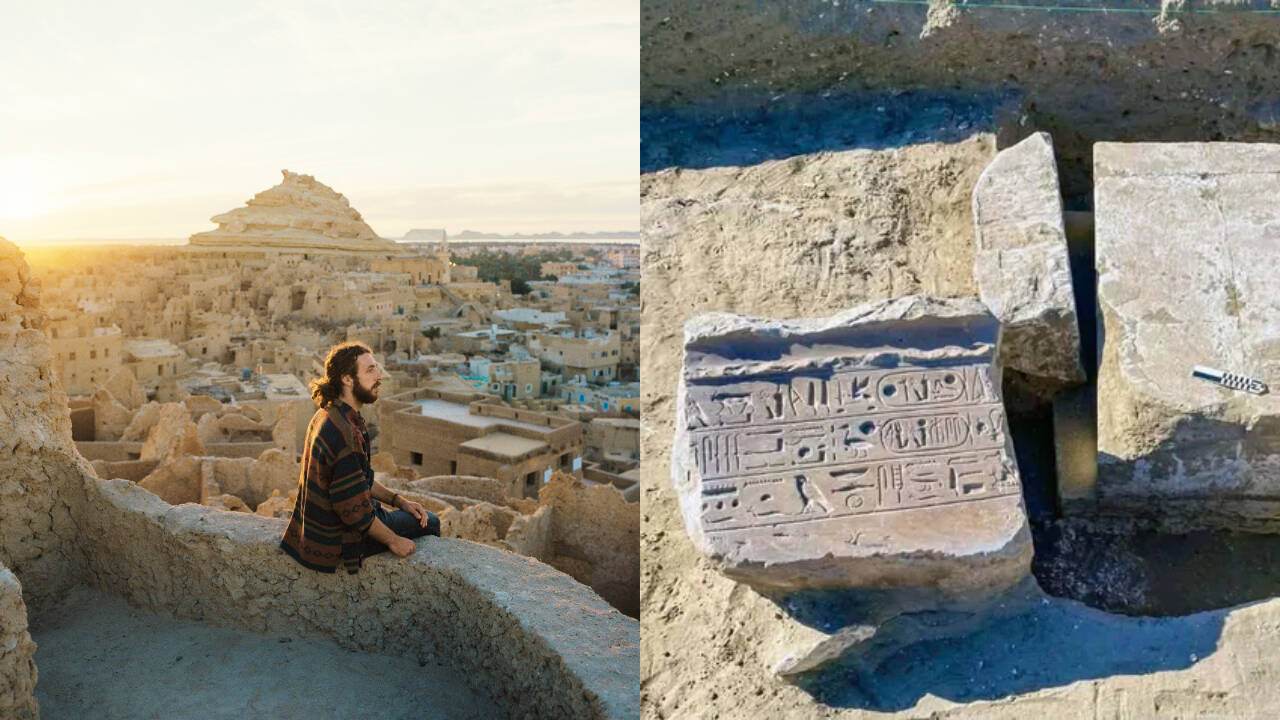
Photo via Times of India

3,200-year-old inscription may help locate Egypt’s lost city of Mesen

Read the original at Times of India ↗
Cite

TOI Science Desk. (2026, September 19). 3,200-year-old inscription may help locate Egypt’s lost city of Mesen. Times of India. https://timesofindia.indiatimes.com/science/archaeology/around-1200-bc-an-inscription-named-the-ancient-egyptian-city-of-mesen-3200-years-later-it-may-have-helped-archaeologists-locate-the-lost-city/articleshow/134342445.cms

Dated when The Aporia collected the article, usually within hours of publication. Check the original for its exact date and byline.

Times of India · collected 2026-09-19 · by TOI Science Desk

Quick Summary

Live Science reports on a recent archaeological discovery in Egypt's northern Sinai that may pinpoint the location of Mesen, an ancient city lost for over 3,200 years. Excavations at Tell Abu Seifi, near the Suez Canal, revealed a sandstone lintel inscribed with titles of Pharaoh Ramesses II and references to Horus as Lord of Mesen, along with remnants of a temple dedicated to Horus and an enclosure wall. Additional evidence includes bronze seals and coffins from the Ptolemaic period bearing similar inscriptions, suggesting a long-standing connection between Tell Abu Seifi and the cult of Horus. However, archaeologists caution that further research is needed to confirm definitively that this site is indeed Mesen.
Written by AI on 2026-09-19, from this article's own text only (the story summary below draws on all the coverage).

AI analysis

Story summary

Archaeologists have discovered an 3,200-year-old inscription in Egypt's northern Sinai that may help locate the lost city of Mesen. The stone lintel was found at Tell Abu Seifi, a site near the Suez Canal and the eastern Nile Delta. Inscriptions on the lintel mention Ramesses II, who ruled from 1279 to 1213 B.C., and identify Horus as the Lord of Mesen. This find is significant because it offers concrete evidence for the location of an ancient city that has been mentioned in historical records but never precisely identified until now. Additionally, excavations at Tell Abu Seifi have uncovered remnants of a temple dedicated to Horus, though this structure is heavily damaged and provides limited information about its original design. The discovery could shed light on Mesen's importance as a major military route toward the Levant during ancient times.


Written for “Ancient Egyptian Inscription Discovery” on 2026-11-04, grounded in this article and the 0 other(s) covering the same event.

Story

📰 Ancient Egyptian Inscription Discovery
World · 1 article(s) covering the same event.

Compared with similar articles

Nothing to compare against. No article is close enough to this one for the pipeline to have linked or judged the pair.
How this article was measured signals, leaning charts, publisher record, byline, topics and claims

Signals How these are calculated →

Claims extracted
23
sentences that state something as happening or true
Uncertain
22%
5 of 23 hedged ("reportedly", "may", "according to")
Leaning
not political
takes no side on a contested political question
Publisher signals
59/100
Times of India's corrections and hedging, across everything collected from it. Not a measure of accuracy.
Outlets on this story
1
World
Same framing elsewhere
1
articles that frame the event the way this one does
Analyzed 2026-09-19 · how these are computed

How this is being covered How these are calculated →

Article leaning vs. publisher reliability
Source leaning vs. consistency

Publisher

Times of India · 4086 article(s) · 4 correction(s) detected
Running correction rate · 4 correction(s)

Who wrote this

TOI Science Desk
308 article(s) here · 1 carrying a prediction
🔮 Researchers are continuing to examine daily measurements to determine whether temperatures will climb further.
🔮 According to Reuters reporting by Will Dunham, a new study published in the journal Spixiana documents more than 90 Bangka slow lorises identified between 2015 and 2025.
🔮 “Normally, my job is quite monotonous, so I wanted to create something that would entertain people, turning my ‘serious’ job into something fun,” he said in a Guinness World Records news release.
🔮 The subsequent collision between the two galaxy clusters may then have compressed the cloud or re-energised its particles, causing it to shine more brightly in radio wavelengths once again.
🔮 The mathematicians at the University of California, Davis, argue that the answer may already lie within Einstein’s own equations and that an invisible form of energy may not be needed at all.
🔮 The work will be carried out by the West Tennessee River Basin Authority, which is preparing a plan to restore the river and the land around it.
🔮 Cornell University scientists have developed genetically engineered tomato plants that turn red-purple when nitrogen becomes scarce, giving farmers a visible warning that crops may need fertiliser.
🔮 By studying these crystals and other mineral grains, scientists could establish the meteorite's age and identify later changes caused by water.
🔮 Centuries later, bronze objects found in Scandinavia would preserve chemical signatures consistent with the metals produced at this Spanish site, offering evidence of connections that may have crossed much of Europe.
🔮 Deposited impurities and staining may also have contributed, while low temperatures and humidity could cause the fabric to crack.
Wire or desk byline, not an individual reporter.
Also by TOI Science Desk
Nothing else under this byline is closely related to this article, so these are simply their most recent.
All 308 articles by TOI Science Desk →

Topics

Egypt Egyptian Live Science Mesen Sinai

Subjects

Horus PERSON · 8× Mesen GPE · 7× Egyptian NORP · 3× Egypt GPE · 2× Ramesses II PERSON · 2× Egyptian Ministry of Tourism ORG · 1× Live Science ORG · 1× New Kingdom GPE · 1× Sinai GPE · 1× istock ORG · 1×

Narrative

Archaeologists have also uncovered the remains of a temple dedicated to Horus at Tell Abu Seifi, although the structure has been heavily damaged and offers limited information about its original design.
framing: mixed · carried by 1 article(s) · first seen 2026-09-19
🔮 Now, a battered stone inscription found in Egypt's northern Sinai may have given archaeologists their strongest clue yet to the city's whereabouts, states an online report by Live Science.
2026-09-19 · Times of India
3,200-year-old inscription may help locate Egypt’s lost city of Mesen · mixed framing

Claims (23 extracted, 5 hedged)

For more than three millennia, the name Mesen survived in ancient records without a confirmed place on the map. asserted
name → survive → map
Now, a battered stone inscription found in Egypt's northern Sinai may have given archaeologists their strongest clue yet to the city's whereabouts, states an online report by Live Science. uncertain
report → find → Science
As per the report the discovery was made at Tell Abu Seifi, an archaeological site near the Suez Canal, close to the northern Sinai Desert and the eastern Nile Delta. asserted
discovery → make → Desert
Excavations have uncovered remains that appear to connect the site with Mesen, an ancient city associated with the Egyptian god Horus and a major military route leading toward the Levant. asserted
that → uncover → Levant
A name carved in stone The key discovery is a massive sandstone lintel that was broken in half but remains inscribed on three sides, states the report. asserted
report → carve → sides
The inscriptions include the titles of Ramesses II, who ruled Egypt from around 1279 to 1213 B.C., along with references to restoration work involving a statue of Horus. asserted
who → include → Horus
Most importantly, the ancient text identifies Horus as the Lord of Mesen. asserted
text → identify → Mesen
If we go by the report, the connection is significant because Mesen has long been known from historical sources, yet archaeologists have never been able to establish its precise location. asserted
archaeologists → go → location
Signs of a city beneath the site The inscription is not the only evidence pointing toward Mesen. asserted
inscription → point → Mesen
Archaeologists have also uncovered the remains of a temple dedicated to Horus at Tell Abu Seifi, although the structure has been heavily damaged and offers limited information about its original design. asserted
structure → uncover → design
Also, excavations have revealed a mudbrick enclosure wall and its gateways, adding further evidence that the location once formed part of a substantial settlement. asserted
location → reveal → settlement
The repeated connection with Horus is particularly striking. asserted
connection → repeat → Horus
A bronze seal previously discovered at the site dates to the Ptolemaic period, roughly 304 to 30 B.C., and also carries the title linking Horus with Mesen. asserted
seal → discover → Mesen
Coffins found at Tell Abu Seifi from the same period bear similar inscriptions. asserted
Coffins → find → inscriptions
A city with a long history If Tell Abu Seifi does turn out to be ancient Mesen, the settlement appears to have survived for centuries, adds the report. asserted
report → turn → centuries
Also, the Ptolemaic finds suggest that the connection between the site and the cult of Horus continued long after the reign of Ramesses II. asserted
connection → suggest → II
That would place the possible city within a much broader stretch of Egyptian history than the original New Kingdom inscription alone suggests. uncertain
inscription → place → history
Archaeologists currently lack enough evidence to estimate its population or determine the full extent of the settlement, states the report as well. asserted
report → lack → settlement
The mystery isn't quite solved The discoveries have strengthened the case for identifying Tell Abu Seifi with Mesen, but archaeologists are stopping short of declaring the mystery closed. asserted
mystery → solve → Mesen
More excavation and analysis will be needed to establish the identification with greater certainty. asserted
excavation → need → certainty
The near-destruction of the Horus temple also means that important evidence may already have been lost. uncertain
evidence → mean → temple
Still, after roughly 3,200 years, the inscriptions and ruins at Tell Abu Seifi may finally be pointing archaeologists toward a city that has existed mostly as a name in ancient Egyptian history. uncertain
that → point → history
If the identification is confirmed, a long-lost stop along the Way of Horus could finally have a place on the modern map. uncertain
stop → confirm → map
💬Give feedback · no sign-in needed

No sign-in needed for now. Your note is sent without a name, so it cannot be answered.

🕘History 🎫Support