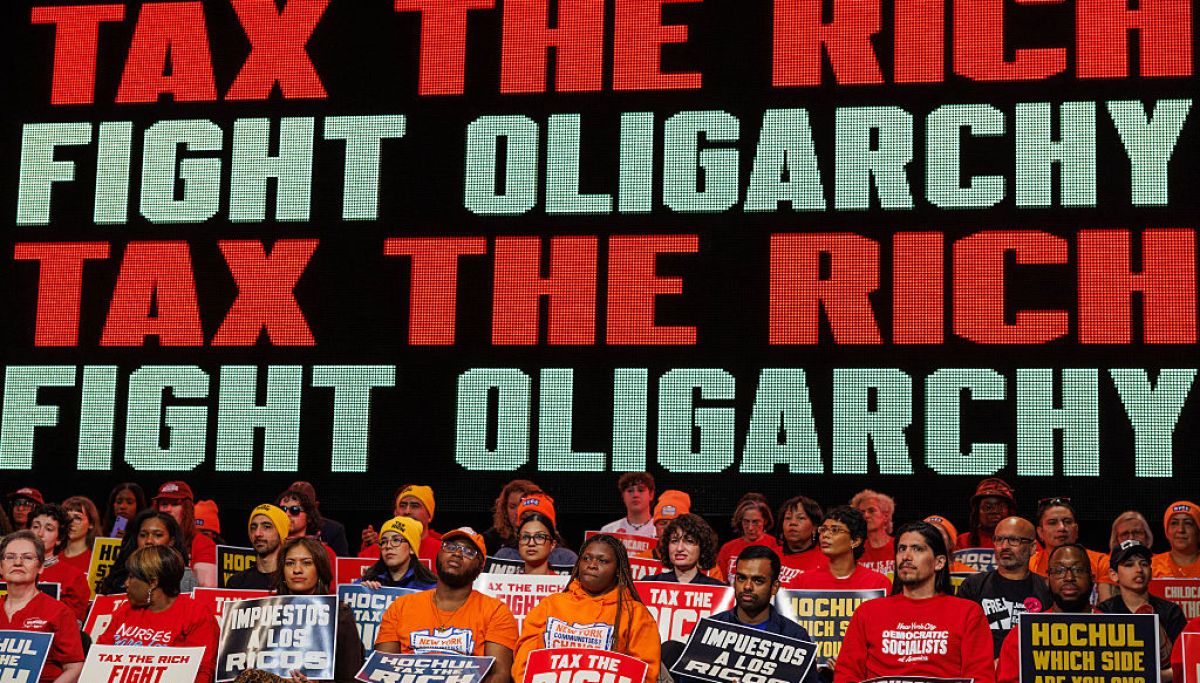
Economists know how important psychological factors are in the economy, yet they have paid little attention to the effects of a social climate in which rich people are seen either as role models or as scapegoats.
asserted
people → know → scapegoats
A comparison of 12 countries reveals an interesting and quite striking pattern.
asserted
comparison → reveal → pattern
For my international studies on attitudes toward the rich, I commissioned the polling institute Ipsos MORI to conduct representative surveys in 13 countries.
asserted
I → commission → countries
On the basis of these surveys, a “Social Envy Coefficient” was calculated, among other things.
asserted
Coefficient → calculate → things
Put simply, it measures how widespread social envy toward the rich is in a country.
asserted
envy → Put → country
A value of 1 means that there are approximately as many people with pronounced social envy as there are people without pronounced social envy.
asserted
value → mean → envy
I exclude the results for China from the following comparison.
asserted
I → exclude → comparison
Opinion polls are more difficult to conduct there because of the political conditions, and the results are far less precise.
asserted
results → conduct → conditions
Nevertheless, it is not implausible that China’s weaker economic dynamism in recent years is also connected with a change in attitudes toward wealth, which have become less positive compared with the 2010s.
asserted
which → connect → 2010s
In the following, I focus on the remaining 12 countries.
asserted
I → follow → countries
A remarkable pattern emerges.
asserted
pattern → emerge → ?
France has the highest Social Envy Coefficient among the countries surveyed, at 1.26.
asserted
France → have → 1.26
Germany ranks second at 0.97.
asserted
Germany → rank → 0.97
At the same time, France and Germany are among the countries whose economies have developed with comparatively little dynamism in recent years.
asserted
economies → develop → years
In Poland, the Social Envy Coefficient is only 0.21, compared with 0.33 in South Korea and 0.43 in Vietnam.
asserted
Coefficient → compare → Vietnam
At the same time, Poland, South Korea, and Vietnam have experienced much more dynamic economic development over longer periods.
asserted
Poland → experience → periods
The contrast becomes even clearer when we look at the personal characteristics respondents associate with the rich.
asserted
respondents → become → rich
In Germany, the five most frequently mentioned characteristics are self-centered (62%), materialistic (56%), ruthless (50%), greedy (49%), and arrogant (43%).
asserted
characteristics → mention → Germany
Thus, all five characteristics Germans most frequently associate with the rich are negative.
asserted
Germans → associate → rich
The five most frequently mentioned characteristics are visionary/farsighted (74%), intelligent (69%), bold/daring (67%), industrious (63%), and imaginative (62%).
asserted
characteristics → mention → ?
In Poland, too, four of the five most frequently mentioned personality traits are positive: bold/daring (49%), imaginative (45%), industrious (43%), and intelligent (39%).
asserted
four → mention → traits
Only one negative term, materialistic (41%), was among the five personality traits most frequently associated with the rich by Poles.
asserted
term → associate → Poles
The findings suggest an interesting hypothesis: Countries in which rich and successful people are seen less as scapegoats and more as role models may have better conditions for economic dynamism.
uncertain
people → suggest → dynamism
Where wealth is primarily associated with greed, exploitation, and injustice, people have less incentive to become entrepreneurs themselves, take risks, build businesses, and create wealth.
asserted
people → associate → wealth
At the same time, demands for higher taxes, greater redistribution, and additional restrictions on entrepreneurs are more likely to find support in such a society.
asserted
demands → find → society
Where successful entrepreneurs are regarded more as role models, however, a different mechanism can operate.
asserted
mechanism → regard → models
People are then less likely to ask, “Why does he have so much?” or “What could be taken away from him?” and more likely to ask, “How did he achieve that — and how can I do the same?”
uncertain
I → ask → same
Both countries have experienced a remarkable economic rise in recent decades.
asserted
countries → experience → decades
In Vietnam, rich people are frequently associated with positive characteristics.
asserted
people → associate → characteristics
At the same time, the country has experienced an enormous economic rise since the market-oriented Doi Moi reforms.
asserted
country → experience → reforms
Per capita income has multiplied, while poverty has fallen from almost 80% in 1990 to around 3% today.
asserted
poverty → multiply → %
Poland, too, has developed since the capitalist reforms of the early 1990s from one of Europe’s poorest countries into one of its most dynamically growing economies.
asserted
Poland → develop → economies
Another survey conducted in 34 countries showed that attitudes toward capitalism were considerably more positive in countries such as Poland, the United States, South Korea, and Vietnam than in Germany and France, for example.
asserted
attitudes → conduct → example
A society in which successful entrepreneurs are regarded as role models and many people aspire to become economically successful themselves creates a more favorable climate for entrepreneurship, innovation, and economic advancement than a society in which wealth primarily provokes distrust, envy, and demands for redistribution.
asserted
wealth → regard → redistribution
Economists and social psychologists should devote more attention to these connections.
asserted
Economists → devote → connections
 The Aporia