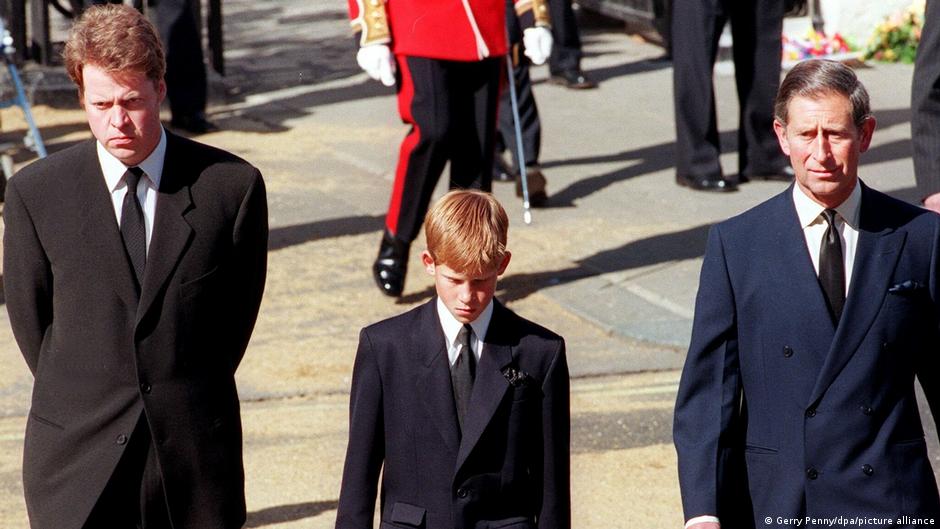
Photo via BBC News

Kuenssberg: I asked Earl Spencer who we should believe - him or the King?

Read the original at BBC News ↗
Cite

Kuenssberg, L. (2026, September 20). Kuenssberg: I asked Earl Spencer who we should believe - him or the King? BBC News. https://www.bbc.co.uk/news/articles/cqe9epzjy0klo?at_medium=RSS&at_campaign=rss

Dated when The Aporia collected the article, usually within hours of publication. Check the original for its exact date and byline.

BBC News · collected 2026-09-20 · by Laura Kuenssberg

Quick Summary

Rachel Sylvester, a political editor for the BBC, discusses an interview she conducted with Charles, Earl Spencer, at his home Althorp on Thursday. Spencer provided explosive claims about Prince Charles’s behavior immediately after Princess Diana’s death in 1997, which Buckingham Palace challenged vigorously in a statement questioning Spencer's judgment and memory. The article focuses on Sylvester's exploration of who to believe between the King and Earl Spencer regarding these controversial recollections.
Written by AI on 2026-09-20, from this article's own text only (the story summary below draws on all the coverage).

AI analysis

Story summary

In September 2026, Prince Harry and his wife Meghan moved their children, Prince Archie (aged seven) and Princess Lilibet (five), to a new school in Britain after just two days due to security concerns. The couple's spokesperson cited heavy traffic between their home and the original school as the reason for the move. This decision came shortly after Harry and Meghan returned to Britain from California, where they had lived for six years. Additionally, the family's publicly-funded security is currently being reviewed by a government committee known as Ravec (the Executive Committee for the Protection of Royalty and Public Figures).

Written for “Charles Spencer's Memoir Controversy” on 2026-10-31, grounded in this article and the 141 other(s) covering the same event.

Story

📰 Charles Spencer's Memoir Controversy
Entertainment · 142 article(s) covering the same event. See how they differ ↓

Compared with similar articles

This article reads leans left and hedges 16% of its claims. Each row says how that neighbour differs.
Deutsche Welle
Hedges 3 of 17 claims Outlet record 95/100
Evening Standard
Hedges 4 of 18 claims Outlet record 65/100
Evening Standard
Hedges 8 of 27 claims Outlet record 65/100
BBC News
⚖️ Leans left Hedges 8 of 72 claims Outlet record 68/100
BBC News
Hedges 0 of 1 claims Outlet record 68/100
Daily Mail
Hedges 2 of 30 claims Outlet record 68/100
“The articles describe different events: Article A discusses a conversation with Earl Spencer about claims in his book, while Article B covers an apology from Earl Spencer to Piers Morgan over alleged incorrect statements.”
Evening Standard
Hedges 3 of 9 claims Outlet record 65/100
“While both articles discuss claims made by Earl Spencer in a new book about Princess Diana and reactions to those claims, they describe different aspects of the situation on separate dates.”
Daily Mail
⚖️ Leans left Hedges 6 of 61 claims Outlet record 68/100
“The articles discuss different perspectives on Earl Spencer's memoir and its impact, rather than describing the same specific incident or occurrence.”
Daily Mail
⚖️ Leans right further right than this Hedges 7 of 62 claims Outlet record 68/100
“The articles discuss related topics about Earl Spencer and King Charles but describe different events and perspectives.”
Evening Standard
Hedges 2 of 12 claims Outlet record 65/100
“The articles refer to different phases of the controversy: Article A describes initial claims by Earl Spencer, while Article B discusses a later interview and Buckingham Palace's response.”
How this article was measured signals, leaning charts, publisher record, byline, topics and claims

Signals How these are calculated →

Claims extracted
38
sentences that state something as happening or true
Uncertain
16%
6 of 38 hedged ("reportedly", "may", "according to")
Leaning
Leans left
of the writing, not the subject · beta estimate
Publisher signals
68/100
BBC News's corrections and hedging, across everything collected from it. Not a measure of accuracy.
Outlets on this story
142
Entertainment
Same framing elsewhere
1
articles that frame the event the way this one does
Analyzed 2026-09-20 · how these are computed

How this is being covered How these are calculated →

Article leaning vs. publisher reliability
Source leaning vs. consistency

Publisher

BBC News · 4744 article(s) · 6 correction(s) detected
Running correction rate · 6 correction(s)

Who wrote this

Laura Kuenssberg
7 article(s) here · 1 carrying a prediction
🔮 So, Kemi Badenoch will tread the same stage ageing rockers Marillion took last month - and where sequinned soprano Katherine Jenkins will perform next week.
🔮 Andy Burnham might not yet have delivered his all-important conference speech, but he has been preparing for this moment for years.
2026-09-26 · assertive framing · How long can Labour's feel-good factor last?
🔮 - Published The BBC's financial situation and changing audience habits "may well mean" some channels and radio stations have to close so resources can be invested in on-demand services, its director general has said.
🔮 Did the earl, a historian and former journalist himself, have evidence of another of his memories, that Charles had "hissed" at him that the world would "forget her soon enough"?
🔮 Earl Spencer claims in a new book the then-Prince of Wales said "we'll forget her soon enough" during an argument over whether Princes William and Harry should walk in Diana's funeral procession.
🔮 The standout moment was at the despatch box this week when Prime Minister Andy Burnham declared that national security couldn't come at the expense of social security - a phrase immediately seized on by the Tories, interpreting it as the PM saying he'd never cut welfare spending to pay for defence.
🔮 Orr has told Sky News he will co-operate fully with Reform's internal investigation.
Also by Laura Kuenssberg
Nothing else under this byline is closely related to this article, so these are simply their most recent.
All 7 articles by Laura Kuenssberg →

Topics

Althorp English Palace

Subjects

Earl Spencer PERSON · 7× Charles PERSON · 5× Diana PERSON · 5× Earl Spencer's PERSON · 3× Palace ORG · 3× Spencer PERSON · 2× Althorp ORG · 1× English NORP · 1× Harry PERSON · 1× William PERSON · 1×

Narrative

- Published When I arrived at Althorp on Thursday to speak to Charles, Earl Spencer, only a handful of people were in evidence in the vast stately home, where Princess Diana had once tapdanced in the hall and rollerskated in the cavernous library.
framing: assertive · carried by 1 article(s) · first seen 2026-09-20
🔮 Did the earl, a historian and former journalist himself, have evidence of another of his memories, that Charles had "hissed" at him that the world would "forget her soon enough"?

Claims (38 extracted, 6 hedged)

- Published When I arrived at Althorp on Thursday to speak to Charles, Earl Spencer, only a handful of people were in evidence in the vast stately home, where Princess Diana had once tapdanced in the hall and rollerskated in the cavernous library. asserted
Diana → publish → library
It was only hours after Buckingham Palace had sent out its blistering statement in response to the explosive claims made in a new book by Earl Spencer. uncertain
Palace → send → Spencer
From the particularly English peace of this grand countryside setting, Diana's brother had provoked a storm. asserted
brother → provoke → storm
That Palace statement, questioning Earl Spencer's account of the days after his sister's death, was a total contrast to its normal "never explain, never complain" mantra. asserted
statement → question → mantra
But it meant that as we sat down, with oil paintings of Earl Spencer's aristocratic ancestors staring down at our TV lights, the interview was not just about his recollections of his sister. asserted
interview → mean → sister
It had become about whether the earl, or the King himself, was telling the truth. asserted
earl → become → truth
As we asked Earl Spencer: which Charles are we meant to believe? asserted
we → ask → Spencer
That's why it was so important to test Earl Spencer's claims. uncertain
it → test → claims
Was he really sure that the then-Prince Charles had sounded "giddy" after his former wife had died on that terrible night in 1997? asserted
wife → sound → 1997
Did the earl, a historian and former journalist himself, have evidence of another of his memories, that Charles had "hissed" at him that the world would "forget her soon enough"? asserted
world → have → her
Why does he, the uncle of William and Harry, think the world needs to hear his version of events from all those years ago? asserted
world → think → events
Earl Spencer was resolute; strong in his conviction that his version of events needed to be told as a matter of record. asserted
version → need → record
And he recounted his memories of his conversations with the King in meticulous detail, noting carefully in our discussion that the Palace had not explicitly denied his claims, instead choosing to question his judgement. uncertain
Palace → recount → judgement
There is deep unhappiness and frustration in Buckingham Palace at what Earl Spencer has put into the public domain. asserted
Spencer → be → domain
Their strongly worded statement tells you everything you need to know about how upset they are. asserted
they → word → everything
"While we do not comment on books as a matter of principle, His Majesty is mindful that the pain of fraternal grief can cloud reason, affect judgment and colour memory in ways others do not recognise, even many years after such a loss," it said. asserted
it → comment → loss
Bear in mind that the two Charleses have had a difficult relationship for decades. asserted
Charleses → bear → decades
Even before either of them was born, the Spencers and the Windsors, two aristocratic families, had years of splits and spats. asserted
Spencers → bear → splits
In the past 48 hours, allies on either side have lined up to back the two different accounts, with acolytes of the King suggesting he would never have said such things. asserted
he → line → things
Others emerged to back Spencer. asserted
Others → emerge → Spencer
There is no way of being completely sure what exactly happened. asserted
what → be → ?
There hasn't been an explicit denial, but the Palace has objected in very strong terms to how Earl Spencer has presented the past. asserted
Spencer → object → past
But speaking to Diana's brother for about half an hour, I felt he seemed entirely sure in his own mind. asserted
he → speak → mind
His book is carefully constructed to give his account, as well as pay tribute to his sister's life as the 30th anniversary of her death approaches. asserted
anniversary → construct → death
After we had spoken, we walked down to the lake on the estate where, on a wooded island, Diana was laid to rest. asserted
Diana → speak → rest
It's a place where, Earl Spencer told me, she could be safe from intrusion, and is marked as a burial place with a huge stone urn. uncertain
she → tell → urn
We passed the little green rowing boat he uses to go to the island to visit her, and walked to what he calls The Temple. asserted
he → pass → what
It's an 18th Century building that now bears her name and includes a quote from her and another from his famous eulogy to her. asserted
that → bear → her
It's a line he now says was specifically intended to be a riposte to the other Charles' suggestion that she would quickly be forgotten: Diana "will never be extinguished from our minds". asserted
Diana → say → minds
Earl Spencer told me he was not being "vengeful" and that he was not trying to damage the monarchy - even saying there was more he knew about the King that he could relate but had chosen not to. uncertain
he → tell → that
But by speaking out so boldly, publishing his book, serialising it in the papers, and speaking to us, the earl was not just paying a moving tribute to his sister, but stirring up the long-running contest for control of Diana's memory. asserted
earl → speak → memory
In the closing moments of our interview, Earl Spencer revealed himself not to be a public figure trying to settle old scores or correct myths about his incredibly famous sister. asserted
himself → reveal → sister
When I asked how much he missed her, he welled up, and nearly three decades on, the tears still came. asserted
tears → ask → her
He said he missed her every day. asserted
he → say → her
You never get over it," he said. asserted
he → get → it
Charles Spencer was a young man when his sister died at 36 in the most awful circumstances. asserted
sister → die → circumstances
He joked about crying as a 62-year-old man at the end of a TV interview in which he'd discussed the monarchy and also made claims about the King that he was well aware would stir up controversy around the world. uncertain
he → joke → world
In the normally hidden world of Althorp, the grief of a brother was still plainly on display – what happened to Princess Diana is not all in the past. asserted
happened → happen → past

💬Give feedback
🕘History 🎫Support