Photo via The Sydney Morning Herald

‘We are made of iron’: the workers who keep trains running under fire

Read the original at The Sydney Morning Herald ↗
Cite

Crowe, D. (2026, September 20). ‘We are made of iron’: the workers who keep trains running under fire. The Sydney Morning Herald. https://www.smh.com.au/world/europe/we-are-made-of-iron-the-workers-who-keep-trains-running-under-fire-20260921-p60yts.html?ref=rss&utm_medium=rss&utm_source=rss_feed

Dated when The Aporia collected the article, usually within hours of publication. Check the original for its exact date and byline.

The Sydney Morning Herald · collected 2026-09-20 · by David Crowe

Quick Summary

Railway workers in Ukraine continue their duties despite frequent Russian attacks on trains, with over 500 locomotives destroyed or damaged since February 2022. Natalia Kudrich, a railway steward from Kyiv who has worked through the war, exemplifies this resilience by stating, "We are made of iron." The Ukrainian Railways chief, Oleksandr Pertsovskyi, compares attacks on trains to terrorism and highlights the danger to civilians, noting that half of recent attacks occurred in 2023. Recent high-profile incidents, including a drone strike near the Polish border involving former British Prime Minister Boris Johnson, have drawn international attention to the risk faced by Ukrainian rail workers and passengers.
Written by AI on 2026-09-21, from this article's own text only (the story summary below draws on all the coverage).

AI analysis

Story summary

In Kyiv, a passenger train hit by a Russian drone in eastern Ukraine left a charred carriage at the central station, serving as a grim reminder of the ongoing risks faced by railway workers. The attack killed six people and injured several others. Despite such dangers, Natalia Kudrich, a 40-year-old railway steward from Lviv, continues her work, stating, "Why do we keep working? Because we are made of iron." This resilience is common among Ukrainian Railways staff who consider themselves “iron people,” both in reference to their company's name and as a testament to their strength. The national rail service, Ukrzaliznytsia, remains crucial for the country despite frequent attacks on civilian infrastructure by Russia. To mitigate threats from rapidly advancing drone technology, managers now raise alerts when potential dangers are within 100 kilometers of trains, previously set at just 50 kilometers.

Written for “War In Ukraine” on 2026-11-04, grounded in this article and the 0 other(s) covering the same event.

Story

📰 War In Ukraine
World · 1 article(s) covering the same event.

Compared with similar articles

This article reads unscored and hedges 5% of its claims. Each row says how that neighbour differs.
CBC News
⚖️ Leans left Hedges 1 of 42 claims Outlet record 74/100
“Article A describes a recent attack on a train in Kharkiv with one death and seven injuries. Article B refers to an earlier incident where six people were killed, involving a different location and casualty count.”
Deutsche Welle
⚖️ Leans left Hedges 5 of 43 claims Outlet record 95/100
“Article A describes recent drone attacks on Ukrainian railways, while Article B discusses workers' resilience after a past attack that killed six people near Kyiv.”
How this article was measured signals, leaning charts, publisher record, byline, topics and claims

Signals How these are calculated →

Claims extracted
63
sentences that state something as happening or true
Uncertain
5%
3 of 63 hedged ("reportedly", "may", "according to")
Leaning
withheld
no quote in the article backed the model's score
Publisher signals
61/100
The Sydney Morning Herald's corrections and hedging, across everything collected from it. Not a measure of accuracy.
Outlets on this story
1
World
Same framing elsewhere
1
articles that frame the event the way this one does
Analyzed 2026-09-21 · how these are computed

How this is being covered How these are calculated →

Article leaning vs. publisher reliability
Source leaning vs. consistency

Publisher

The Sydney Morning Herald · 5986 article(s) · 15 correction(s) detected
Running correction rate · 15 correction(s)

Who wrote this

David Crowe
39 article(s) here · 1 carrying a prediction
🔮 He warned of the risks from technologies that were being released at “at dizzying speed” and urged the Commonwealth to address some of the changes this would bring.
🔮 The federal government’s gross debt is forecast to surpass $1 trillion this financial year.
2026-11-02 · assertive framing · Albanese blasts Taylor on Caribbean travel demand
🔮 “Renewable energy will lower costs, not increase them, and will boost economic growth and productivity,” the prime minister said.
🔮 Democracies are under increasing danger from violent threats and political polarisation, Prime Minister Anthony Albanese will warn in a speech to political leaders at a Commonwealth summit of 56 nations.
🔮 Its budget deficit is 5.4 per cent of gross domestic product (GDP) this year and will improve only if the National Assembly can agree on budget reforms, an unlikely prospect when all parties are preparing for elections next year.
🔮 But every stop takes the King closer to a meeting in Antigua where he will have to navigate the grim history of slavery in his talks with Commonwealth leaders from former British colonies.
🔮 “We would never confirm details of ongoing inquiries, and it would be inappropriate to comment further.”
🔮 Finding the facts will take time, however, because Spain goes to a national election on November 29.
🔮 Two trains have collided on a high-speed line in central Spain in a crash that has killed at least 10 people, with authorities warning the number is expected to rise.
2026-10-28 · assertive framing · Ten dead in high-speed train crash in Spain
🔮 Prince William has revealed he once dreamt of becoming a policeman or a DJ when he considered careers other than being heir to the throne.
Also by David Crowe
Albanese blasts Taylor on Caribbean travel demand
2026-11-02 · The Sydney Morning Herald
King Charles joins Albanese, Forrest aboard climate ship
2026-11-02 · The Sydney Morning Herald
Nothing else under this byline is closely related to this article, so these are simply their most recent.
All 39 articles by David Crowe →

Topics

Kyiv Polish Russian Ukraine Ukrainian Railways

Subjects

Kyiv ORG · 5× Russian NORP · 5× Ukraine GPE · 4× Ukrainian Railways ORG · 3× Pertsovskyi PERSON · 2× Polish NORP · 2× Ukrainian NORP · 2× Kudrich PERSON · 1× Lviv GPE · 1× Natalia Kudrich PERSON · 1×

Narrative

In the past, managers would raise an alert when a drone came within 50 kilometres of a train; now, given the speed of the turbojet drones being launched by Russia on most days, the alert is raised when a threat is as far as 100 kilometres away. “The speed is such that otherwise there would be no time to evacuate,” Pertsovskyi says.
framing: assertive · carried by 1 article(s) · first seen 2026-09-21
🔮 Looking at the smashed windows and the blackened interior, many railway staff might think twice about their daily work.
2026-09-21 · The Sydney Morning Herald
‘We are made of iron’: the workers who keep trains running under fire · assertive framing

Claims (63 extracted, 3 hedged)

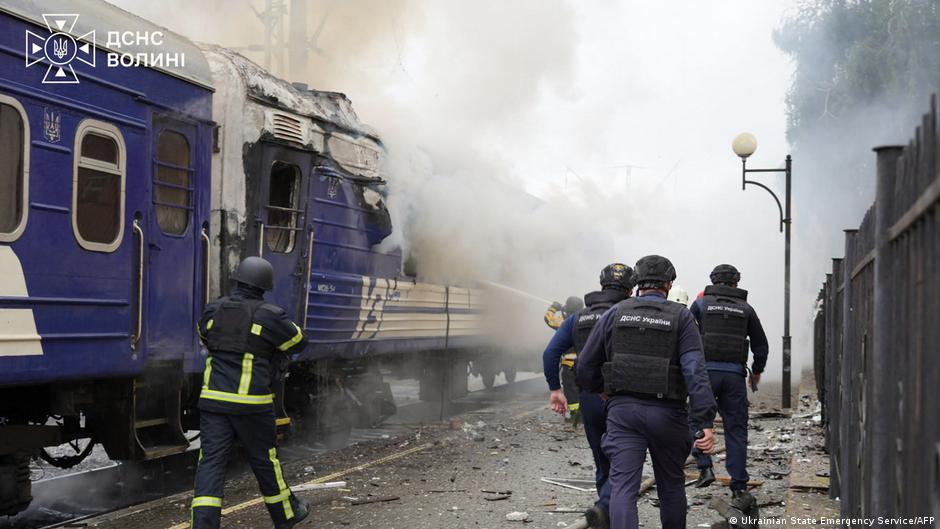
The burnt train carriage on a city platform reminds thousands of workers of the risks they run on their journeys across Ukraine each day. asserted
they → burn → Ukraine
The carriage at the central station in Kyiv was part of a passenger train that was hit by a Russian drone in eastern Ukraine last year, killing six people. asserted
that → hit → people
Looking at the smashed windows and the blackened interior, many railway staff might think twice about their daily work. uncertain
staff → look → work
But Natalia Kudrich, a railway steward, says she will not change careers. asserted
she → say → careers
“Why do we keep working? asserted
we → keep → ?
Because we are made of iron,” she says. asserted
she → make → iron
Kudrich, 40, comes from a family of rail workers in Lviv, in the far west of the country. asserted
Kudrich → come → country
She joined Ukrainian Railways when she was 19 and she has kept working throughout the war. asserted
she → join → war
That makes her just one example of the people who keep essential services running despite Russian attacks on civilians. asserted
who → make → civilians
The national rail service, Ukrzaliznytsia, is so vital to the country that its staff call themselves “iron people” – a play on words because the company’s name incorporates the word for iron. asserted
name → call → iron
The latest attacks have heightened anxiety about civilian deaths. asserted
attacks → heighten → deaths
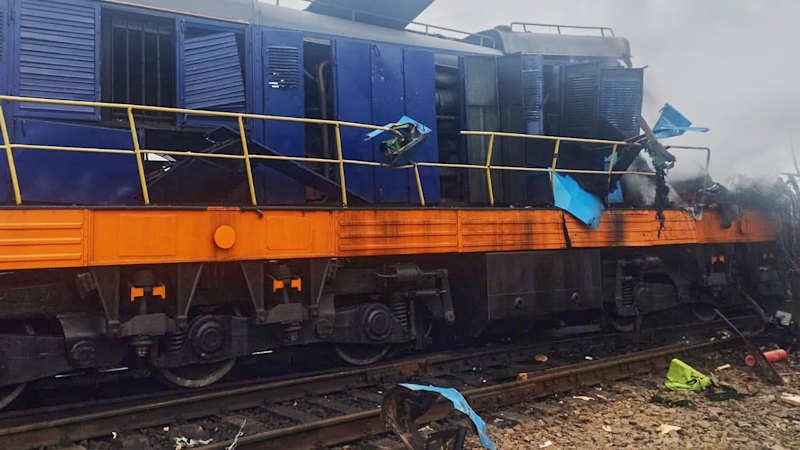
A drone strike on a locomotive triggered global headlines last week because Russia attacked a civilian service only 2 kilometres from the Polish border when visitors, including former British prime minister Boris Johnson, were on a train nearby. asserted
visitors → trigger → train
The head of Ukrainian Railways, Oleksandr Pertsovskyi, says the attacks on trains should prompt the same outrage as a military strike on a civilian aircraft. asserted
attacks → say → aircraft
“If this happened to an aircraft somewhere in Europe, it would be on the front page of every newspaper. asserted
it → happen → newspaper
It is a very clear case of terrorism,” he tells this masthead in an interview in Kyiv. asserted
he → tell → Kyiv
“Unfortunately, it’s become normal here. asserted
it → become → ?
And it should not be happening.” asserted
it → happen → ?
Russian forces have destroyed or damaged more than 500 locomotives across Ukraine since the full-scale invasion began in February 2022, according to Ukrainian Foreign Minister Andrii Sybiha. uncertain
invasion → destroy → Sybiha
Half of these attacks have occurred this year alone. asserted
Half → occur → attacks
The civilian casualties are mounting. asserted
casualties → mount → ?
A Russian drone hit a commuter passenger train near Kharkiv Oblast last Friday, killing a man and injuring seven other passengers, Ukrainian officials said. asserted
officials → hit → passengers
Two carriages were engulfed in flames, killing one man and wounding eight others. asserted
carriages → engulf → others
The Russian strike near the Polish border, on September 14, highlighted the risk to passengers as well as the Kremlin’s willingness to provoke Western countries. asserted
strike → highlight → countries
A jet-powered drone hit a Ukrainian Railways locomotive at Yahodyn station just after passengers had been evacuated from their carriages. asserted
passengers → power → carriages
One of the passengers was former CIA director David Petraeus, who was leaving Ukraine after speaking at the Yalta European Strategy conference in Kyiv. asserted
who → leave → Kyiv
Videos posted to social media showed passengers running from the explosions and flames. asserted
passengers → post → explosions
A separate train had passed through the station shortly before the drone strike, carrying another group of conference speakers including Johnson. asserted
train → pass → Johnson
Pertsovskyi says this service was ahead of schedule. asserted
service → say → schedule
“Pretty much every international train at the moment carries ambassadors, business people, media. asserted
train → carry → ambassadors
Safety-wise, we are concerned for each and every one, so it’s not that we differentiate between those trains,” he says. asserted
he → concern → trains
“It just happened to be that one of them came earlier, others were still there, and the routing decision was made on the spot. asserted
decision → happen → spot
“Clearly, the Russians were aiming to hit very close to the EU and NATO border. asserted
Russians → aim → border
Clearly, they were doing it at the station where there’s a bunch of trains with international visitors of all ranks. asserted
they → do → ranks
Pertsovskyi, an economist, took on the chief executive position in August 2024 after running the passenger division for several years. asserted
Pertsovskyi → take → years
Educated in Kyiv, he did a masters degree at Brandeis University in the US before joining logistics giant DHL, where he worked for six years in the US and Singapore. asserted
he → educate → US
He returned to Ukraine in 2016. asserted
He → return → 2016
What does he need most right now? asserted
he → need → What
More locomotives, he says. asserted
he → say → locomotives
An Australian engine, however, would not work. asserted
engine → work → ?
The Ukrainian network, a legacy of the Soviet era, uses the 1520 millimetre broad gauge. asserted
network → use → gauge
…and 23 more, not listed.

💬Give feedback
🕘History 🎫Support