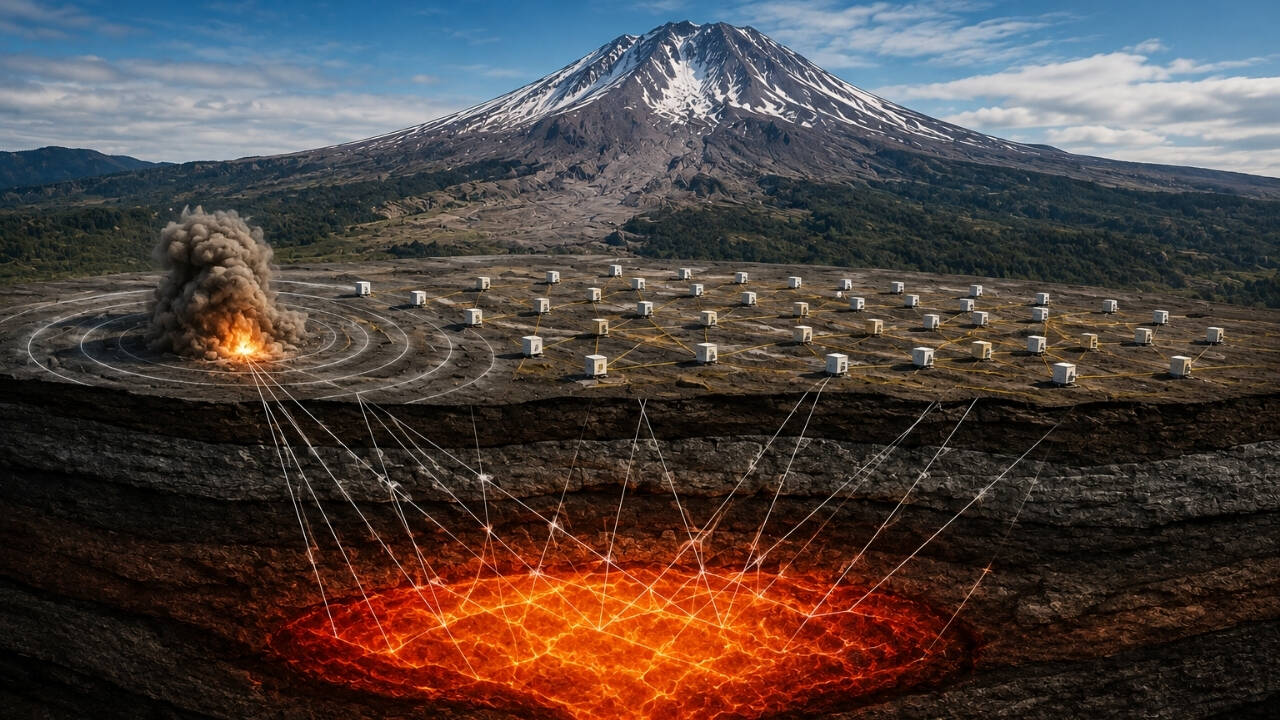
Mount St. Helens is one of the most closely studied volcanoes in the United States, but scientists still cannot directly see the complex system of magma and rock hidden beneath it.
asserted
scientists → study → it
In 2014, researchers launched an ambitious experiment to change that.
asserted
researchers → launch → that
According to the Imaging Magma Under St. Helens (iMUSH) project, a field team used 23 controlled explosions and a remarkably dense network of seismic instruments to send waves through the ground and map what lay beneath the volcano.
uncertain
what → accord → volcano
The results, combined with later seismic studies, helped identify an upper-crustal magma-storage zone roughly 4 to 15 kilometres beneath the volcano.
asserted
results → combine → volcano
An experiment beneath a volcano
The 2014 project was part of iMUSH, an interdisciplinary effort designed to investigate the magmatic plumbing system beneath Mount St. Helens.
asserted
project → design → Helens
Rather than waiting for natural earthquakes to provide the necessary seismic signals, researchers deliberately generated their own waves.
asserted
researchers → wait → waves
In late July and early August 2014, a field crew of about 70 people conducted the active-source seismic experiment.
asserted
crew → conduct → experiment
They created 23 controlled explosions at different distances from the volcano and recorded the resulting seismic waves using hundreds of instruments spread across the region.
asserted
They → create → region
The explosions were not intended to imitate an eruption.
asserted
explosions → intend → eruption
Instead, they acted as artificial seismic sources.
asserted
they → act → sources
When an explosion sends waves through the Earth, those waves travel at different speeds through different types of rock.
asserted
waves → send → rock
By measuring how quickly the waves arrive at numerous recording stations, scientists can work backwards to construct an image of the underground structure.
asserted
scientists → measure → structure
Researchers used roughly 800 to 1,000 Reftek seismic recorders along each of two major profiles, while another 1,600 to 1,800 instruments were deployed in broader arrays extending away from the volcano.
asserted
instruments → use → volcano
Closer to Mount St. Helens, about 300 additional instruments and 920 nodal seismic units were positioned along trails within roughly 7.5 kilometres of the summit.
asserted
instruments → position → summit
The project also included more than a dozen large arrays around the volcano for recording natural earthquakes.
asserted
project → include → earthquakes
The network was designed to capture seismic waves from many directions.
asserted
network → design → directions
In total, the instruments recorded approximately 80,000 seismic traces from the 23 shots.
asserted
instruments → record → shots
This dense coverage was important because a volcano is not built like a simple stack of uniform layers.
asserted
volcano → build → layers
Its interior can contain fractured rock, solidified magma, partially molten material and other complicated structures.
asserted
interior → contain → rock
Conventional seismic imaging can struggle in such environments.
asserted
imaging → struggle → environments
Turning explosions into an underground map
The researchers used the controlled seismic signals to study how waves travelled through the crust beneath Mount St. Helens.
asserted
waves → turn → Helens
Two long seismic profiles extended as far as 150 kilometres from the volcano.
asserted
profiles → extend → volcano
These were designed to investigate structures ranging from the upper crust down toward the boundary between Earth's crust and mantle, known as the Moho.
asserted
These → design → Moho
Closer to the volcano, two rings of controlled shots were positioned at approximately 15 and 30 kilometres from the summit.
asserted
rings → control → summit
These provided much denser seismic coverage of the shallower structures beneath and around Mount St. Helens.
asserted
These → provide → Helens
Additional shots were placed as far as 50 to 80 kilometres from the summit to help probe deeper parts of the crust.
asserted
shots → place → crust
The strategy allowed scientists to examine the volcano at multiple scales rather than simply looking for one large underground feature.
asserted
scientists → allow → feature
One of the most important findings to emerge from seismic studies using iMUSH data was evidence for an upper-crustal magma-storage zone approximately 4 to 15 kilometres beneath Mount St. Helens.
asserted
One → emerge → Helens
A low seismic velocity means that seismic waves travel more slowly through that region than through surrounding rock.
asserted
waves → mean → rock
Such a feature can be produced by hot, fractured or partially molten material, making it an important clue to the location of magma.
asserted
it → produce → magma
A 2023 presentation to the Seismological Society of America described the upper-crustal low-velocity zone as the primary magma reservoir, with estimates suggesting it may contain roughly 10% to 12% partial melt.
uncertain
it → describe → melt
That does not mean the entire region is a giant underground pool of liquid magma.
asserted
region → mean → magma
A magma reservoir is better understood as a complex zone containing varying proportions of molten material, crystals and surrounding rock.
asserted
reservoir → understand → material
The seismic results also showed that Mount St. Helens is supplied by a much more complicated underground system than a simple pipe leading from a single magma chamber.
asserted
Helens → show → chamber
Later receiver-function studies using iMUSH data identified variations in seismic properties throughout the crust.
asserted
studies → use → crust
Researchers found evidence associated with the shallow magma reservoir as well as unusual high-velocity regions deeper in the crust.
asserted
Researchers → find → crust
These deeper features have been interpreted in different ways, including as accumulated crystallised magma, known as magmatic cumulates, or other high-velocity geological material.
asserted
features → interpret → cumulates
Researchers also used measurements of seismic-wave properties such as the ratio between P-wave and S-wave velocities to investigate variations within the crust.
asserted
Researchers → use → crust
These analyses provided additional clues about the distribution and characteristics of the magma-related structures.
asserted
analyses → provide → structures
Why Mount St. Helens matters
Understanding what lies beneath Mount St. Helens is important because the volcano has a history of powerful eruptions, most famously its catastrophic 1980 eruption.
asserted
volcano → matter → eruptions
…and 7 more, not listed.
 The Aporia