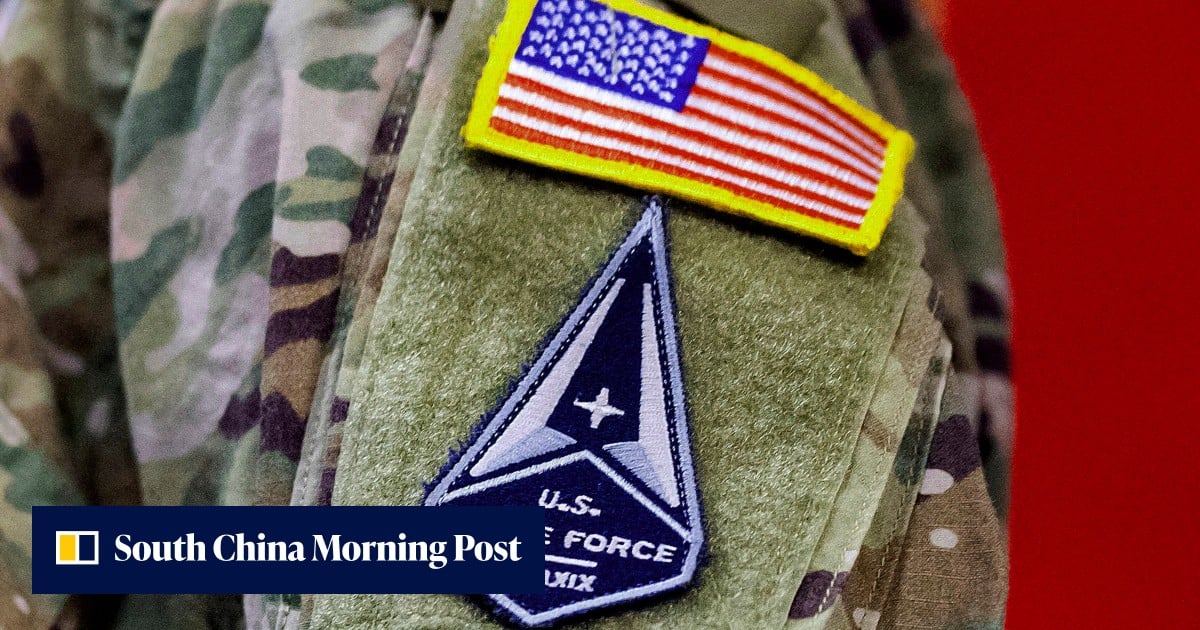
IN his first term in office, US President Donald Trump announced the creation of the Space Force, a new branch of the US military to add to the existing army, navy, air force, etc.
asserted
Trump → announce → army
Now, in 2026, not only has the US announced for the first time that it has actually put weapons in space, it has also released the uniforms designed for the Space Force.
asserted
it → announce → Force
To no one’s surprise, they look identical to the uniforms of the Imperial Navy in Star Wars.
asserted
they → look → Wars
In case you’ve been exiled to Alpha Centauri for the last century, those were the Bad Guys.
asserted
those → exile → century
Unfortunate Sith parallels aside, the US has not revealed the exact nature of the weaponry but US military leaders have previously spoken about the need for space-based military capabilities, purportedly to counter alleged Russian and Chinese capabilities.
asserted
leaders → reveal → capabilities
In particular, the US has been looking at anti-satellite systems designed to disable or blind an adversary’s eye-in-the-sky capabilities.
asserted
US → look → capabilities
That capability has been quite irksome for the US during its disastrous war on Iran, with reports claiming that Chinese and Russian satellites provided information for Iranian drone and missile strikes, enabling pinpoint accuracy when it comes to targeting US assets in the region.
asserted
it → claim → region
And then, a few weeks ago, an orbiting Chinese satellite — Yaogan-50 — disintegrated into over 40 pieces.
asserted
satellite → orbit → pieces
Was this a coincidence or a demonstration of America’s now-declared capabilities?
asserted
this → declare → capabilities
We’ll likely never know.
asserted
We → know → ?
Development of space-based weapons continues.
asserted
Development → base → weapons
What we do know is that China — which has protested against the US announcement — has tried to develop anti-satellite capabilities of its own likely based on the philosophy that while space-based weapons are difficult to deploy and expensive, countermeasures against enemy satellites may be an easier way out, similar to the philosophy of area denial by fielding anti-ship and aircraft carrier missiles.
uncertain
countermeasures → know → missiles
In 2007, China successfully targeted an aging weather satellite with a ground-based missile.
asserted
China → target → missile
Next year, the US followed suit by shooting down a military satellite it claimed was about to crash, and in 2010, China shot down another satellite.
asserted
China → follow → satellite
But since destroying satellites entirely can be messy, capabilities are being developed to ‘blind’ them instead, rendering them useless; along with the US, Russia and China are also developing and deploying ground-based directed-energy weapons and satellite-blinding lasers.
asserted
Russia → destroy → weapons
The US is already deploying the Meadowlands Counter Communication System which can fry orbital satellites using electromagnetic beams.
asserted
which → deploy → beams
In one sense, the first shot in the Space Wars was fired in World War II when German scientists created the V1 and V2 rocket and missile, the predecessors of the cruise and ballistic missiles, but the real push to weaponise space began with the space race where the USSR scored early wins with the launch of Sputnik in 1957 and by making cosmonaut Yuri Gagarin the first man in space four years later.
asserted
Gagarin → fire → space
In 1962, the US conducted a high-altitude nuclear weapons test codenamed Starfish Prime — not just as a warning to the USSR but also to see if the resulting electromagnetic pulse would disrupt nearby satellites.
asserted
pulse → conduct → satellites
With the spectre of nuclear weapons in space looming large and talk of potential military bases on the moon, the Outer Space Treaty was signed in 1967, prohibiting the placement of nuclear weapons or other WMDs and proclaiming that no country would seek sovereignty over the moon.
But the development of space-based weapons continued nevertheless.
asserted
development → loom → weapons
In 1974, the Soviets successfully tested the first known armed satellite.
asserted
Soviets → test → satellite
The Salyut-3 satellite was equipped with an aircraft cannon from which it fired a single round proving that it was indeed possible to arm satellites although questions of accuracy and feasibility remained.
asserted
questions → equip → accuracy
Over a decade later, the USSR returned to the concept by testing a heavy satellite — the Polyus — which was armed with a carbon-dioxide laser and a cannon to boot.
asserted
which → return → laser
However, it failed to launch.
asserted
it → fail → ?
Then there was Reagan and his ‘Star Wars’ initiative that envisioned a national ballistic missile shield for the US, some components of which would be space-based: the ‘Brilliant Pebbles’ project envisioned the deployment of thousands of small interceptors in orbit that would then collide with Soviet ICBMs — a sort of Patriot Missile system in space.
asserted
that → be → space
Other proposals included satellites armed with lasers.
asserted
proposals → include → lasers
Whether or not Reagan knew, most of these plans were impossible to implement because of cost and lack of requisite technology.
asserted
most → know → technology
But the USSR took it seriously enough to try and play catch-up.
asserted
USSR → take → up
Arguably, the costs thus incurred played a part in the downfall of the Soviet Empire.
asserted
costs → incur → Empire
But this isn’t the Cold War anymore, and the rapid technological developments we are seeing now mean that ideas once safely relegated to the realm of science fiction are becoming fact.
asserted
ideas → see → fiction
 The Aporia