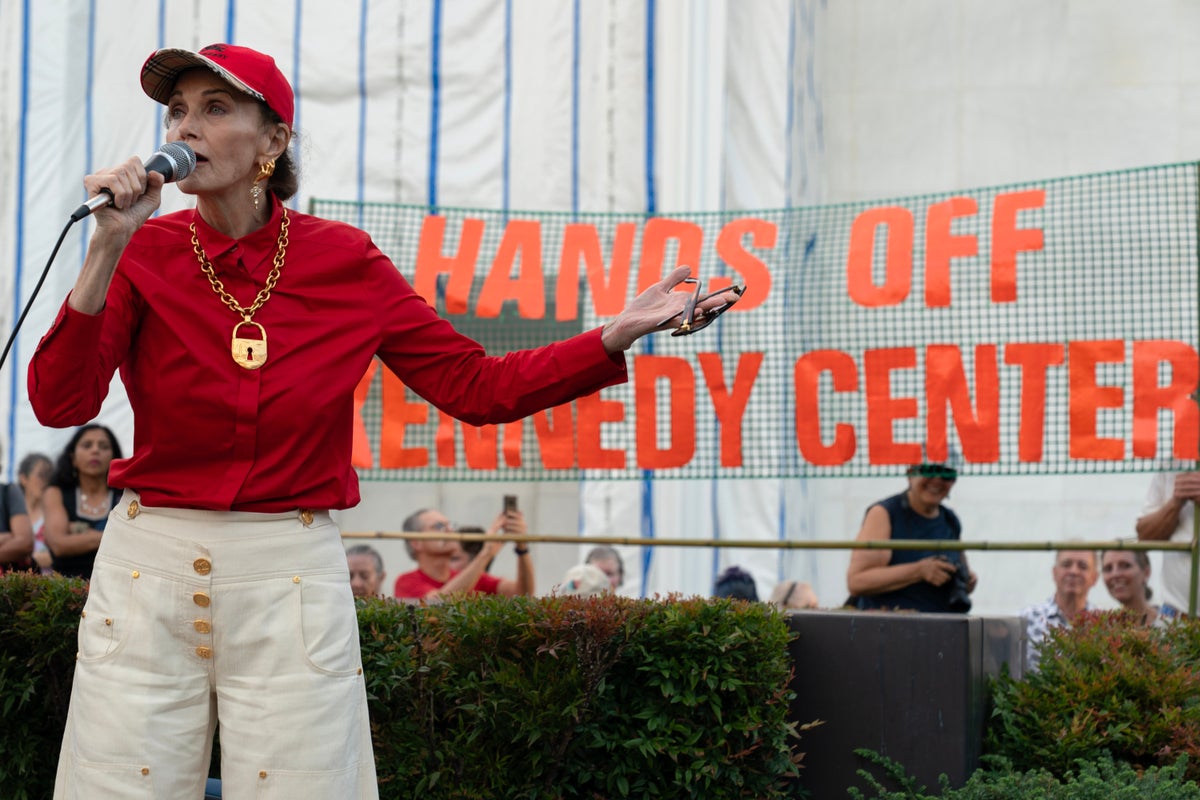
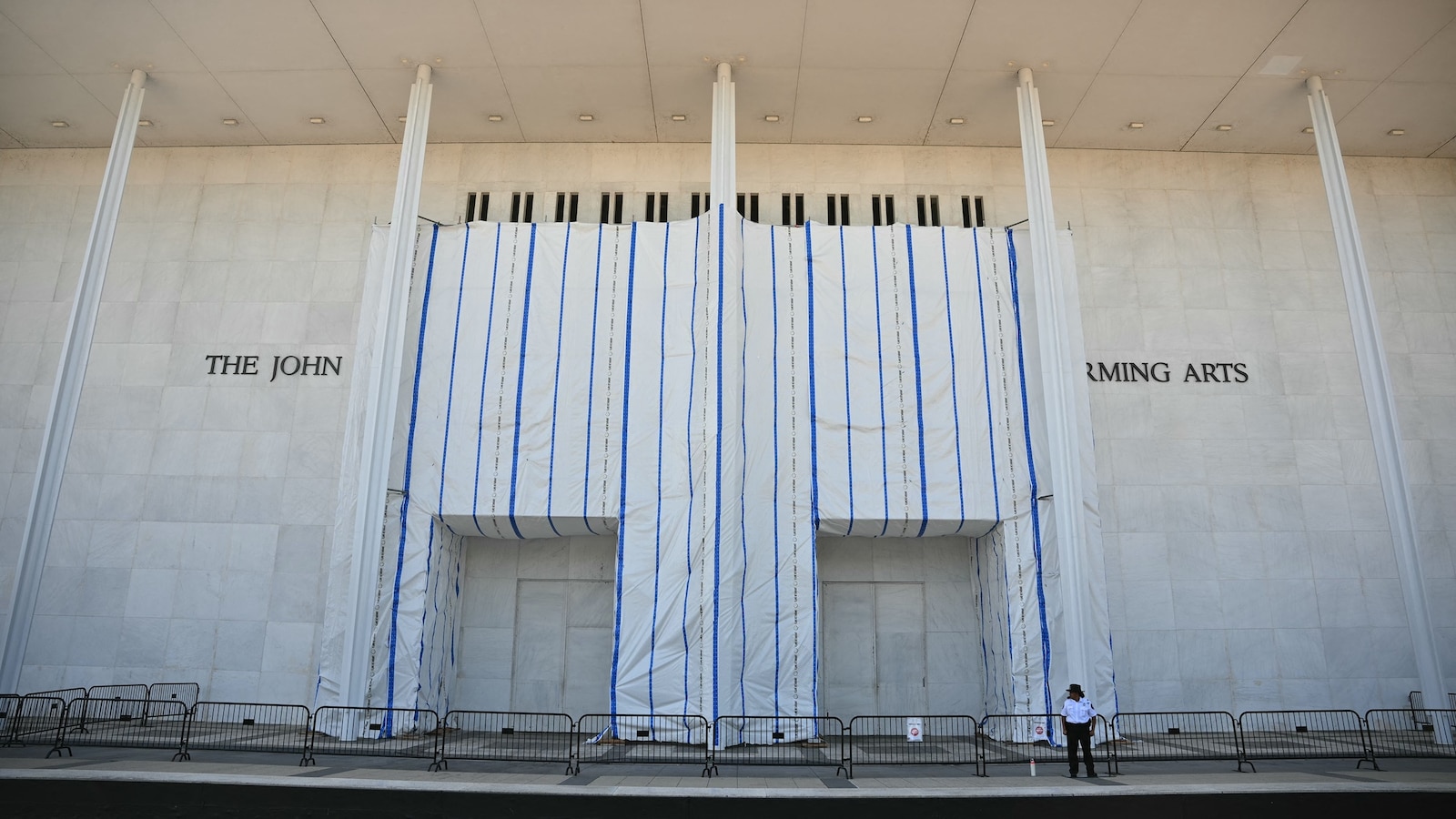
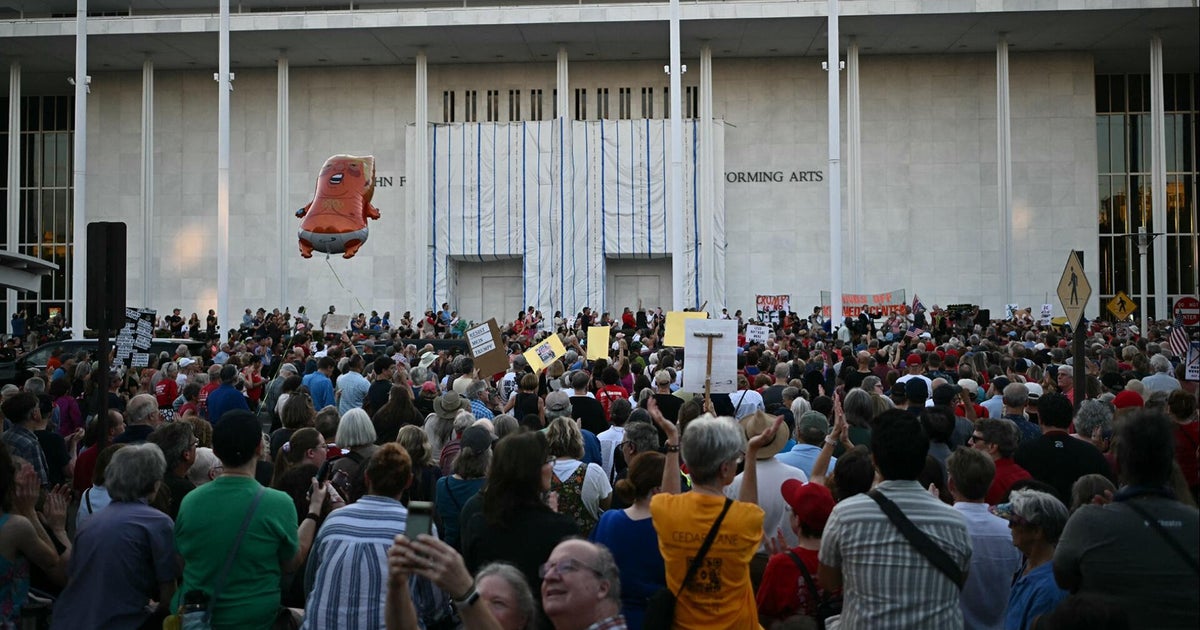
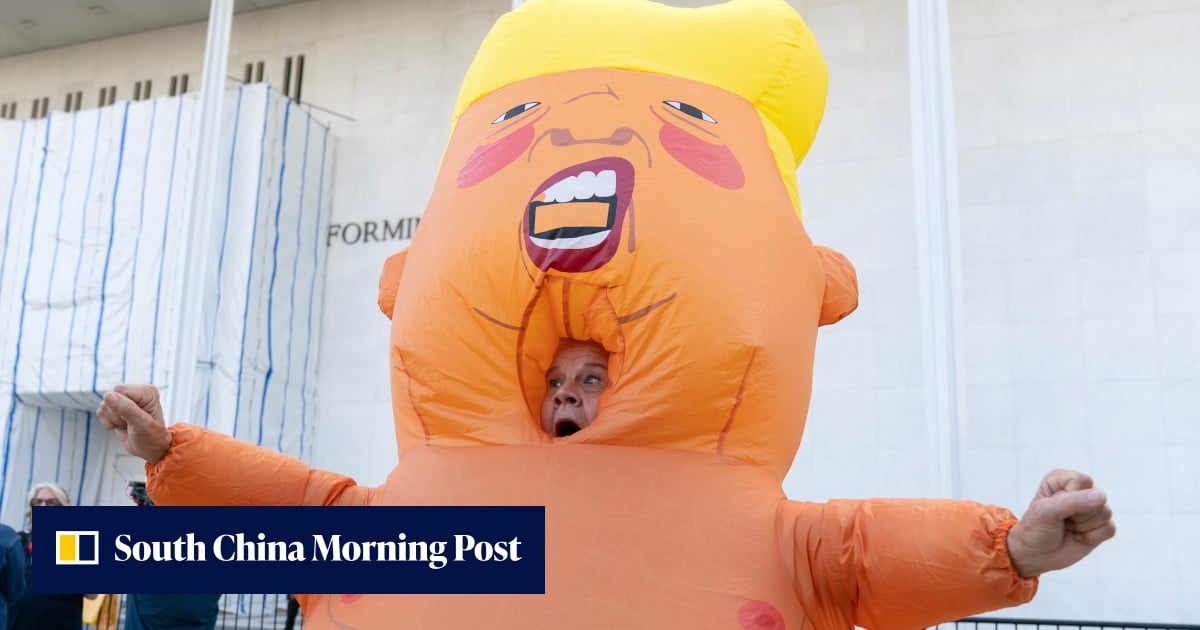
Thousands of people gathered outside the John F. Kennedy Center for the Performing Arts Friday evening to protest Trump’s takeover of the building and his threat to shut it down or even demolish it unless his name goes onto the facade.
asserted
name → gather → facade
U.S. District Judge Christopher Cooper of the District of Columbia has ordered the board of the center to give 30 days’ notice before making any major physical changes to the building.
asserted
Cooper → order → building
Recognizing the leeway the courts have given him over anything that falls under “national security,” Trump this morning decided to take a proactive approach to making sure the courts don’t stop his triumphal arch.
asserted
courts → recognize → arch
He announced on social media:
“At the strong request of the United States Military, and for National Security purposes, I have agreed to convert the magnificent Triumphal Arch, planned since the Civil War Era many years ago, at the Receptive Circle adjoining the Arlington Memorial Bridge, into a top grade Military Complex/Triumphal Arch, to house, store, and have the rapid ability to use large numbers of drones, plus Snipers, on both the roof and plaza areas, and additionally have and hold large quantities of sniper ammunition in storage.
asserted
I → announce → storage
Out of the 59 top cities and Capitals, Washington, D.C., IS THE ONLY ONE IN THE WORLD THAT DOES NOT HAVE A TRIUMPHAL ARCH, but it will now and, by far, the greatest of them all!
asserted
it → have → them
This is the same justification he made for his ballroom where the East Wing used to be.
asserted
Wing → make → ballroom
When it became clear that his claim to need an entertainment space up to his aesthetic standards would not fly, he began to claim that the ballroom is imperative for national security.
uncertain
ballroom → become → security
We have since learned that there already is a secure space under the White House, built in secret during President Barack Obama’s administration.
asserted
We → learn → administration
Dan Diamond reported in the Washington Post last Wednesday, September 16, that officials from the National Park Service have agreed that the construction will adversely affect Arlington National Cemetery, the Lincoln Memorial, and several dozen other historical sites, but urged those concerned about historic preservation to sign on to the project through a memorandum of agreement that will stand as approval by noon tomorrow anyway.
asserted
that → report → noon
The document asserts that the arch is supposed “to celebrate 250 years of American independence by honoring America’s founding principles.”
asserted
arch → assert → principles
Now Trump says the arch is imperative for “National Security purposes” and will have drones and snipers.
asserted
arch → say → drones
Rebecca Miller, executive director of the DC Preservation League, responded to the request to sign the document: “This is not consistent with NPS practice, NPS regulations, or the intent of the National Historic Preservation Act.”
asserted
This → respond → Act
While Trump suggests he will defend the United States from atop his triumphal arch, our European allies are much more concerned with Russia’s drone strike last Sunday on a passenger train traveling from Kyiv, Ukraine, to Warsaw, Poland.
uncertain
allies → suggest → Warsaw
The train was just over a mile—two kilometers—from the Polish border when the drone hit at a border crossing.
asserted
drone → hit → crossing
The drone hit just after a convoy carrying former leaders and high-level diplomats, including former U.K. prime minister Boris Johnson, had passed through.
asserted
convoy → hit → Johnson
The train operators were warned of the coming drone and no one was hurt, but European leaders widely interpreted the strike so close to Poland as, in the words of Kaja Kallas, the European Union’s high representative for foreign and security policy, “clearly a message to the western world.”
asserted
leaders → warn → world
Twelve nations founded NATO in 1949 to resist Soviet aggression.
asserted
nations → found → aggression
After the Soviet Union collapsed in 1991, NATO’s mission shifted toward crisis management, and then to resisting the aggression of Russia’s president Vladimir Putin.
asserted
mission → collapse → president
Over the years, NATO has grown to include 32 countries, 30 of which are in Europe (the U.S. and Canada are the two NATO countries in North America).
asserted
U.S. → grow → America
The success of their collective defense system rests on Article 5 of the North Atlantic Treaty, which states that an attack against any one member of NATO will be treated as an attack against all of them.
asserted
attack → rest → them
So a threat to Poland threatens all the NATO countries.
asserted
threat → threaten → countries
Russia has been pushing NATO countries with what European leaders call “hybrid attacks.”
asserted
leaders → push → what
Rather than launching classic military attacks, Putin has been allowing drones to go into NATO airspace, cutting undersea telecommunications networks on which European countries depend, and possibly placing bombs on a train in France.
uncertain
countries → launch → France
Russia has been a bad actor for years, destabilizing NATO countries by flooding them with disinformation that affects elections, paying for political parties, bribing politicians, and so on.
asserted
that → destabilize → politicians
But the increase in Russian provocations now seems to be related to Putin’s attempt to undercut European support for Ukraine as Ukraine’s drones have brought the war home to Russia’s oil industry and to the Russian people.
asserted
drones → seem → people
In a speech on Wednesday, NATO Secretary General Mark Rutte, former prime minister of the Netherlands, noted that “Russia wants to stop us helping Ukraine—but their actions will only lead us to do more for Ukraine.”
asserted
actions → note → Ukraine
Kurt Volker, who served as U.S. ambassador to NATO under President George W. Bush, told NPR’s Elissa Nadworny that President Trump “has largely looked at all of this and said, that’s a European problem.
asserted
that → serve → this
He doesn’t feel a threat to the United States from Russia, and he doesn’t see a need for the U.S. to increase its pushback on Russia at all.”
asserted
U.S. → feel → Russia
“I disagree with this,” Volker said.
asserted
Volker → disagree → this
“I think that we have a vested interest in freedom and free people everywhere being safe and prosperous.
asserted
we → think → freedom
It creates a better world for us.”
asserted
It → create → us
Trump’s stand is interesting in light of news that Russia has been helping Iran in its fight against the United States, sending upgraded munitions as well as satellite imagery and targeting data to hit U.S. forces in the Middle East.
asserted
Russia → help → East
Last week, CNN reported that fourteen Russian spy satellites moved over the Prince Sultan Air Base in Saudi Arabia, used by the U.S., two days before a devastating March 27 attack by Iran.
asserted
satellites → report → Iran
A CNN investigation showed that the spacecraft had access to a large spectrum of data.
asserted
spacecraft → show → data
U.S. officials and international intelligence sources told CNN that the information the satellites gathered helped Iranian forces conduct some of its most precise attacks against American forces and assets.
asserted
forces → tell → forces
Two months later, a Russian close to Putin footed the bill for a three-day celebration for Donald Trump Jr.’s wedding to Bettina Anderson.
asserted
Russian → foot → Anderson
According to Justin Elliott, Brett Murphy, Joshua Kaplan, and Alex Mierjeski of ProPublica, Umar Kremlev spent hundreds of thousands of dollars on the event, held on private islands in the Bahamas.
uncertain
Kremlev → accord → Bahamas
On Tuesday, September 15, the Department of Justice announced charges against five people working for Russian intelligence “to conduct attacks and murders around the world, including in the United States.”
asserted
Department → announce → States
The indictment alleges that a network of Russian hit men has operated since at least 2024 and has recruited U.S. citizens to surveil and murder people, intending to target “all the countries that are helping Ukraine.”
asserted
that → allege → Ukraine
As Daniel Boffey and Andrew Roth of the Guardian note, it was an unwritten rule of the Cold War that Russia would not attack people in the U.S. (although Russian agents are widely believed to be behind the murder of U.S. journalist Paul Klebnikov in Moscow in 2004).
asserted
agents → note → 2004
…and 12 more, not listed.
 The Aporia