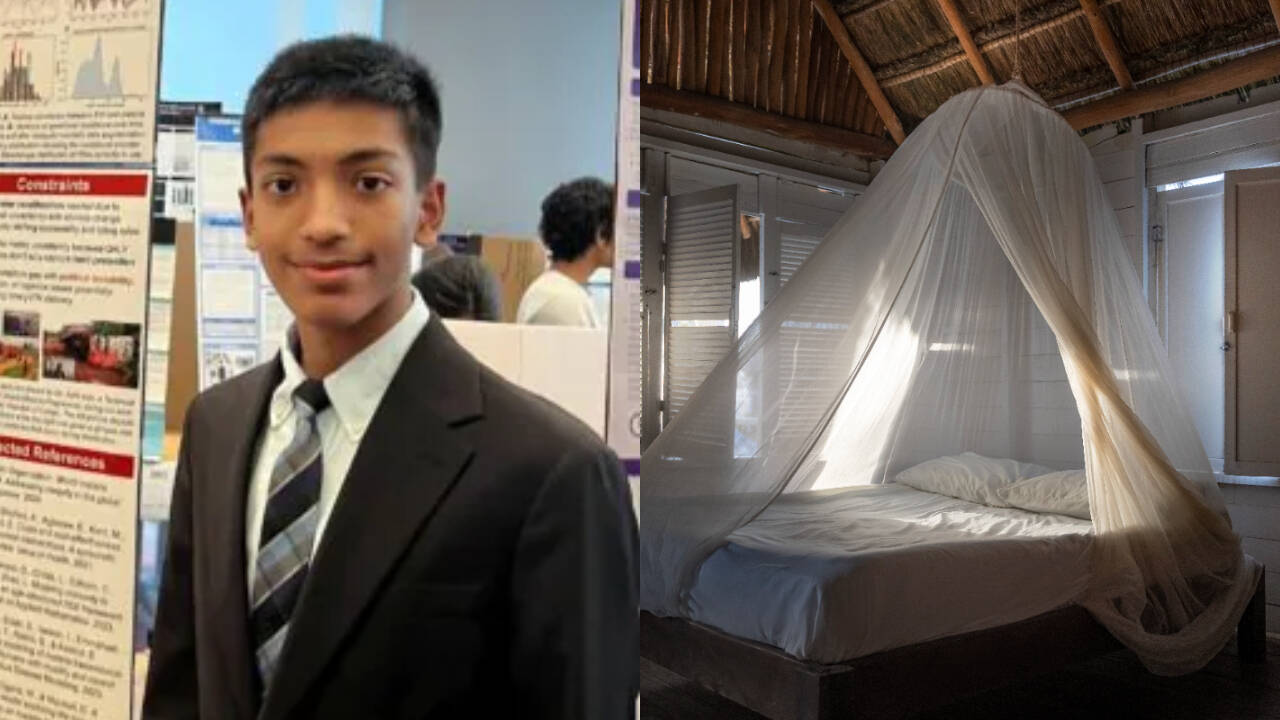
Photo via Times of India

16-year-old student’s malaria model could double impact of mosquito nets, wins $50K

Read the original at Times of India ↗
Cite

TOI World Desk. (2026, September 21). 16-year-old student’s malaria model could double impact of mosquito nets, wins $50K. Times of India. https://timesofindia.indiatimes.com/world/us/meet-rajarshi-mandal-the-16-year-old-lexington-student-whose-malaria-model-showed-the-same-mosquito-net-supply-could-prevent-twice-as-many-infections-he-won-50000/articleshow/134379082.cms

Dated when The Aporia collected the article, usually within hours of publication. Check the original for its exact date and byline.

Times of India · collected 2026-09-21 · by TOI World Desk

Quick Summary

Rajarshi Mandal, a 16-year-old student from Lexington High School, developed a mathematical model that optimizes the distribution of insecticide-treated mosquito nets to prevent malaria more effectively. His model considers factors like insecticide resistance and seasonal changes, which standard approaches often overlook. As a result, his simulation showed that optimized allocation could double the impact of existing net supplies compared to population-based distribution methods. For this achievement, Mandal was awarded a $50,000 Davidson Fellows Scholarship by the Davidson Institute.
Written by AI on 2026-09-21, from this article's own text only (the story summary below draws on all the coverage).

AI analysis

Story summary

Rajarshi Mandal, a 16-year-old student from Lexington High School in Massachusetts, developed a mathematical model to optimize the distribution of insecticide-treated mosquito nets for malaria prevention. His work aims to double the impact of these limited resources by accounting for factors like insecticide resistance, seasonal changes, and net deterioration. Mandal’s innovative approach earned him a $50,000 Davidson Fellows Scholarship from the Davidson Institute. Approximately 200 million mosquito nets are distributed globally each year, but Mandal's model seeks to make this distribution more effective by considering real-world conditions that standard methods often overlook.

Written for “Student Malaria Model Wins Prize” on 2026-10-31, grounded in this article and the 0 other(s) covering the same event.

Story

📰 Student Malaria Model Wins Prize
Science · 1 article(s) covering the same event.

Compared with similar articles

Nothing to compare against. No article is close enough to this one for the pipeline to have linked or judged the pair.
How this article was measured signals, leaning charts, publisher record, byline, topics and claims

Signals How these are calculated →

Claims extracted
28
sentences that state something as happening or true
Uncertain
29%
8 of 28 hedged ("reportedly", "may", "according to")
Leaning
not political
takes no side on a contested political question
Publisher signals
59/100
Times of India's corrections and hedging, across everything collected from it. Not a measure of accuracy.
Outlets on this story
1
Science
Same framing elsewhere
1
articles that frame the event the way this one does
Analyzed 2026-09-21 · how these are computed

How this is being covered How these are calculated →

Article leaning vs. publisher reliability
Source leaning vs. consistency

Publisher

Times of India · 3750 article(s) · 2 correction(s) detected
Running correction rate · 2 correction(s)

Who wrote this

TOI World Desk
1246 article(s) here · 1 carrying a prediction
🔮 Anna plans to appear as a half-deer, half-goat creature on stilts, while Jimmy will dress as Jeepers Creepers, complete with custom wings that unfold.
🔮 Prince William and Kate Middleton may have been made aware of serious allegations against Meghan Markle’s father, Thomas Markle Sr., after a letter detailing the claims was reportedly sent to the joint office shared by the two royal couples at Kensington Palace in 2019.
🔮 The money will support nearly 7,000 children.
🔮 Within two months, Conard identified a property in a Denver strip mall that could be used for a haunted house.
🔮 They allege that Meta could combine this information with activity tracked on Eyemart’s website to identify them and deliver targeted advertisements.
🔮 People from outside Indiana University had also contacted Brian Williams, a professor at the Kelley School of Business who helped develop the programme, expressing interest in taking the course.
🔮 On October 31, the family will take the experience further by welcoming relatives from out of town to help bring the display to life with live actors.
🔮 Thus, a decade ago, he began collecting Halloween costumes for kids who couldn't afford them.
🔮 He expressed concern that the confrontation could cost him his job.
🔮 They said the celebrity's "suicide risk" could be lowered through treatment.
Wire or desk byline, not an individual reporter.
Also by TOI World Desk
Nothing else under this byline is closely related to this article, so these are simply their most recent.
All 1246 articles by TOI World Desk →

Topics

Lexington Lexington High School Mandal Massachusetts the Davidson Institute

Subjects

Mandal PERSON · 7× Lexington GPE · 1× Lexington High School ORG · 1× Massachusetts GPE · 1× Rajarshi Mandal PERSON · 1× the Davidson Institute ORG · 1× the Democratic Republic of Congo GPE · 1×

Narrative

Mandal eventually developed a different architecture that directly scored possible allocations, avoiding the instability he encountered with his original approach. Making the malaria model more realistic The project also presented a problem that had little to do with machine learning.
framing: mixed · carried by 1 article(s) · first seen 2026-09-21
🔮 The Lexington High School student built a mathematical model designed to determine where insecticide-treated mosquito nets could have the greatest impact, and his work earned him a $50,000 Davidson Fellows Scholarship, states an online report by the Davidson Institute.

Claims (28 extracted, 8 hedged)

At 16, Rajarshi Mandal is already tackling a problem that has challenged public-health systems for decades: how to make limited malaria-prevention resources go further. asserted
resources → tackle → decades
The Lexington High School student built a mathematical model designed to determine where insecticide-treated mosquito nets could have the greatest impact, and his work earned him a $50,000 Davidson Fellows Scholarship, states an online report by the Davidson Institute. uncertain
report → build → Institute
The report adds that Mandal, a rising junior from Lexington, Massachusetts, developed an ordinary differential equation model that simulates malaria transmission under conditions that more closely resemble the real world. asserted
that → add → world
His approach considers factors that standard population-based distribution can miss, including insecticide resistance, seasonal changes in transmission and the gradual deterioration of mosquito nets. asserted
distribution → consider → nets
Rethinking where mosquito nets go Insecticide-treated nets are among the most affordable tools available for preventing malaria, but supplies are limited. asserted
supplies → rethink → malaria
According to the report, around 200 million nets are distributed globally each year, with allocations often based largely on population. uncertain
allocations → accord → population
Mandal wanted to know whether the same number of nets could prevent more infections if they were distributed differently. uncertain
they → want → infections
His simulation examined how malaria transmission changes across different settings and then evaluated where each available net could have the greatest effect. uncertain
net → examine → effect
In his model, an optimized allocation prevented twice as many infections as a population-based approach using the same supply. asserted
allocation → prevent → supply
Experts say that finding matters because it suggests that better allocation, rather than simply producing more nets, could potentially increase the impact of an existing public-health investment. uncertain
allocation → say → investment
From a newspaper image to a research project For Mandal, the idea began with footage showing fishermen using donated mosquito nets as fishing material because the mesh was available when conventional fishing equipment was not. asserted
equipment → begin → material
The image prompted Mandal to look more closely at how mosquito nets are distributed and what happens when conditions on the ground do not match assumptions made in a distribution plan. asserted
conditions → prompt → plan
His first attempt used a Deep Q Network, a type of machine-learning system. asserted
attempt → use → system
But the model struggled because allocation decisions produced noisy results and the benefits of those decisions could be delayed, making it difficult for the system to settle on reliable value estimates, states the report. uncertain
report → struggle → estimates
Mandal eventually developed a different architecture that directly scored possible allocations, avoiding the instability he encountered with his original approach. Making the malaria model more realistic The project also presented a problem that had little to do with machine learning. asserted
that → develop → learning
Early versions of Mandal's malaria simulation repeatedly drove infection levels down to zero, which did not reflect conditions in endemic regions. asserted
which → drive → regions
Guidance from researchers led him to investigate backward bifurcation, a phenomenon that can allow disease transmission to persist under circumstances where simpler models might predict elimination, explains the online report. uncertain
report → lead → elimination
He derived the model's reproduction number and confirmed that the simulation could sustain transmission at realistic mosquito-biting rates. uncertain
simulation → derive → rates
The final framework incorporated seasonality, insecticide resistance, net degradation and the logistical challenges associated with reaching remote areas. asserted
framework → incorporate → areas
Beyond the numbers Mandal's interest in the project extends beyond improving a statistic. asserted
interest → extend → statistic
He points to the everyday consequences of malaria infections, including missed school, lost work and disruptions to farming and family responsibilities. asserted
He → point → farming
The project also exposed him to the realities of delivering public-health interventions. asserted
project → expose → interventions
A photograph of a transport truck overturned in the Democratic Republic of Congo, with mosquito nets scattered around it, underscored how easily logistical problems can interfere with even carefully designed programs, adds the report. asserted
report → overturn → programs
For Mandal, the lesson is that mathematical modeling cannot eliminate every obstacle. asserted
modeling → eliminate → obstacle
It can, however, help make better decisions with the resources that reach their intended destinations. asserted
that → help → destinations
Alongside his research, Mandal studies advanced mathematics and computing, plays piano and has performed at Carnegie Hall twice. asserted
Mandal → study → Hall
He also enjoys volleyball, skiing, mountain biking and karate, where he holds a black belt. asserted
he → enjoy → belt
The Davidson Fellows recognition places his malaria research among a broader community of young researchers, giving the 16-year-old both a scholarship and a larger platform for work aimed at turning better decisions into measurable health benefits. asserted
recognition → place → benefits

💬Give feedback
🕘History 🎫Support