Photo via The Sydney Morning Herald

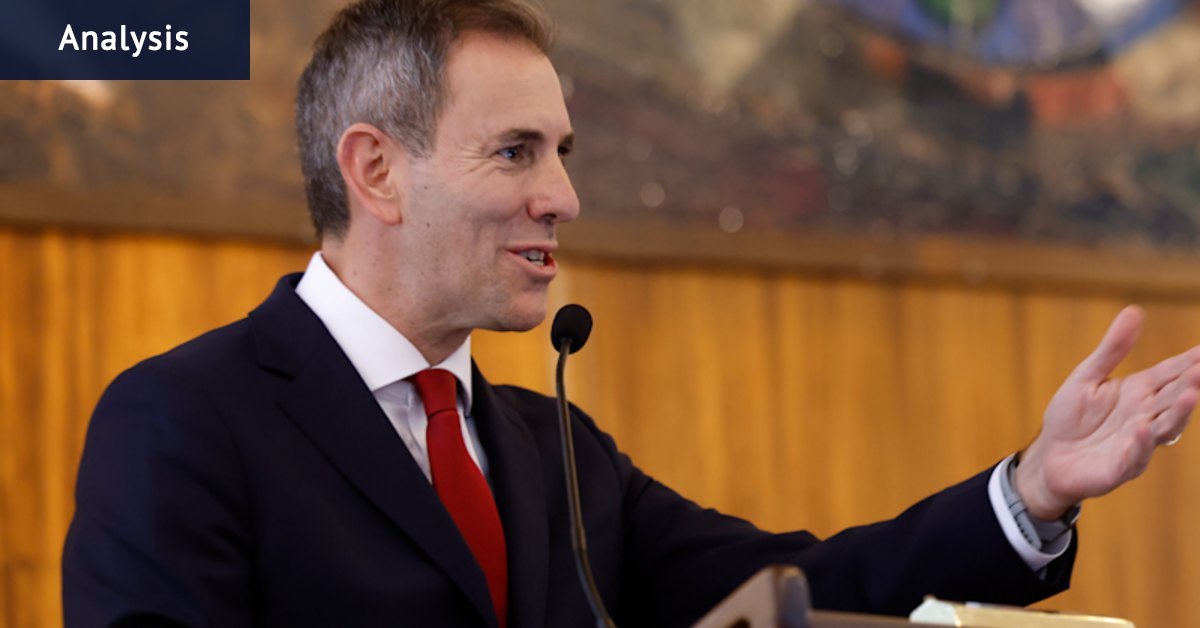
Chalmers can try to predict 40 years into the future, but he’s really talking 2028

Read the original at The Sydney Morning Herald ↗
Cite

Massola, J. (2026, September 21). Chalmers can try to predict 40 years into the future, but he’s really talking 2028. The Sydney Morning Herald. https://www.smh.com.au/politics/federal/chalmers-can-try-to-predict-40-years-into-the-future-but-he-s-really-talking-2028-20260921-p60z37.html?ref=rss&utm_medium=rss&utm_source=rss_feed

Dated when The Aporia collected the article, usually within hours of publication. Check the original for its exact date and byline.

The Sydney Morning Herald · collected 2026-09-21 · by James Massola

Quick Summary

Treasurer Jim Chalmers released the seventh intergenerational report from Treasury, which attempts to forecast economic trends for the next four decades. The report focuses heavily on recent government policies rather than long-term predictions, highlighting issues such as housing affordability and NDIS cuts. Chalmers emphasized five main challenges including artificial intelligence, clean energy transition, aging population, industrial transformation, and geopolitical fragmentation, while also stressing the importance of productivity growth for economic health. The article questions the report's optimistic view on productivity levels compared to other forecasts, noting potential significant impacts on Australia’s debt-to-GDP ratio if productivity falls short of projections.
Written by AI on 2026-09-21, from this article's own text only (the story summary below draws on all the coverage).

AI analysis

Story summary

Treasurer Jim Chalmers is set to release Australia's seventh Intergenerational Report (IGR) on Monday, forecasting that by 2066, Australia’s population will reach nearly 40 million people with longer life expectancies but lower fertility rates. The IGR outlines significant economic challenges due to an aging population and declining birthrates, emphasizing the critical role of migration in maintaining workforce growth.

Chalmers has hinted at potential further tax cuts for workers as part of his plan to address these long-term issues, suggesting that recent budget improvements have created room for additional relief. However, critics argue that while borrowing less than previously expected is positive, it does not equate to having surplus funds available for such measures without sustainable funding from spending restraint or alternative revenue sources.

The report also highlights the need for policy decisions today to prepare future generations for technological advancements like AI and to address geopolitical uncertainties in a more fragmented world. Prime Minister Anthony Albanese has been pushing for global cooperation on AI regulation during his visit to the United States, where he announced Siobhan McKenna as Australia's next Consul-General in New York, despite concerns about her past ties with News Corp. The announcements come amid efforts by the Australian government to secure a two-year term on the UN Security Council.

Written for “Australia's Economic Future Challenges” on 2026-11-03, grounded in this article and the 18 other(s) covering the same event.

Story

📰 Australia's Economic Future Challenges
Economy/Business · 19 article(s) covering the same event. Compare every outlet's account →

Compared with similar articles

This article reads leans left and hedges 0% of its claims. Each row says how that neighbour differs.
The Guardian
⚖️ Leans strongly left further left than this Hedges 2 of 19 claims Outlet record 66/100
The Sydney Morning Herald
Hedges 1 of 26 claims Outlet record 61/100
The Guardian
Hedges 2 of 37 claims Outlet record 66/100
“Both articles discuss the intergenerational report but focus on different aspects; Article A emphasizes forecasts and warnings, while Article B critiques its political nature and accuracy.”
The Sydney Morning Herald
⚖️ Leans left Hedges 1 of 35 claims Outlet record 61/100
The Guardian
Hedges 2 of 25 claims Outlet record 66/100
“While both articles discuss the release of Australia's seventh intergenerational report, they do not describe the exact same incident or occurrence but rather different aspects and interpretations of the report.”
The Sydney Morning Herald
Hedges 0 of 2 claims Outlet record 61/100
The Sydney Morning Herald
⚖️ Leans right further right than this Hedges 1 of 26 claims Outlet record 61/100
“The articles discuss different aspects of housing policy and forecasts without clearly referencing the same specific event or time.”
How this article was measured signals, leaning charts, publisher record, byline, topics and claims

Signals How these are calculated →

Claims extracted
25
sentences that state something as happening or true
Uncertain
0%
0 of 25 hedged ("reportedly", "may", "according to")
Leaning
Leans left
of the writing, not the subject · beta estimate
Publisher signals
61/100
The Sydney Morning Herald's corrections and hedging, across everything collected from it. Not a measure of accuracy.
Outlets on this story
19
Economy/Business
Same framing elsewhere
1
articles that frame the event the way this one does
Analyzed 2026-09-21 · how these are computed

How this is being covered How these are calculated →

Article leaning vs. publisher reliability
Source leaning vs. consistency

Publisher

The Sydney Morning Herald · 5927 article(s) · 15 correction(s) detected
Running correction rate · 15 correction(s)

Who wrote this

James Massola
16 article(s) here · 1 carrying a prediction
🔮 This year’s event, held in Antigua and Barbuda, couldn’t have come at a worse time for Anthony Albanese.
🔮 On Tuesday, a woman cited in the letter came forward expressing dismay the WA senator went public with details about their relationship.
🔮 Canavan’s potential move to the lower house has been long mooted, but the seat is expected to be hotly contested by One Nation, potentially by the party’s national director James Ashby.
🔮 First and foremost, whether the women who experienced the alleged misconduct will actually come forward and speak to the inquiry.
🔮 Crucially, the prime minister said the motive of the suspect was not yet known and refused to speculate on what it might have been, but the presence of Home Affairs Minister Tony Burke alongside Albanese spoke volumes about what the government seems to believe has occurred.
🔮 The senator criticised Shoebridge for saying he had requested time off “because I knew it would be read as validating a story where there isn’t one”.
🔮 I will, of course, participate in any investigation that follows a specific allegation” but alleges that the motive for pushing for an inquiry now is to influence forthcoming party preselections.
🔮 On Friday morning, Shoebridge confirmed Steele-John would take a leave of absence from parliament during the investigation.
🔮 It sounds like a boring but sensible budget decision by the tax office because taxpayers would be on the hook to cover the additional costs.
🔮 The gloss might be starting to come off One Nation, but the government shouldn’t get too excited yet because voters clearly believe that Anthony Albanese and Labor are to blame for the cost of living crisis affecting Australians.
Also by James Massola
Nothing else under this byline is closely related to this article, so these are simply their most recent.
All 16 articles by James Massola →

Topics

Albanese Australia Labor NDIS Treasury

Subjects

Australia GPE · 9× Chalmers PERSON · 3× Labor ORG · 3× Australians NORP · 2× Treasury ORG · 2× Albanese NORP · 1× NDIS ORG · 1× New Zealand GPE · 1× the Reserve Bank of Australia ORG · 1×

Narrative

Debates about productivity send most people to sleep, but it is productivity growth that determines whether, over time, Australians grow richer and their businesses succeed, as the relative cost of producing goods and services declines. And here’s the rub: this document projects productivity will remain at or near the 30-year average of 1.2 per cent rather than the 20-year average of 0.8 per cent, even though the Reserve Bank of Australia believes 0.8 per cent is more realistic.
framing: assertive · carried by 1 article(s) · first seen 2026-09-21
🔮 The only thing you can take to the bank for sure from Treasury’s latest attempt to predict the next four decades is that some of the forecasts will be dead wrong.
2026-09-21 · The Sydney Morning Herald
Chalmers can try to predict 40 years into the future, but he’s really talking 2028 · assertive framing

Claims (25 extracted, 0 hedged)

The only thing you can take to the bank for sure from Treasury’s latest attempt to predict the next four decades is that some of the forecasts will be dead wrong. asserted
some → take → forecasts
Treasury’s seventh intergenerational report is as much a political document as it’s a top-to-bottom analysis of the state of the economy. asserted
it → ’ → economy
But for a document that is supposed to look 40 years into the future, there is a notable focus on what Labor has done in its five years in office, and how the government’s most recent budget tackles issues like housing affordability, and how cuts to the NDIS will help mend the fiscal hole in the budget. asserted
cuts → suppose → budget
The 40-year challenges this report sets out are quite obviously framed around the solutions that the Albanese government is already rolling out and, in an amazing coincidence, those policy prescriptions are the right ones. asserted
prescriptions → set → coincidence
It’s all a bit too neat. asserted
It → ’ → ?
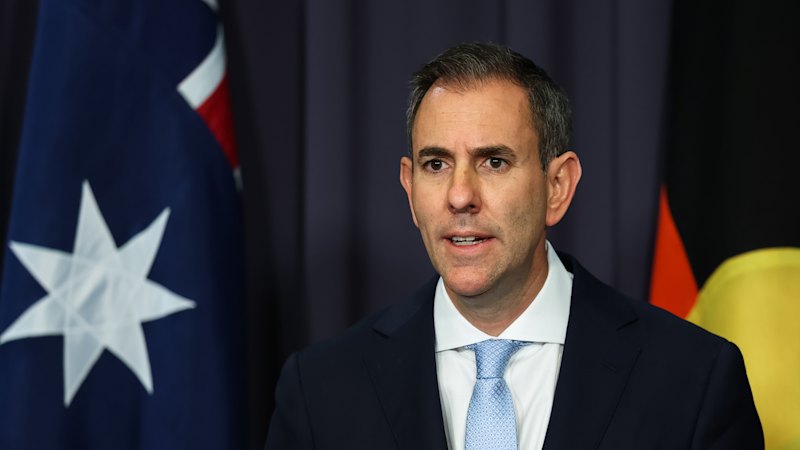
Chalmers, in a Q&A session after the release of the document, said that “our government and other governments of both political persuasions must cut income taxes further when the budget can afford it”. asserted
budget → say → it
The report has been carefully framed around what Chalmers believes are the five primary challenges and opportunities facing Australia. asserted
Chalmers → frame → Australia
For Chalmers, the quintet includes the rise of artificial intelligence, the clean energy transition, Australia’s ageing population, industrial transformation and geopolitical fragmentation. asserted
quintet → include → intelligence
The treasurer sees a world which is more dangerous, unpredictable, unequal and divided. asserted
which → see → world
“If people are unmoored economically, generationally, they feel disconnected from, and disregarded in, our politics ... it’s eroding trust in the institutions of our democracy. asserted
it → feel → democracy
It’s exacerbating the strain felt by younger generations, in particular. asserted
It → exacerbate → generations
” But the one word that looms over this document more than any other, which calls into question some of the rosier forecasts, is productivity. asserted
which → loom → forecasts
Debates about productivity send most people to sleep, but it is productivity growth that determines whether, over time, Australians grow richer and their businesses succeed, as the relative cost of producing goods and services declines. And here’s the rub: this document projects productivity will remain at or near the 30-year average of 1.2 per cent rather than the 20-year average of 0.8 per cent, even though the Reserve Bank of Australia believes 0.8 per cent is more realistic. asserted
cent → send → Australia
A chart on page 195 of the report makes clear how big a difference that 0.4 per cent productivity change can be, over time. asserted
be → make → time
Australia’s gross debt-to-GDP ratio will fall from about 35 per cent to 28 per cent between now and 2066 under the scenario in which Australia achieves 1.2 per cent productivity growth, and would mean that Australia’s gross debt to GDP ratio is relatively low. asserted
ratio → fall → GDP
But shaving 0.4 per cent off productivity growth, which is also modelled, would mean Australia’s gross debt to GDP ratio would nearly double to just about 60 per cent of GDP by 2066, a huge increase and a bigger problem as Australians grow older. asserted
Australians → shave → 2066
Increasing average productivity to 1.6 per cent would all but wipe out Australia’s gross debt. asserted
Increasing → increase → debt
Those tiny increases or decreases in productivity are worth tens of billions of dollars and are the reason why productivity matters so much. asserted
productivity → matter → dollars
Much of the work of achieving that productivity growth of 1.2 per cent is expected to be done by the growth in the use of AI, but there is little detail of exactly how that will work (the document does acknowledge this). asserted
document → achieve → this
The treasurer argued on Monday that Australia’s productivity estimates were lower than the UK and the US, but higher than New Zealand, “so we are broadly in the middle ranges of the productivity assumption”. asserted
we → argue → assumption
Labor deserves credit for taking tough decisions on housing tax breaks and the NDIS in the most recent budget, even if some economists believe the measures won’t solve the housing crisis. asserted
measures → deserve → crisis
We will know in the next couple of years if Labor’s tax changes fix some of Australia’s housing problems. asserted
changes → know → problems
We will also see if the Australian public believes them when they go to the polls. asserted
they → see → polls
But Chalmers and his colleagues will be long gone from the parliament by the time we find out whether AI makes a material difference to our incomes and quality of life. asserted
AI → go → life
Subscribers can sign up to our weekly Inside Politics newsletter. asserted
Subscribers → sign → newsletter
💬Give feedback
🕘History 🎫Support