Photo via South China Morning Post

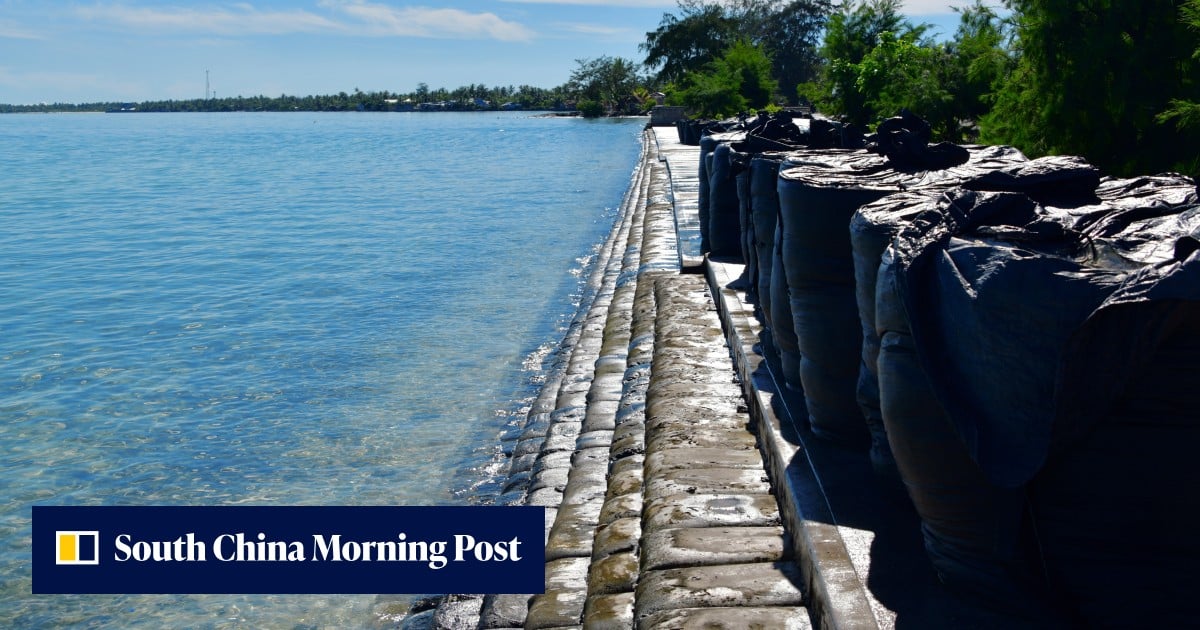
Why China is weighing into the debate on how to respond to shrinking coastlines

Read the original at South China Morning Post ↗
Cite

Chen, A. (2026, September 21). Why China is weighing into the debate on how to respond to shrinking coastlines. South China Morning Post. https://www.scmp.com/news/china/diplomacy/article/3368220/why-china-weighing-debate-how-respond-shrinking-coastlines?utm_source=rss_feed

Dated when The Aporia collected the article, usually within hours of publication. Check the original for its exact date and byline.

South China Morning Post · collected 2026-09-21 · by Alyssa Chen

Quick Summary

China is considering its stance on how international law addresses shrinking coastlines due to rising sea levels. The central debate involves whether maritime boundaries should adapt to changing coastlines or remain static. China sees an opportunity to position itself as a supportive player by providing technical assistance like surveying and coastal protection technology, while also advocating for fixed maritime boundaries.
Written by AI on 2026-09-21, from this article's own text only (the story summary below draws on all the coverage).

AI analysis

Story summary

Rising sea levels are prompting international discussions about how to handle shifting coastlines, particularly regarding maritime boundaries. While this issue is not an immediate threat to China, it has significant implications for international law and other global areas. The central debate revolves around whether maritime boundaries should adjust with changing coastlines or remain fixed. Some analysts suggest that China could play a crucial role as both a legal advocate and technical partner by providing surveying expertise, coastal protection technology, and support for establishing immutable maritime borders to help vulnerable Pacific nations. This position would enhance China's influence in the region while offering practical assistance to countries facing existential threats from rising waters.


Written for “China Climate Change Policy” on 2026-11-01, grounded in this article and the 0 other(s) covering the same event.

Story

📰 China Climate Change Policy
Environment · 1 article(s) covering the same event.

Compared with similar articles

Nothing to compare against. No article is close enough to this one for the pipeline to have linked or judged the pair.
How this article was measured signals, leaning charts, publisher record, byline, topics and claims

Signals How these are calculated →

Claims extracted
4
sentences that state something as happening or true
Uncertain
25%
1 of 4 hedged ("reportedly", "may", "according to")
Leaning
Leans left
of the writing, not the subject · beta estimate
Publisher signals
64/100
South China Morning Post's corrections and hedging, across everything collected from it. Not a measure of accuracy.
Outlets on this story
1
Environment
Same framing elsewhere
1
articles that frame the event the way this one does
Analyzed 2026-09-21 · how these are computed

How this is being covered How these are calculated →

Article leaning vs. publisher reliability
Source leaning vs. consistency

Publisher

South China Morning Post · 3532 article(s) · 6 correction(s) detected
Running correction rate · 6 correction(s)

Who wrote this

Alyssa Chen
21 article(s) here · 1 carrying a prediction
🔮 Agreement on AMRAAM assembly follows announcement that Japan plans to conduct missile training exercises in India Japanese Defence Minister Shinjiro Koizumi announced late Wednesday that the two allies would construct a final assembly facility in Japan for the AIM-120 Advanced Medium-Range Air-to-Air Missile (AMRAAM).
🔮 Why Chinese pundits say France’s riots could reshape European politics Protests stem from falling competitiveness with an eroded middle class, providing ‘fertile ground’ for polarisation, observers say The social unrest roiling France is being closely watched for a possible spillover effect beyond the country’s borders that could reshape European politics, Chinese analysts said.
🔮 Chinese ambassador denies threatening Philippines after saying a war may prove easy to win Foreign ministry in Manila summoned ambassador Jing Quan after his comments further inflamed long-running tensions Philippine Foreign Secretary Theresa Lazaro met Jing on Monday to express “serious concern and strong objections” over his “provocative and unacceptable” language.
🔮 ‘Hot economics, cold politics’: why China gave nod for expanded Japanese trade trip Allowing more executives to visit Beijing shows that China aims to use economic leverage to pressure Tokyo, experts say Beijing’s decision to allow a bigger Japanese business delegation to go to China next month may be cause for some optimism but “hot economics, and cold politics” will continue to dominate the strained relationship between the two countries, observers say.
🔮 Chinese business visit to Kuril Islands will do nothing to ease tensions in Tokyo The trip was aimed at identifying joint Russia-China investment opportunities in the disputed southernmost part of the archipelago Officials and business leaders from Heilongjiang province, which borders Russia’s far east, travelled to Etorofu – known to Russians as Iturup – to survey potential investment opportunities, according to the Sakhalin Oblast government, which oversees the island.
🔮 Technical problems cited in disruptions that struck at crucial time for mainland students at height of overseas university admissions season The British Council said its IELTS examinations across China would resume Wednesday, ending four days of cancellations stemming from technical problems that left test takers scrambling at the height of the overseas university admissions season.
🔮 Educational exchanges are in the firing line as tensions between the two countries spill over into the classroom Around 150 Chinese language teachers in the Philippines are returning home following mounting criticism from Philippine security officials that educational exchanges involving China could pose national security threats.
🔮 3 top reasons Trump will face a stronger Xi Jinping at November Apec forum in China Vital host diplomacy leverage and upgraded US-China ties among reasons cited by experts forecasting an even more confident Chinese side
🔮 Will the Trump-Xi wartime ally nostalgia prompt a Japanese rethink on China ties?
🔮 When Japanese Prime Minister Sanae Takaichi meets US President Donald Trump in New York on Tuesday, the leader casting the longest shadow over the meeting will not even be in the building.
Also by Alyssa Chen
Nothing else under this byline is closely related to this article, so these are simply their most recent.
All 21 articles by Alyssa Chen →

Topics

China

Subjects

China GPE · 3×

Narrative

Some analysts have argued that China should position itself as both a legal advocate and technical partner for Pacific nations to offer tangible support – such as surveying expertise, coastal protection technology and advocacy for fixed maritime boundaries.
framing: mixed · carried by 1 article(s) · first seen 2026-09-21
🔮 Why China is weighing into the debate on how to respond to shrinking coastlines Rising sea levels are not an existential threat to China, but their impact on international law could have a knock-on effect in other areas
2026-09-21 · South China Morning Post
Why China is weighing into the debate on how to respond to shrinking coastlines · mixed framing

Claims (4 extracted, 1 hedged)

Why China is weighing into the debate on how to respond to shrinking coastlines Rising sea levels are not an existential threat to China, but their impact on international law could have a knock-on effect in other areas uncertain
impact → weigh → areas
At the heart of this lies a contentious question: should maritime boundaries shift with changing coastlines, or should they be frozen in place? asserted
they → lie → place
The answer carries profound implications not only for the survival of vulnerable islands but also for the rest of the world. asserted
answer → carry → world
Some analysts have argued that China should position itself as both a legal advocate and technical partner for Pacific nations to offer tangible support – such as surveying expertise, coastal protection technology and advocacy for fixed maritime boundaries. asserted
nations → argue → boundaries
💬Give feedback
🕘History 🎫Support