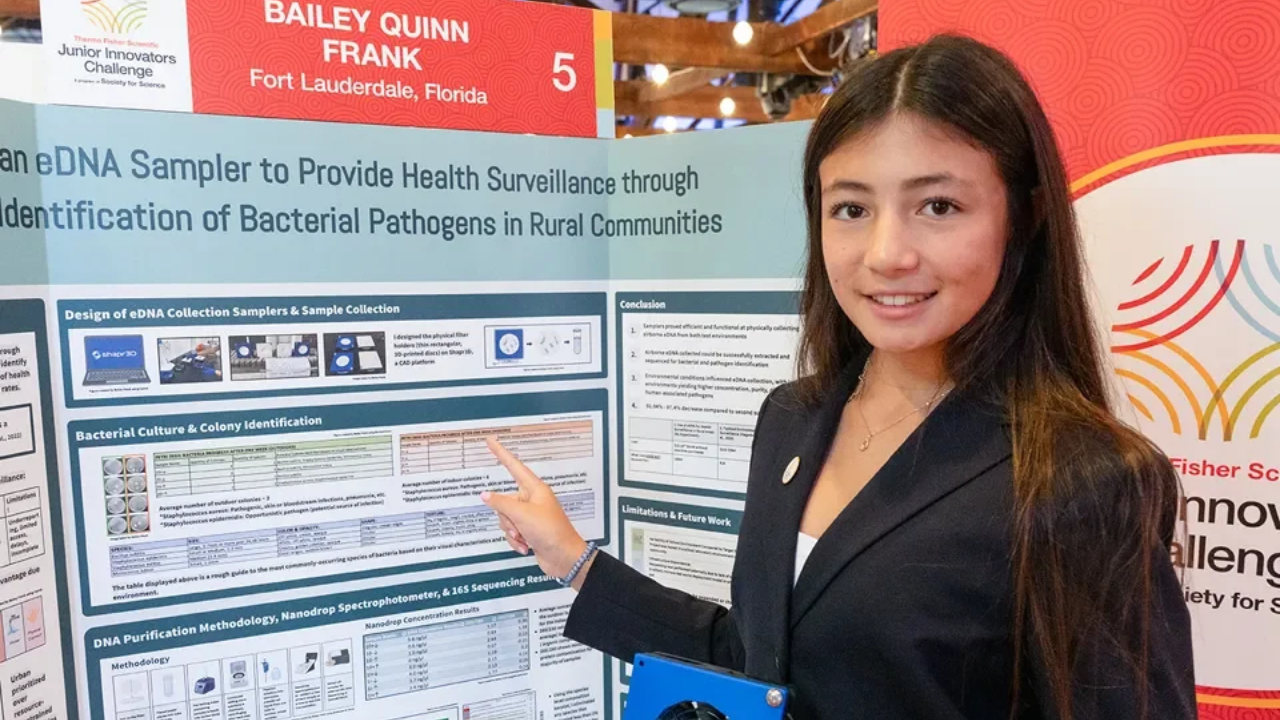
Jiaen Jiang, a 16-year-old student from Rosenberg, Texas, has won a $25,000 Davidson Fellows Scholarship for an engineering project designed to capture fine lunar dust before it enters future Moon habitats.
asserted
it → win → habitats
Jiang's project, called the Moondust Magnet, uses a bipolar interdigitated electrode array to create controlled electric fields that can attract and capture both charged and neutral particles of lunar regolith.
asserted
that → call → regolith
The system is intended for use inside habitat airlocks, where dust carried in on astronauts' suits and equipment could otherwise enter the living area and reach primary filtration systems.
uncertain
dust → intend → systems
Jiang has demonstrated the concept through benchtop experiments using lunar dust simulants.
asserted
Jiang → demonstrate → simulants
She was also one of five finalists selected by the 2025-26 MIT THINK programme from 1,042 applications, according to MIT's results document.
uncertain
She → select → document
The Davidson Institute describes the scholarship as one of the nation's most prestigious honours for students aged 18 and under.
asserted
Institute → describe → students
Lunar dust could pose a health problem on future Moon missions
Lunar regolith is the loose layer of soil and fragmented rock covering the Moon's surface.
uncertain
regolith → pose → surface
Its fine particles can become a problem during human missions because dust can cling to spacesuits, equipment and other surfaces and be carried into habitats.
asserted
dust → become → habitats
Jiang's Davidson project description says inhaled lunar regolith can cause severe respiratory irritation and that repeated exposure may contribute to chronic lung disease and cellular damage.
uncertain
exposure → say → disease
Research into lunar dust has also identified its movement and adhesion as important challenges for future exploration systems.
asserted
Research → identify → systems
Jiang's device is intended to address the problem after astronauts return from the lunar surface.
asserted
astronauts → intend → surface
Instead of relying solely on a habitat's primary filtration system, the proposed system would capture airborne dust inside the airlock before it reaches those filters.
asserted
it → rely → filters
According to the Davidson Institute, removing the particles at this stage could reduce astronauts' exposure, lessen the strain on filtration equipment and reduce the amount of time crews spend in airlocks.
uncertain
crews → accord → airlocks
The project remains at an experimental stage.
asserted
project → remain → stage
Jiang's current work uses benchtop experiments with lunar dust simulants to demonstrate whether the approach is feasible.
asserted
approach → use → simulants
It has not been tested on the Moon, and the Davidson Institute says additional research is needed.
asserted
research → test → Moon
She turned a dust-repelling idea into a dust-catching system
The idea for the Moondust Magnet emerged from a different area of lunar research.
asserted
idea → turn → research
Jiang said she was reviewing research into preventing rocket-plume damage and studying electrodynamic dust shields, which use electrostatic waves to repel lunar regolith from surfaces.
asserted
which → say → surfaces
That led her to consider whether a similar electrostatic approach could instead attract and capture airborne dust.
uncertain
approach → lead → dust
The resulting system uses a bipolar interdigitated electrode array.
asserted
system → result → array
Rather than relying on a conventional magnet, the electrodes generate controlled electric fields that interact with dust particles and allow the system to collect both charged and neutral regolith.
asserted
system → rely → regolith
The Davidson Institute describes the array as acting similarly to a magnet for small particles, which is where Jiang's "Moondust Magnet" name comes from.
asserted
name → describe → where
Jiang's MIT THINK project had a more specific experimental target.
asserted
project → have → target
The programme's 2025-26 finalist abstract says she planned to prototype and test a custom high-voltage embedded bipolar electrode array in an enclosed environment using different lunar dust simulants.
asserted
she → say → simulants
The stated goal was to extract at least 80% of airborne lunar dust particles within an airlock.
asserted
goal → state → airlock
That 80% figure is a target for the project, not a reported final performance result.
asserted
figure → report → project
Much of the research was done independently
Jiang is a student researcher at the University of
Houston and says much of the project was conducted independently of her school.
asserted
much → do → school
She taught herself concepts in electrostatics, experimental design and data analysis while developing the system.
asserted
She → teach → system
Her current project listing describes the work as an ongoing effort, with further development being carried out at the University of Houston.
asserted
development → describe → Houston
Her MIT THINK finalist project also represents a relatively early stage of development.
asserted
project → represent → development
The competition abstract describes a system that is being prototyped and evaluated in an enclosed test environment rather than a completed device ready for deployment in a lunar habitat.
asserted
that → describe → habitat
MIT selected five finalists from 1,042 applications during the 2025-26 cycle, the largest applicant pool in the programme's history.
asserted
MIT → select → history
Electrostatic methods have previously been investigated for removing lunar dust from equipment and surfaces, including solar panels and optical components.
asserted
methods → investigate → panels
A 2023 review of lunar dust-remediation technologies found that electrostatic dust shields and other approaches remained under development, with further work needed to establish their performance and operational safety.
asserted
work → find → performance
The project earned her a $25,000 Davidson Fellowship
asserted
project → earn → Fellowship
The Davidson Institute selected Jiang as a 2026 Davidson Fellow and awarded her a $25,000 scholarship for the Moondust Magnet project.
asserted
Institute → select → project
The institute lists her age as 16 and her hometown as Rosenberg, Texas, and says she is a rising junior from the Greater Houston area.
asserted
she → list → area
The scholarship adds to several other recognitions.
asserted
scholarship → add → recognitions
Jiang's Davidson profile says she previously received a Space Center Houston scholarship and Houston's Nova Spotlight Award for an aerospace engineering project.
asserted
she → say → project
She was also selected as an MIT THINK finalist for the Moondust Magnet project.
asserted
She → select → project
…and 4 more, not listed.
 The Aporia