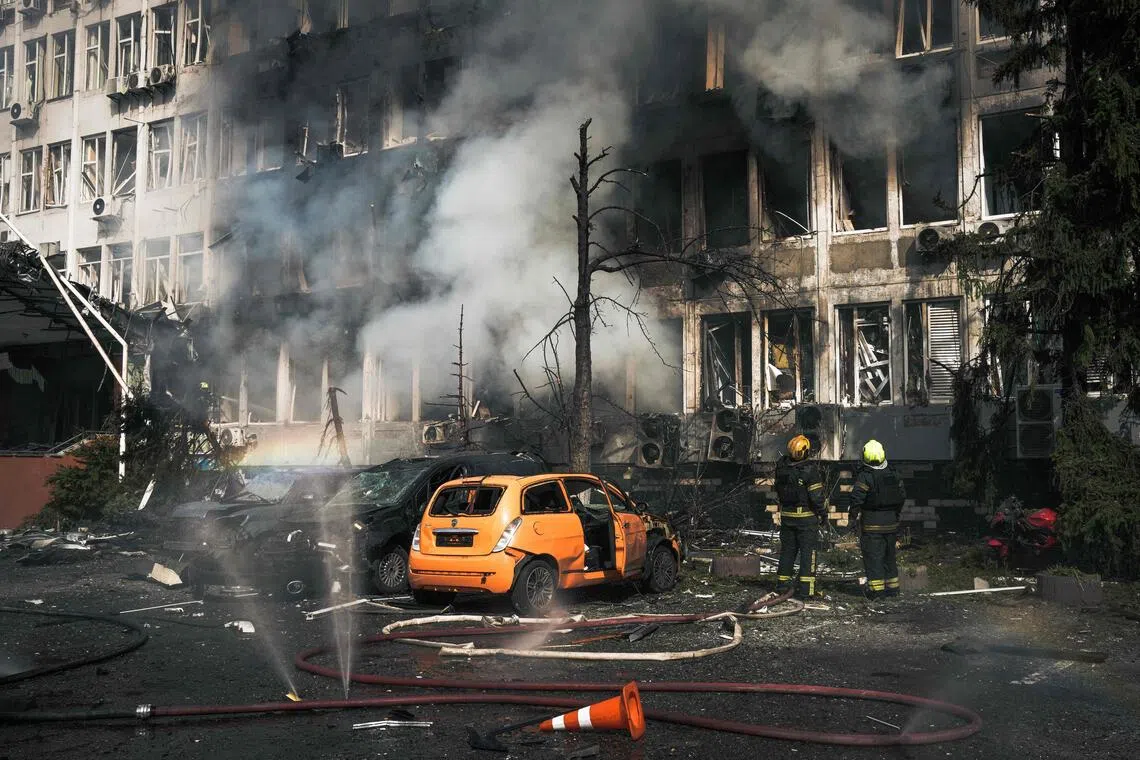
Seconds before the Russian drone struck, Viktor Kruglov was thinking about textbooks — tens of thousands of them, and how to get them to Ukrainian schools faster.
asserted
Kruglov → strike → schools
Minutes later, a second explosive-laden Shahed drone hit, laying waste to the main hub of his publishing house, Ranok, in northeastern Kharkiv.
asserted
drone → lade → Kharkiv
“Steel was blazing and burning,” Kruglov said of the Aug. 1 attack, adding that the huge warehouse’s reinforced concrete melted and the roof caved in.
The blaze burned for almost a week, reducing millions of books to ash.
asserted
blaze → blaze → ash
Ukraine’s publishing industry is facing its worst crisis yet, driven by targeted Russian attacks — part of a broader culture war in which nearly 5,000 cathedrals, churches, museums, theaters and other cultural sites have been destroyed or damaged and 35,000 art objects looted.
asserted
objects → face → which
More than 13 million books — a third of the country’s annual print run — were destroyed in two months this summer, causing at least $39.3 million (1.75 billion hryvnias) in damage, the Ministry of Culture said.
asserted
Ministry → destroy → Culture
Kremlin spokesman Dmitry Peskov did not respond to an Associated Press request for comment about the Russian strikes on Ukraine’s publishing infrastructure.
asserted
Peskov → respond → infrastructure
Despite a surge in demand for Ukrainian-language books following Russia’s 2022 invasion, the destruction is setting the industry back — and the losses go beyond money.
asserted
losses → follow → money
Publishers are expected to invest less in debut authors, threatening the future of Ukrainian literature.
asserted
Publishers → expect → literature
Small, independent houses may publish less or close altogether, narrowing the market, while larger publishers play it safe and lean on bestsellers.
uncertain
publishers → publish → bestsellers
“This is a deliberate policy of Russia because they understand that culture is what makes us feel resilient, what makes us feel the owners of our land, of our destiny,” said Tetiana Berezhna, Ukraine’s culture minister.
asserted
Berezhna → understand → destiny
Russia is deliberately waging war on Ukraine’s book industry
asserted
Russia → wag → industry
Besides Ranok, at least 40 other publishing houses and multiple bookstores have suffered damage in recent weeks.
asserted
houses → suffer → weeks
“This is a huge blow to the industry, and if we don’t move quickly to put strategic support measures in place … the industry could collapse entirely,” Kruglov said, adding that the book industry is an “element of Ukraine’s national security.”
uncertain
industry → move → security
The Ranok warehouse Russia destroyed opened in 2013 as an automated logistics hub capable of processing tens of thousands of books a day, Kruglov said.
asserted
Kruglov → destroy → books
“There were difficult periods” for Ranok, he said, tied to the 2008 global economic crisis and the COVID-19 pandemic, “but no one could have imagined that almost a year’s turnover for Ranok could be destroyed at once.
uncertain
turnover → be → Ranok
The strike destroyed 8 million books, including 620,000 textbooks, which Ranok supplies to nearly all of Ukraine’s schools.
asserted
Ranok → destroy → schools
Still, Kruglov said the company has backup warehouses and stores all its files in the cloud.
asserted
company → say → cloud
“That’s probably what’s keeping us going, because we’re able to reprint books, and we’ve kept our team,” he said.
asserted
he → ’ → team
“They’ve been doing it for centuries,” she said.
asserted
she → do → centuries
She points to the 19th century, when much of modern Ukraine was part of the Russian Empire, and Russia issued decrees banning or severely restricting the publishing and public speaking of the Ukrainian language.
asserted
Russia → point → language
“But still, the Ukrainian language exists.
asserted
language → exist → ?
Ukrainian literature exists.
asserted
literature → exist → ?
We have the books in our libraries, which were kept in secret from the very old ages, and they still exist,” she said.
“It shows us the hope that Ukraine will stay strong.”
asserted
Ukraine → have → hope
The future of Ukrainian literature is at risk
Still, there are many immediate challenges.
asserted
future → be → risk
The attacks have hit publishers financially, Berezhna said, hurting their ability to invest in new authors.
asserted
Berezhna → hit → authors
Debut writers are costly to publish, compared with the safer, more profitable bet of bestsellers and established translated literature.
asserted
writers → publish → bestsellers
These “newcomers, debut literature, in 100 years will become Ukrainian classics that will tell the world about Ukraine,” she said, adding that she fears there will be less support for young Ukrainian authors.
asserted
she → become → authors
That’s why the ministry is working on putting together a financial support package for the industry, including state purchases of Ukrainian books for school libraries, grants to help small publishing houses cover printing costs, rent compensation for bookstores and a war-risk insurance program for print runs.
asserted
houses → ’ → runs
But many in the publishing industry say it’s not enough.
asserted
it → publish → industry
Months after a Russian missile tore through the ceiling of the Konvi print shop in July, burned pages of fourth-grade English textbooks still littered the floor and paper sat frozen inside the destroyed printing machine.
asserted
paper → tear → machine
Before the attack, millions of books a year were printed in this space, where there’s now nothing but piles of swollen book stock, ruined after firefighters put out the blaze.
asserted
firefighters → print → blaze
The print shop specialized in fiction, educational material and scientific literature.
asserted
shop → specialize → fiction
Viktoriia Haidai, the shop’s commercial director, said replacing the printing press will cost 1.2 million euros ($1.37 million) and it will take four to five years to fully restore capacity.
asserted
it → say → capacity
The Russians are striking shops like hers, she said, because “we are critical infrastructure, because we shape the future — we work on education, on culture.
asserted
we → strike → culture
We work to preserve history.”
asserted
We → work → history
“Without this, no nation has a future.”
asserted
nation → have → future
Textbook printing that once took three to four months will stretch to six to seven months, she said.
asserted
she → take → months
This threatens deadlines for next year and beyond.
asserted
This → threaten → year
“It’s not just the large printing houses that are suffering,” she said.
asserted
she → ’ → ?
“Many small printers, who don’t make themselves known publicly, have also been destroyed.”
asserted
themselves → make → ?
…and 13 more, not listed.
 The Aporia