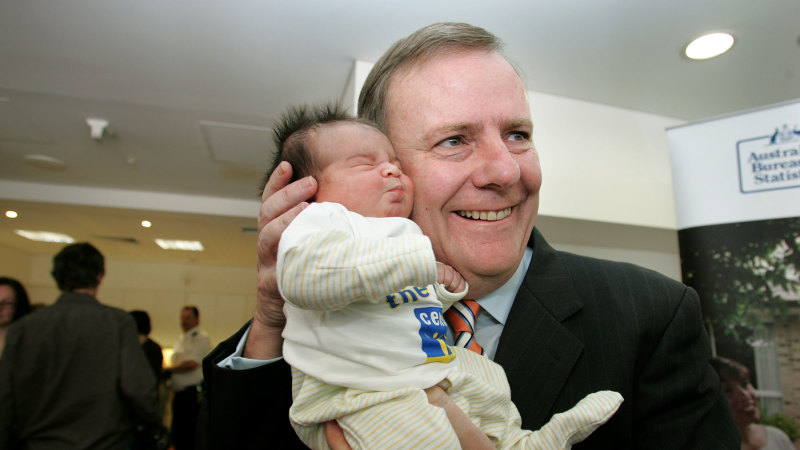
Photo via The Guardian

Universal early childhood education better than baby bonus to increase Australia’s birthrate, Labor says

Read the original at The Guardian ↗
Cite

editor, T. M. P. (2026, September 21). Universal early childhood education better than baby bonus to increase Australia’s birthrate, Labor says. The Guardian. https://www.theguardian.com/australia-news/2026/sep/21/universal-early-childhood-education-better-than-baby-bonus-to-increase-australias-birthrate-labor-says

Dated when The Aporia collected the article, usually within hours of publication. Check the original for its exact date and byline.

The Guardian · collected 2026-09-21 · by Tom McIlroy Political editor

Quick Summary

Labor argues that improving access to early childhood education and care is a better solution than implementing a new "baby bonus" to boost Australia's declining birthrate. The intergenerational report released on Monday forecasts more deaths than births in 2065, with the fertility rate projected to drop to 1.34 by then from 1.5 children per woman in 2030–31. Labor highlights its efforts to make it easier for families to have more children through measures like expanded paid parental leave and improved childcare access, while some opposition figures suggest a return to economic incentives such as the previous baby bonus program could be considered.
Written by AI on 2026-09-21, from this article's own text only (the story summary below draws on all the coverage).

AI analysis

Story summary

Australia's birthrate is declining, as highlighted by Monday’s intergenerational report which projects that more Australians will be dying than being born within 40 years. This trend mirrors the situation already faced by countries such as South Korea, Italy, Germany, and Japan. The Labor government argues that investing in universal early childhood education and care is a better strategy to address this issue compared to introducing a new “baby bonus.” Treasurer Jim Chalmers emphasized that families should make personal decisions about starting a family without government pressure or free advice. By 2065–66, Australia’s fertility rate is projected to drop to 1.34 children per woman, down from 1.5 in 2030–31, leading to an estimated population decline of 1.7 million people and a median age increase by 1.7 years. The report attributes this trend to factors including better access to contraception, longer education periods, career development priorities, and delayed marriage or partnerships.

Written for “Australia Birthrate Policy Debate” on 2026-11-03, grounded in this article and the 0 other(s) covering the same event.

Story

📰 Australia Birthrate Policy Debate
Politics · 1 article(s) covering the same event.

Compared with similar articles

This article reads unscored and hedges 4% of its claims. Each row says how that neighbour differs.
The Sydney Morning Herald
Hedges 0 of 89 claims Outlet record 61/100
“Article A discusses the general unreliability of intergenerational reports, while Article B specifically addresses a particular forecast in the most recent report about population trends.”
Times of India
Hedges 3 of 14 claims Outlet record 59/100
“While both articles discuss aspects of Australia's ageing population and declining birthrate based on a recent intergenerational report, they describe different specific topics within that broader context—one focuses on migration debates and the other on proposed policy solutions to increase births.”
The Sydney Morning Herald
Hedges 0 of 28 claims Outlet record 61/100
“The articles discuss related themes of Australia's ageing population and declining birthrates but describe different aspects and do not focus on the same specific incident or happening.”
ABC News (AU)
Hedges 4 of 26 claims Outlet record 68/100
“While both articles discuss demographic challenges and a declining birthrate in Australia based on an intergenerational report, they do not describe the same specific event or incident. Article A focuses on the statistics and projections from the report itself, whereas Article B discusses Labor's response to the report.”
How this article was measured signals, leaning charts, publisher record, byline, topics and claims

Signals How these are calculated →

Claims extracted
24
sentences that state something as happening or true
Uncertain
4%
1 of 24 hedged ("reportedly", "may", "according to")
Leaning
withheld
no quote in the article backed the model's score
Publisher signals
66/100
The Guardian's corrections and hedging, across everything collected from it. Not a measure of accuracy.
Outlets on this story
1
Politics
Same framing elsewhere
1
articles that frame the event the way this one does
Analyzed 2026-09-21 · how these are computed

How this is being covered How these are calculated →

Article leaning vs. publisher reliability
Source leaning vs. consistency

Publisher

The Guardian · 2872 article(s) · 6 correction(s) detected
Running correction rate · 6 correction(s)

Who wrote this

Tom McIlroy Political editor
23 article(s) here · 1 carrying a prediction
🔮 The NSW premier, Chris Minns, has warned an expected interest rate increase will force job losses and cause businesses to close, insisting the federal government and states should rein in spending to take pressure off the economy.
🔮 Privately, Labor MPs admit the strong likelihood of the Reserve Bank delivering the year’s fifth interest rate increase next week will compound the government’s political problem over the high cost-of-living, with some calling for radical moves from the federal government.
🔮 The co-host of popular podcast The Rest is Politics, Campbell said Haines’ eventual return to parliament would help bring about change.
🔮 “I did not feel that Angus Taylor read the room when it comes to the lesson that Helen would like us all to learn.
🔮 The cost of Snowy Hydro 2.0 has blown out to as much as $25bn, with a major reassessment finding the long-delayed renewable energy project will not be completed until the end of the decade.
🔮 “She is a determined person who will do her best with our support and love to recover, and that is what we hope for,” he said.
🔮 What happened will urgently change how MPs assess their personal safety, not least because local settings are no longer free from danger.
🔮 Paul Brereton, the first boss of the commission, quit in May, saying criticism of him was “drawing attention away” from the body’s purpose.
🔮 After sustained criticism of the government’s handling of the ban on tax bills being paid by credit card, Chalmers last week announced new funding for the ATO to ensure card payments could continue until the end of the financial year.
🔮 The Greens will push Labor to dramatically toughen new laws designed to rein in big tech, calling for individuals to have the right to take platforms to court and win financial compensation.
Also by Tom McIlroy Political editor
Nothing else under this byline is closely related to this article, so these are simply their most recent.
All 23 articles by Tom McIlroy Political editor →

Topics

Australia Australians Italy Labor South Korea

Subjects

Australia GPE · 3× Australians NORP · 3× Labor ORG · 2× Anthony Albanese PERSON · 1× Germany GPE · 1× Italy GPE · 1× Japan GPE · 1× Jim Chalmers PERSON · 1× South Korea GPE · 1× Treasury ORG · 1×

Narrative

The treasurer, Jim Chalmers, said fewer families with more than three children was part of the drop. “When it comes to fertility rates, I do not and will not give people free advice about these very personal decisions that they make about whether to start a family and when to start family,” he said.
framing: assertive · carried by 1 article(s) · first seen 2026-09-21
🔮 Monday’s intergenerational report showed that more Australians will be dying than being born in 40 years’ time, a point already reached by countries including South Korea, Italy, Germany and Japan.

Claims (24 extracted, 1 hedged)

Labor says better investment in early childhood education and care, such as a possible move to universal access for families, is a better way to address Australia’s declining birthrate, rejecting the need for a new “baby bonus”. asserted
investment → say → bonus
Monday’s intergenerational report showed that more Australians will be dying than being born in 40 years’ time, a point already reached by countries including South Korea, Italy, Germany and Japan. asserted
Australians → show → Korea
It is the first time the three-yearly report has forecast more deaths than births. asserted
report → forecast → births
Lower fertility rates will drive slower population growth, according to Treasury’s report. uncertain
rates → drive → report
Australia’s fertility rate is projected to decline to 1.34 by 2065–66, down from 1.5 children per woman in 2030–31. asserted
rate → project → 2030–31
Fertility rates have been below the replacement rate of 2.1 children per woman for 50 years, contributing to a projected drop in population of 1.7 million people and an increase in the projected median age by 1.7 years in 2065–66. asserted
rates → contribute → 2065–66
The report says a complex mix of economic, social and cultural factors is to blame, including greater access to contraception, more time spent in education, career development, longer periods living with parents, and delays in forming partnerships and having children. asserted
mix → say → children
The treasurer, Jim Chalmers, said fewer families with more than three children was part of the drop. “When it comes to fertility rates, I do not and will not give people free advice about these very personal decisions that they make about whether to start a family and when to start family,” he said. asserted
he → say → family
He said federal Labor was making it easier for adults to choose to have more children if they wished, citing expanded paid parental leave, superannuation settings and access to childcare. asserted
they → say → childcare
The prime minister, Anthony Albanese, wants universal childcare to be part of his political legacy, and the government has commissioned consulting giant Deloitte to help design a universal system. asserted
government → want → system
The assistant minister for productivity, Andrew Leigh, said the government would “prefer that it were otherwise, but that’s the norm around the world.” asserted
that → say → world
“My read of the evidence, as an economist, is that the biggest impact you have is around childcare, and that’s why we made it such a priority upon coming to government, improving access to childcare, ensuring that it is affordable for Australians.” asserted
it → have → Australians
But, Liberal frontbencher Andrew Hastie said he was “open minded” about an economic incentive, like a return to the Howard government’s baby bonus payment. asserted
he → say → payment
“The real problem is of course that family formation is being delayed because people can’t get into home soon enough, and families are having less children,” he told ABC TV. asserted
he → delay → TV
“We want Australians to have a better chance of getting into a home, forming a family and having children of their own.” asserted
Australians → want → own
The Nationals leader, Matt Canavan, said families should have more support, but a baby bonus payment was not the right approach. asserted
payment → say → support
He has previously called for a “hyper” Australia and “more Australian babies”. asserted
He → call → Australia
He said solutions should be designed around helping families working for their own advancement. asserted
solutions → say → advancement
“The baby bonus, it was just ‘Here’s some cash’, without you having to put in the effort as well.” asserted
you → ’ → effort
Research by the e61 thinktank found that the baby bonus, introduced by then treasurer Peter Costello in 2004, led to births increasing by 6.5%. asserted
births → find → %
Births increased by 10% among mothers with no taxable income, by 8% among below-median income mothers, while there was no change among high-income mothers. asserted
Births → increase → mothers
It also found that births of a third child increased by 9%, and that mothers who received the baby bonus, as a group, had 6.8% more children in total by 2022. asserted
who → find → 2022
The finance minister, Katy Gallagher, said the government would not revisit the baby bonus. asserted
government → say → bonus
“Our government doesn’t get into promoting choices for individual families, but we recognise that people making those choices should be supported.” asserted
people → get → choices

💬Give feedback
🕘History 🎫Support