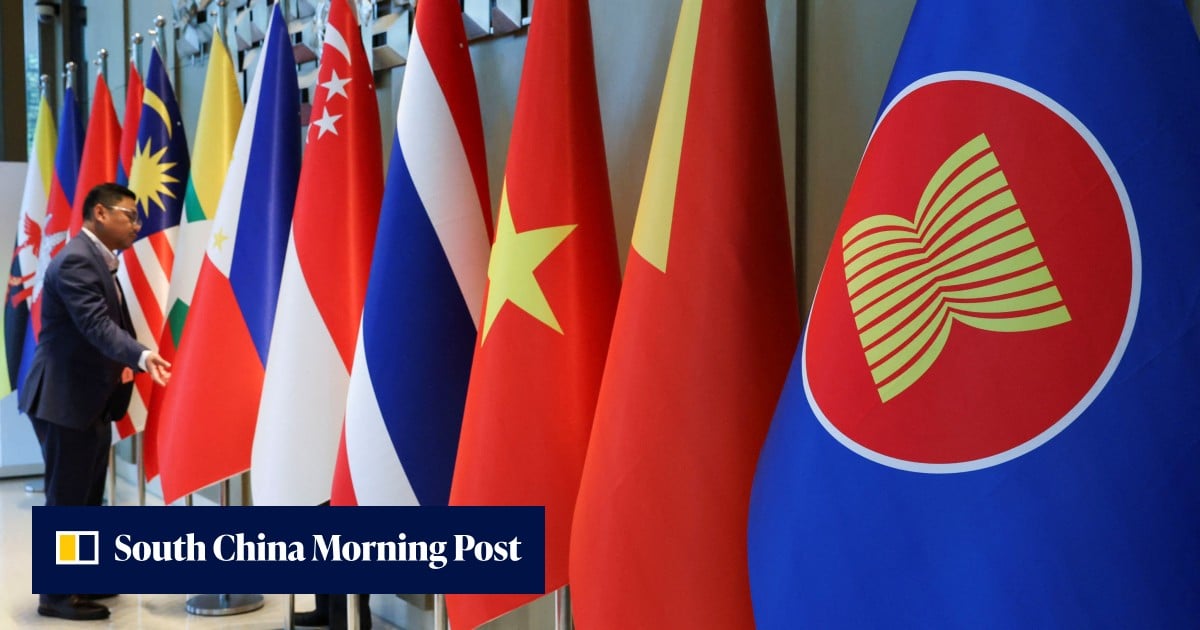
Photo via South China Morning Post

Southeast Asia supports multilateralism, wary of US or China leadership: survey

Read the original at South China Morning Post ↗
Cite

Beltran, S. (2026, September 21). Southeast Asia supports multilateralism, wary of US or China leadership: survey. South China Morning Post. https://www.scmp.com/week-asia/politics/article/3368278/southeast-asia-supports-multilateralism-wary-us-or-china-leadership-survey?utm_source=rss_feed

Dated when The Aporia collected the article, usually within hours of publication. Check the original for its exact date and byline.

South China Morning Post · collected 2026-09-21 · by Sam Beltran

Quick Summary

A Rockefeller Foundation survey indicates that Southeast Asia strongly supports multilateralism and is hesitant to accept leadership from either the United States or China. The region scored 63% in believing global cooperation works effectively, higher than any other surveyed area including the US (37%) and Western Europe (31%). Analysts attribute this stance to a desire among smaller Southeast Asian nations to maintain strategic independence amid potential superpower dominance.
Written by AI on 2026-09-21, from this article's own text only (the story summary below draws on all the coverage).

AI analysis

Story summary

A recent Rockefeller Foundation survey indicates that Southeast Asia strongly supports multilateralism and is cautious about aligning too closely with either the US or China. The region scored positively at 63% when asked if global cooperation was effective, compared to lower scores for regions like North America (37%), Oceania (32%), and Western Europe (31%). Analysts suggest that this reflects a desire among smaller and middle powers in Southeast Asia to maintain strategic independence amid concerns about superpower dominance from Washington or Beijing.

Written for “Southeast Asia Multilateralism Concerns” on 2026-11-01, grounded in this article and the 0 other(s) covering the same event.

Story

📰 Southeast Asia Multilateralism Concerns
Politics · 1 article(s) covering the same event.

Compared with similar articles

Nothing to compare against. No article is close enough to this one for the pipeline to have linked or judged the pair.
How this article was measured signals, leaning charts, publisher record, byline, topics and claims

Signals How these are calculated →

Claims extracted
3
sentences that state something as happening or true
Uncertain
0%
0 of 3 hedged ("reportedly", "may", "according to")
Leaning
Leans left
of the writing, not the subject · beta estimate
Publisher signals
64/100
South China Morning Post's corrections and hedging, across everything collected from it. Not a measure of accuracy.
Outlets on this story
1
Politics
Same framing elsewhere
1
articles that frame the event the way this one does
Analyzed 2026-09-21 · how these are computed

How this is being covered How these are calculated →

Article leaning vs. publisher reliability
Source leaning vs. consistency

Publisher

South China Morning Post · 3517 article(s) · 6 correction(s) detected
Running correction rate · 6 correction(s)

Who wrote this

Sam Beltran
28 article(s) here · 0 carrying a prediction
🔮 Hegseth pitches US-Asean defence framework but will it be a hard sell?
🔮 At this time of year, Fatima Ramos would normally be preparing her balikbayan boxes.
🔮 The Philippines is turning to the United States to build its oil stockpile amid the global energy crunch, with observers saying the move could also serve Washington’s military interests and deepen strategic ties.
🔮 Both sides will develop an offshore wind project in line with Vietnam’s goal to boost renewable electricity generation Vietnam is well placed to grow its renewable electricity sector by tapping its large pool of engineering talent and abundant wind resources with help from Denmark, a global leader in wind energy, according to analysts.
🔮 We would move on and proceed to the next voyage,” he said.
🔮 The Philippines’ telco industry wants the country to become a regional digital hub anchored by stable underwater cables, but a leading executive and analysts warn that slow approvals for repairs, limited monitoring and fragmented official oversight could undermine the ambition.
🔮 Advertisement Trump’s second Asean summit presence comes at a price for region On the president’s list are supply-chain security, critical minerals, technology cooperation, AI and investment in the US, experts say 4-MIN READ4-MIN US President Donald Trump is expected to drive hard bargains on tariffs and critical minerals in his return to the Asean summit in Manila next month, with Washington seeking greater economic and strategic concessions while remaining hawkish on China. The Philippines confirmed on Wednesday that Trump would fly in for the summit from November 16 to 18, before attending the Asia-Pacific Economic Cooperation (Apec) summit in Shenzhen that same week.
🔮 “I got worried, I got scared that maybe I wouldn’t be able to come home any more,” added the 29-year-old, whose six-year-old son lives in the Philippines under her parents’ care.
🔮 Aged 14, he already had accounts on Instagram and TikTok – among the platforms Jakarta said children would be banned from using – as well as popular video game Minecraft and gaming platform Roblox.
Also by Sam Beltran
Nothing else under this byline is closely related to this article, so these are simply their most recent.
All 28 articles by Sam Beltran →

Topics

Beijing Canada China Rockefeller Foundation Washington

Subjects

Beijing GPE · 1× Canada GPE · 1× China GPE · 1× Rockefeller Foundation ORG · 1× Washington GPE · 1×

Narrative

A recent Rockefeller Foundation survey shows strong regional belief in global cooperation and a reluctance to accept superpower dominance Analysts said the findings reflected a long-standing regional preference for keeping strategic options open, particularly among smaller and middle powers wary of an international order dominated by either Washington or Beijing.
framing: assertive · carried by 1 article(s) · first seen 2026-09-21
2026-09-21 · South China Morning Post
Southeast Asia supports multilateralism, wary of US or China leadership: survey · assertive framing

Claims (3 extracted, 0 hedged)

Southeast Asia supports multilateralism, wary of US or China leadership: survey asserted
Asia → support → leadership
A recent Rockefeller Foundation survey shows strong regional belief in global cooperation and a reluctance to accept superpower dominance Analysts said the findings reflected a long-standing regional preference for keeping strategic options open, particularly among smaller and middle powers wary of an international order dominated by either Washington or Beijing. asserted
findings → show → Washington
Southeast Asia was among the regions most positive about whether global cooperation was working effectively, scoring 63 per cent compared with 37 per cent for the US and Canada, 32 per cent for Oceania and 31 per cent for western Europe. asserted
cooperation → work → Europe
💬Give feedback
🕘History 🎫Support