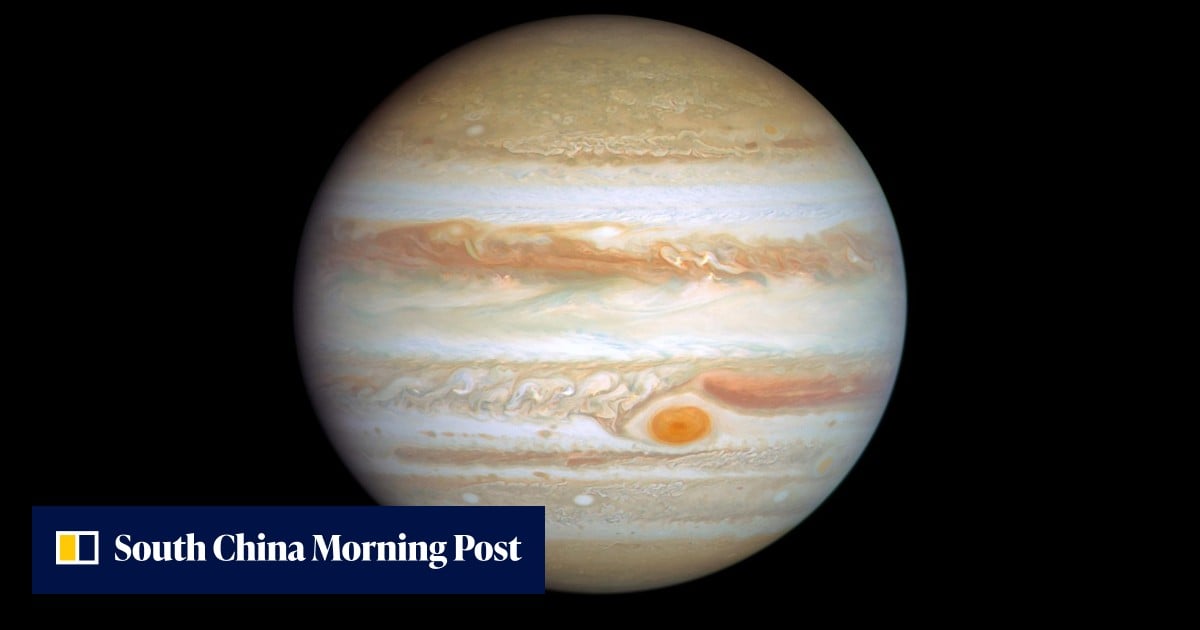
Photo via South China Morning Post

China gets closer to Jupiter mission by bringing Nasa’s StarNAV concept to life

Read the original at South China Morning Post ↗
Cite

Xin, L. (2026, September 21). China gets closer to Jupiter mission by bringing Nasa’s StarNAV concept to life. South China Morning Post. https://www.scmp.com/news/china/science/article/3368292/china-gets-closer-jupiter-mission-bringing-nasas-starnav-concept-life?utm_source=rss_feed

Dated when The Aporia collected the article, usually within hours of publication. Check the original for its exact date and byline.

South China Morning Post · collected 2026-09-21 · by Ling Xin

Quick Summary

China is advancing its space navigation technology by implementing NASA's StarNAV concept, which uses shifts in starlight to track spacecraft speed and position autonomously. In January, China tested this stellar aberration navigation on the Tianhui-7 satellite, achieving a positioning accuracy of about 5km, comparable to NASA’s Deep Space Network. This development is crucial for future missions like those to Jupiter, where radio signal delays can exceed 50 minutes, making real-time ground intervention impossible.
Written by AI on 2026-09-21, from this article's own text only (the story summary below draws on all the coverage).

AI analysis

Story summary

China is developing advanced space navigation technology by adopting NASA's StarNAV concept, which uses subtle shifts in starlight to track speed and position. Known as stellar aberration navigation, this method allows spacecraft to navigate deep space autonomously without constant reliance on ground-based commands from Earth.

In January, the Tianhui-7 satellite successfully tested this technology in low-Earth orbit, achieving a positioning accuracy of about 5km (3.1 miles), comparable to NASA's Deep Space Network antenna-based approach. This capability is crucial for missions like exploring Jupiter, which can be up to 900 million km from Earth, making real-time ground intervention impossible due to the delay in radio signal transmission exceeding 50 minutes.

Researchers from the China Academy of Space Technology, a key spacecraft manufacturer, highlighted these achievements in an upcoming paper in the Journal of Deep Space Exploration. This advancement underscores China's growing ambition and technological prowess in space exploration.


Written for “Chinese Jupiter Mission Advances” on 2026-11-02, grounded in this article and the 0 other(s) covering the same event.

Story

📰 Chinese Jupiter Mission Advances
Technology · 1 article(s) covering the same event.

Compared with similar articles

Nothing to compare against. No article is close enough to this one for the pipeline to have linked or judged the pair.
How this article was measured signals, leaning charts, publisher record, byline, topics and claims

Signals How these are calculated →

Claims extracted
5
sentences that state something as happening or true
Uncertain
0%
0 of 5 hedged ("reportedly", "may", "according to")
Leaning
not political
takes no side on a contested political question
Publisher signals
63/100
South China Morning Post's corrections and hedging, across everything collected from it. Not a measure of accuracy.
Outlets on this story
1
Technology
Same framing elsewhere
1
articles that frame the event the way this one does
Analyzed 2026-09-21 · how these are computed

How this is being covered How these are calculated →

Article leaning vs. publisher reliability
Source leaning vs. consistency

Publisher

South China Morning Post · 3547 article(s) · 7 correction(s) detected
Running correction rate · 7 correction(s)

Who wrote this

Ling Xin
14 article(s) here · 1 carrying a prediction
🔮 Chinese astronomers find planets that somehow avoided death by red giant stars Study suggests the long-term fate of the solar system, including Earth, ‘may be far more complicated than predicted’, according to scientist When a star like our sun grows old, it puffs up into a red giant that can gobble up its nearest planets.
🔮 At the ceremony, Qian said he would also work on “virtual cells” – computer models that mimic real cells so scientists can test how they might respond to drugs or disease without lab experiments.
🔮 China-US astronomy team may have found possible relic of a recent ‘gold factory’ Mystery glow seen in the Milky Way could be the result of a violent collision between two orbiting neutron stars, according to scientists The violent smash spewed out atoms and a flood of neutrons, which the atoms soaked up to form some of the universe’s heaviest elements, such as gold, platinum and uranium, while the wreckage collapsed into a black hole.
🔮 According to the latest papers, the Beijing scientists also showed that two crystals grown separately kept the same time – a sign such clocks could be reliably reproduced, they said.
🔮 David vs Goliaths: Singapore builds most accurate clock ever, leaves US and China in dust The decade-long project could help to pave the way for a redefinition of the second, researchers claim in a new paper The clock, built with a single ion of a rare earth metal element known as lutetium, is so precise that it would lose one second every 260 billion years – nearly 20 times the age of our universe.
🔮 Claims China’s BeiDou satellite was refuelled in orbit could change space race
🔮 That made it impossible for ground controllers to intervene in real time, wrote researchers from the China Academy of Space Technology – the country’s main spacecraft manufacturer – in a paper that will be published in the Journal of Deep Space Exploration.
🔮 China uses 100,000 home-grown AI chips to build leading weather forecast system The Sugon 8,000 system can predict weather 10 days in advance, bringing the country closer to its ambitious forecasting goals China said it can now predict weather 10 days in advance at a cutting-edge resolution of 5km (3.1 miles), finer than most major systems in routine use around the world.
🔮 The project will involve partners from at least five other countries as they track the development of space weather China has started an international project to build a three-dimensional satellite network between Earth and the moon that will track solar activity and study some of the universe’s most powerful explosions.
Also by Ling Xin
Nothing else under this byline is closely related to this article, so these are simply their most recent.
All 14 articles by Ling Xin →

Topics

China Deep Space Network Nasa StarNAV the China Academy of Space Technology

Subjects

Nasa ORG · 2× China GPE · 1× the China Academy of Space Technology ORG · 1× the Journal of Deep Space Exploration ORG · 1×

Narrative

The tech uses subtle shifts in starlight to track speed and position, allowing spacecraft to navigate deep space alone Known as stellar aberration navigation, the approach uses tiny shifts in the relative position of stars to work out how fast a probe is moving and in what direction, allowing autonomous real-time navigation without constantly relying on tracking and commands from Earth.
framing: assertive · carried by 1 article(s) · first seen 2026-09-21
🔮 That made it impossible for ground controllers to intervene in real time, wrote researchers from the China Academy of Space Technology – the country’s main spacecraft manufacturer – in a paper that will be published in the Journal of Deep Space Exploration.
2026-09-21 · South China Morning Post
China gets closer to Jupiter mission by bringing Nasa’s StarNAV concept to life · assertive framing

Claims (5 extracted, 0 hedged)

China gets closer to Jupiter mission by bringing Nasa’s StarNAV concept to life asserted
China → get → life
The tech uses subtle shifts in starlight to track speed and position, allowing spacecraft to navigate deep space alone Known as stellar aberration navigation, the approach uses tiny shifts in the relative position of stars to work out how fast a probe is moving and in what direction, allowing autonomous real-time navigation without constantly relying on tracking and commands from Earth. asserted
probe → use → Earth
In a low-Earth-orbit experiment in January, the Tianhui-7 satellite used this method to determine its position to within about 5km (3.1 miles), a performance comparable to Nasa’s antenna-based Deep Space Network. asserted
satellite → use → Network
Jupiter can be up to 900 million km from Earth, with radio signals taking more than 50 minutes to travel one way. asserted
signals → take → minutes
That made it impossible for ground controllers to intervene in real time, wrote researchers from the China Academy of Space Technology – the country’s main spacecraft manufacturer – in a paper that will be published in the Journal of Deep Space Exploration. asserted
that → make → Exploration
💬Give feedback
🕘History 🎫Support