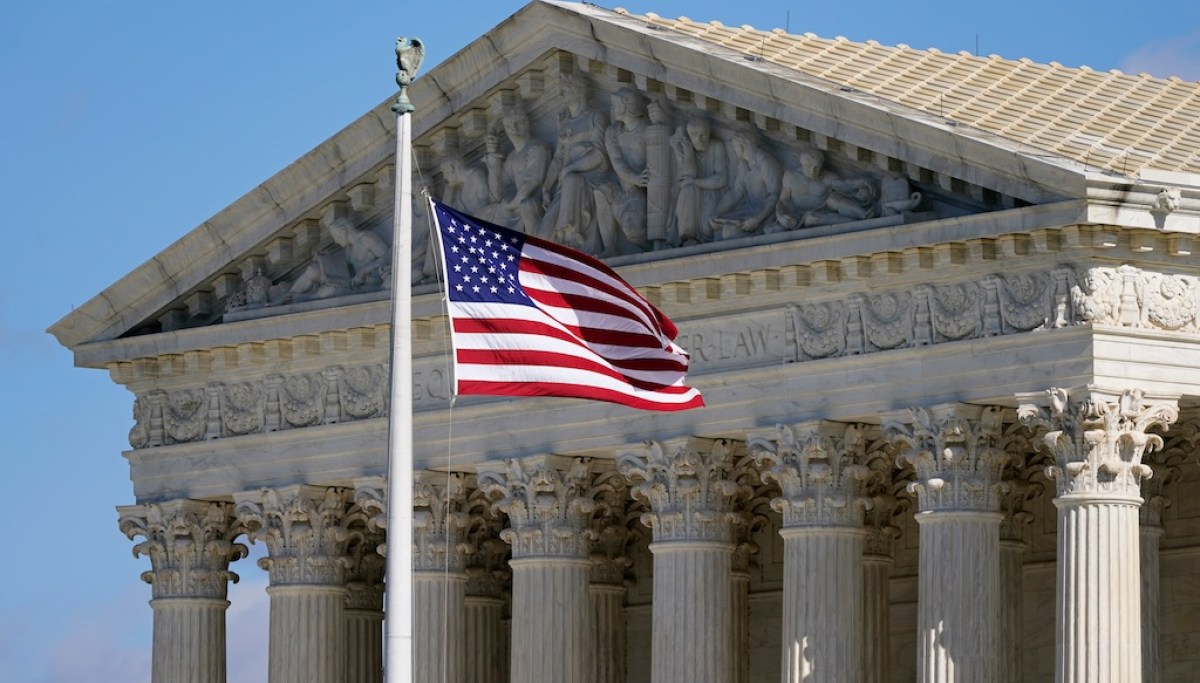
Photo via Washington Examiner

The Supreme Court banned race sorting. Colleges found a 5-digit loophole

Read the original at Washington Examiner ↗
Cite

Rogers, J. (2026, September 21). The Supreme Court banned race sorting. Colleges found a 5-digit loophole. Washington Examiner. https://www.washingtonexaminer.com/op-eds/4733702/college-admissions-zip-code-race-proxy/

Dated when The Aporia collected the article, usually within hours of publication. Check the original for its exact date and byline.

Washington Examiner · collected 2026-09-21 · by Jay Rogers

Quick Summary

Students for Fair Admissions has accused universities of continuing to consider race in admissions under the guise of using "geographic location" as a criterion, despite the Supreme Court's ruling banning racial discrimination in college admissions three years ago. They claim that zip codes and census data effectively serve as proxies for race, influencing admissions decisions similarly to race-based criteria. The College Board’s former adversity score tool, which factored in neighborhood demographics, has been linked to shifts in campus diversity at institutions like Yale before it was discontinued in 2025 due to scrutiny from SFFA. Meanwhile, public schools such as those in Montgomery County, Maryland, have also adopted similar methods to alter their racial composition.
Written by AI on 2026-09-21, from this article's own text only (the story summary below draws on all the coverage).

AI analysis

Story summary

Three years after the Supreme Court ruled that American universities must stop considering race in admissions, Students for Fair Admissions filed a comment letter on September 16, 2023, warning that geographic location has become a loophole for racial discrimination. The Treasury Department and IRS had proposed using an applicant’s home address as a criterion for tax-exempt private schools, which correlates strongly with race in many American neighborhoods due to historical patterns of segregation. In Montgomery County, Maryland, school officials changed their magnet admissions process from test-based to one considering applicants' homes and neighborhoods, altering the racial makeup of incoming classes based on zip codes. This shift highlights how using geographic location as a criterion effectively circumvents the Supreme Court’s ban on race-based discrimination in college admissions.

Written for “College Admissions Race Neutrality” on 2026-11-02, grounded in this article and the 0 other(s) covering the same event.

Story

📰 College Admissions Race Neutrality
Education · 1 article(s) covering the same event.

Compared with similar articles

This article reads leans strongly left and hedges 5% of its claims. Each row says how that neighbour differs.
Toronto Star
Hedges 3 of 56 claims Outlet record 64/100
“The articles discuss related topics but refer to different actions and timespans: Article A describes a current legal filing regarding tax-exempt private schools, while Article B discusses broader changes in civil rights enforcement policy under the Trump administration.”
How this article was measured signals, leaning charts, publisher record, byline, topics and claims

Signals How these are calculated →

Claims extracted
38
sentences that state something as happening or true
Uncertain
5%
2 of 38 hedged ("reportedly", "may", "according to")
Leaning
Leans strongly left
of the writing, not the subject · beta estimate
Publisher signals
70/100
Washington Examiner's corrections and hedging, across everything collected from it. Not a measure of accuracy.
Outlets on this story
1
Education
Same framing elsewhere
1
articles that frame the event the way this one does
Analyzed 2026-09-21 · how these are computed

How this is being covered How these are calculated →

Article leaning vs. publisher reliability
Source leaning vs. consistency

Publisher

Washington Examiner · 3905 article(s) · 7 correction(s) detected
Running correction rate · 7 correction(s)

Who wrote this

Jay Rogers
22 article(s) here · 1 carrying a prediction
🔮 I wasn’t in that control room, and Diawara may have a perfectly good explanation.
🔮 Hollywood would call it a heist hoax film.
2026-10-30 · assertive framing · Fake robberies, real bills
🔮 This week, the justices lifted a court-ordered deadline that would have forced the agency to rule on a Democratic challenge to its political advertising policy before Nov. 3.
2026-10-18 · assertive framing · One ad, one price. Congress should say so
🔮 The 6-3 order is temporary, and the justices will hear arguments on Dec. 9.
🔮 If you entered illegally, a judge ordered you out, and your homeland won’t take you, America can send you somewhere that will.
🔮 Whatever you do, never submit to the extended, adversarial questioning that might reveal what millions of Americans were forced to confront after the June 2024 debate: that the 46th president’s cognitive capacity had been degrading in the most powerful office on Earth.
🔮 That timing placed the release squarely inside the window the DOJ’s own election-sensitivity guidance identifies as the highest-risk period for any government action that could appear to influence a vote.
🔮 Texas redistricting cost him his primary in May, so this was his last lap.
🔮 In Montgomery County, Maryland, school officials swapped a test-based magnet admissions process for one weighing an applicant’s home and neighborhood, after being briefed in advance on exactly how the switch would change the racial makeup of the incoming class.
🔮 A federal judge in Miami will hear oral arguments this week on a legal theory that five people around the country are betting will spring them from noncitizen voting charges.
Also by Jay Rogers
Fake robberies, real bills
2026-10-30 · Washington Examiner
The executive branch needs an executive
2026-10-23 · Washington Examiner
Nothing else under this byline is closely related to this article, so these are simply their most recent.
All 22 articles by Jay Rogers →

Topics

American Harvard Students for Fair Admissions The College Board the Supreme Court

Subjects

Harvard ORG · 3× American NORP · 2× IRS ORG · 2× Students for Fair Admissions ORG · 2× The College Board ORG · 2× Treasury ORG · 2× the Supreme Court ORG · 2× SFFA ORG · 1× Yale ORG · 1× the Treasury Department ORG · 1×

Narrative

On Sept. 16, Students for Fair Admissions filed a comment letter with the Treasury Department and the IRS, warning that “geographic location,” a factor Treasury listed as an acceptable race-neutral criterion in its proposed rule on tax-exempt private schools, has become the preferred hiding place for the discrimination the court outlawed in Students for Fair Admissions v. Harvard.
framing: assertive · carried by 1 article(s) · first seen 2026-09-21
🔮 In Montgomery County, Maryland, school officials swapped a test-based magnet admissions process for one weighing an applicant’s home and neighborhood, after being briefed in advance on exactly how the switch would change the racial makeup of the incoming class.
2026-09-21 · Washington Examiner
The Supreme Court banned race sorting. Colleges found a 5-digit loophole · assertive framing

Claims (38 extracted, 2 hedged)

Three years after the Supreme Court told American universities to stop sorting applicants by race, the sorting hasn’t stopped. asserted
sorting → tell → race
It just got a new address. asserted
It → get → address
On Sept. 16, Students for Fair Admissions filed a comment letter with the Treasury Department and the IRS, warning that “geographic location,” a factor Treasury listed as an acceptable race-neutral criterion in its proposed rule on tax-exempt private schools, has become the preferred hiding place for the discrimination the court outlawed in Students for Fair Admissions v. Harvard. asserted
court → file → Harvard
I’ve spent decades advising fiduciaries on the gap between what a policy says on paper and what it actually does. asserted
it → spend → what
Here’s the mechanism, and it isn’t subtle once you see it. asserted
you → ’ → it
A student’s home address maps to a census tract. asserted
address → map → tract
The census tract maps to a school district, a median income, a housing stock, and, in an awful lot of American neighborhoods, a racial composition that hasn’t moved much since the last century. asserted
that → map → century
Feed an applicant’s zip code into an admissions algorithm, and you’ve built a race classifier that never has to say the word race. asserted
that → feed → word
The College Board figured this out years ago with a tool called Landscape, an “adversity score” built from median family income, educational attainment, single-parent households, and neighborhood crime rates. asserted
Board → figure → income
Researchers who studied the tool found it nudged admissions decisions toward applicants from disadvantaged schools, and analysts have since tied it to shifts in campus racial composition at schools like Yale in the first cycles after the Harvard ruling. asserted
analysts → study → ruling
The College Board quietly retired the product in 2025 after SFFA started asking pointed questions about exactly that correlation. asserted
SFFA → retire → correlation
Nobody kills a moneymaker that’s perfectly legal. asserted
that → kill → moneymaker
The public sector picked up where Landscape left off. asserted
Landscape → pick → ?
In Montgomery County, Maryland, school officials swapped a test-based magnet admissions process for one weighing an applicant’s home and neighborhood, after being briefed in advance on exactly how the switch would change the racial makeup of the incoming class. asserted
switch → swap → class
That case now sits at the Supreme Court. asserted
case → sit → Court
The justices, to their credit, saw this coming. asserted
this → see → credit
In the Harvard opinion, they wrote that “what cannot be done directly cannot be done indirectly,” and that schools “may not simply establish through application essays or other means the regime we hold unlawful today.” uncertain
we → write → regime
None of this means geography is inherently suspect. asserted
geography → mean → this
Family income, first-generation status, military family background, individual hardship: these are legitimate, race-neutral ways to find kids who’ve had a harder road, and I’d defend any school’s right to use them. asserted
I → find → them
My own path ran through a Marine Corps officer program, and a non-Ivy League co-op school, not a legacy pipeline, and I have no quarrel with institutions looking for the kid working two jobs and still acing calculus. asserted
I → run → calculus
The problem isn’t that geography exists as a factor. asserted
geography → exist → factor
The problem is when a school selects, weights, or calibrates that factor because it correlates with race, then measures its own success by the racial makeup it produces. asserted
it → select → makeup
That’s the old redlining map with a new legal memo stapled to it. asserted
That → ’ → it
What’s missing is enforcement with teeth. asserted
missing → miss → teeth
Right now, an institution caught running a race-proxy scheme risks, at worst, a strongly worded finding and a promise to do better. asserted
institution → catch → finding
That’s not a deterrent; it’s a cost of doing business, no different than a compliance fine a hedge fund writes off before lunch. asserted
fund → ’ → lunch
If Treasury and the IRS want this rule to mean something, the final language should state plainly that a facially neutral criterion adopted to produce a racial result is discrimination under section 501(c)(3), regardless of what it’s called, and that evidence that a school calibrated a geographic variable against racial data is proof of intent. asserted
school → want → intent
Beyond the regulation, Congress and state legislatures should attach real teeth, stiffer penalties, and civil damages against institutions that knowingly build these workarounds after the court has already spoken. asserted
court → attach → workarounds
Discrimination doesn’t become lawful because you launder it through a mailing address, and a school that got the memo and routed around it anyway isn’t confused. asserted
that → become → it
It’s defiant, and defiance should cost something. asserted
defiance → ’ → something
Aristotle held that justice means treating equal cases equally. asserted
justice → hold → cases
A zip code tells you nothing about an applicant’s character, work ethic, or mind. asserted
code → tell → character
It tells you where his parents could afford to live. uncertain
parents → tell → you
An admissions system that treats an address as a stand-in for identity isn’t progress. asserted
that → treat → identity
It’s the same discrimination the civil rights movement fought, now wearing a spreadsheet instead of a sign. asserted
movement → ’ → spreadsheet
Close the loophole, or the ruling everyone celebrated in 2023 will turn out to have been mostly decorative. asserted
everyone → close → 2023
He has a Bachelor of Science in criminal justice from Northeastern University and has completed postgraduate studies at UCLA, the University of Pennsylvania, and Harvard. asserted
He → have → Pennsylvania
He writes about issues in finance, constitutional law, national security, human nature, and public policy. asserted
He → write → finance

💬Give feedback
🕘History 🎫Support