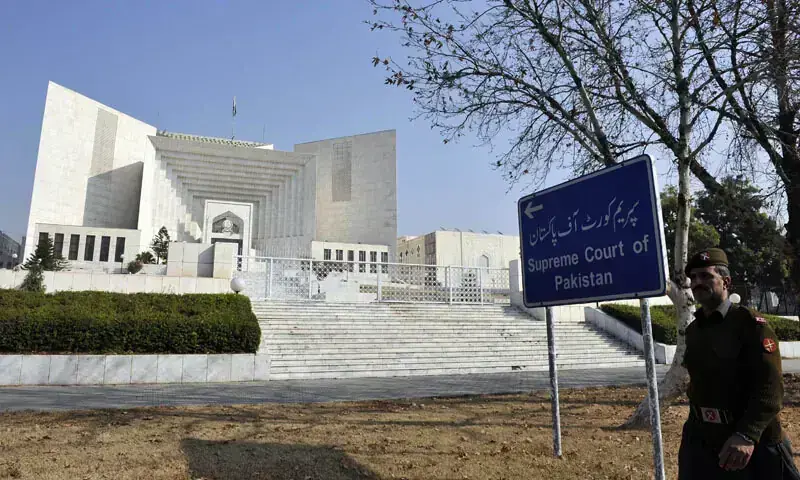
The Federal Constitutional Court (FCC) on Monday observed that an employee cannot be penalised or deprived of a benefit otherwise lawfully available to him on account of an event or administrative delay that was wholly beyond his control.
asserted
that → observe → control
“Therefore, respondent (Dr Munir Ahmad Malik) cannot be made to suffer merely because the Selection Board did not convene or accord its approval during the period of his posting as Project Director, Punjab AIDS Control Programme (PACP),” observed the FCC while rejecting an appeal filed by the Punjab government against the Jan 10, 2025 Lahore High Court (LHC) order.
asserted
FCC → make → order
Earlier, the Supreme Court had also issued a similar directive, stating that employees cannot be made to suffer due to administrative or bureaucratic delays, inefficiencies, systemic delays, or in-house oversights or inadvertences of departments, as recognised under service laws jurisprudence.
asserted
employees → issue → jurisprudence
A three-judge FCC bench, headed by Justice Aamer Farooq and comprising Justice Muhammad Karim Khan Agha and Justice Syed Arshad Hussain Shah, upheld the LHC judgement and directed the payment of a Rs150,000 monthly incentive allowance to Dr Munir Malik, the former PACP project director, whose application for the allowance had earlier been declined.
asserted
application → head → allowance
FCC rejects Punjab govt’s appeal against LHC verdict; upholds Rs150,000 monthly allowance for ex-PACP official
The dispute arose after Dr Malik was appointed as the PACP project director, with effect from July 15, 2019.
asserted
Malik → reject → July
Through a Dec 31, 2019 notification, the Punjab government had sanctioned an incentive allowance for in-service regular government servants posted in projects, programmes and authorities, subject to approval by the Selection Board.
asserted
government → sanction → Board
Dr Malik applied for the allowance, but his application was declined by the then PACP project director on April 19, 2021, primarily on the grounds that the allowance could not be granted retrospectively.
uncertain
allowance → apply → grounds
The department argued that the Selection Board had approved the allowance on March 19, 2021, after Dr Malik had already been transferred from the post on Feb 22, 2021.
asserted
Malik → argue → Feb
The respondent challenged the denial before the LHC, which allowed the petition, prompting the Punjab government to appeal before the FCC.
asserted
which → challenge → FCC
The provincial government argued that the incentive allowance was not an automatic right and was conditional upon approval by the Selection Board, which came after Dr Malik’s transfer.
asserted
which → argue → transfer
Authored by Justice Arshad Hussain Shah, the judgement observed that the case involved questions concerning the legality and validity of the action and its conformity with the applicable statutory framework.
asserted
case → author → framework
It stated that convening the Selection Board meeting and the timing of its decision were matters exclusively within the domain and control of the competent departmental authorities.
asserted
convening → state → authorities
To uphold the department’s decisions would mean permitting the authorities to take advantage of their own wrong, omission or delay and would result in manifest injustice to the employee, the verdict said.
asserted
verdict → uphold → employee
The FCC also cited its 2022 judgement in the Khyber Pakhtunkhwa Police Service Commission case, in which it was held that “where the employee was otherwise entitled and the denial, delay or deferment of the service benefit occurs not because of any fault on his part but because of departmental omission, inaction, error or illegality, the department cannot be allowed to gain a legal advantage upon its own wrong, nor can the employee be made to suffer the continuing prejudice of that wrong”.
asserted
employee → cite → wrong
“In view of the foregoing discussion, the irresistible conclusion is that the LHC judgement is based on a proper appreciation of the facts and the applicable law and does not suffer from any illegality, infirmity, misreading or non-reading of record, or jurisdictional defect warranting interference,” the FCC observed.
asserted
FCC → forego → interference
Consequently, no ground was made out for the exercise of the FCC’s jurisdiction to disturb the well-reasoned findings recorded by the LHC.
asserted
ground → make → LHC
While concluding, the FCC said it did not find any merit in the present case and therefore dismissed the appeal accordingly.
asserted
it → conclude → appeal
 The Aporia