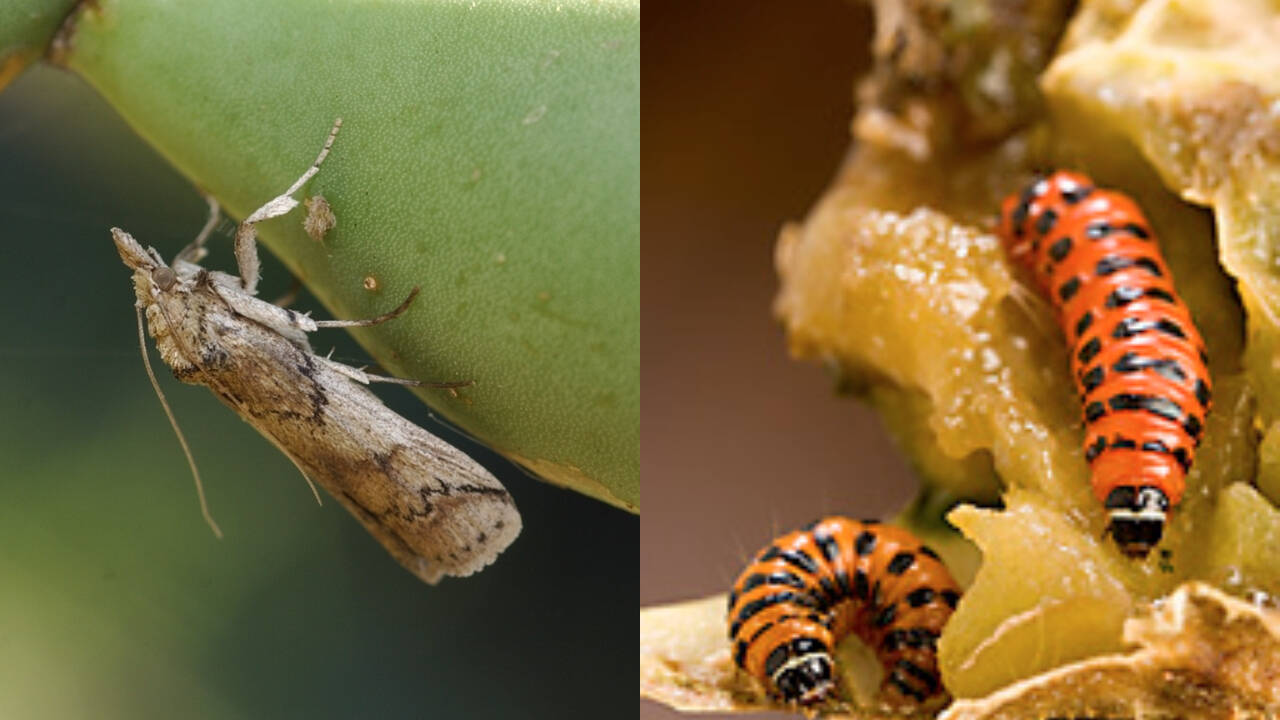
Photo via Times of India

South American moth brought to fight prickly pear now threatens native U.S. cacti

Read the original at Times of India ↗
Cite

TOI Science Desk. (2026, September 22). South American moth brought to fight prickly pear now threatens native U.S. cacti. Times of India. https://timesofindia.indiatimes.com/science/wildlife/in-1957-a-south-american-moth-was-released-in-the-caribbean-to-control-prickly-pear-by-1989-it-had-reached-florida-and-was-attacking-native-and-endangered-cacti/articleshow/134407150.cms

Dated when The Aporia collected the article, usually within hours of publication. Check the original for its exact date and byline.

Times of India · collected 2026-09-22 · by TOI Science Desk

Quick Summary

The South American cactus moth, initially introduced to control invasive prickly pear in Australia and later in the Caribbean, has become a threat to native U.S. cacti since its arrival in Florida in 1989. Researchers at the USDA’s Agricultural Research Service are using a sterile insect technique to combat this issue by releasing sterilized male moths that mate with wild females but produce infertile offspring, aiming to reduce moth populations over time.
Written by AI on 2026-09-22, from this article's own text only (the story summary below draws on all the coverage).

AI analysis

Story summary

In the 1950s, USDA scientists introduced the South American cactus moth in Australia to combat an invasive prickly pear problem. Later, the moth was brought to the Caribbean, specifically Nevis in 1957, at local government request. The goal was to control invasive prickly pear there too. However, the moth has since spread uncontrolled across Florida and into native cactus populations in both the southern United States and Mexico, becoming a new ecological threat. Now, USDA's Agricultural Research Service (ARS) is trying to contain it using biological controls that target the moth’s reproductive cycle.

Written for “Invasive Moth Threatens Cacti” on 2026-10-31, grounded in this article and the 0 other(s) covering the same event.

Story

📰 Invasive Moth Threatens Cacti
Environment · 1 article(s) covering the same event.

Compared with similar articles

Nothing to compare against. No article is close enough to this one for the pipeline to have linked or judged the pair.
How this article was measured signals, leaning charts, publisher record, byline, topics and claims

Signals How these are calculated →

Claims extracted
31
sentences that state something as happening or true
Uncertain
10%
3 of 31 hedged ("reportedly", "may", "according to")
Leaning
not political
takes no side on a contested political question
Publisher signals
59/100
Times of India's corrections and hedging, across everything collected from it. Not a measure of accuracy.
Outlets on this story
1
Environment
Same framing elsewhere
1
articles that frame the event the way this one does
Analyzed 2026-09-22 · how these are computed

How this is being covered How these are calculated →

Article leaning vs. publisher reliability
Source leaning vs. consistency

Publisher

Times of India · 3764 article(s) · 2 correction(s) detected
Running correction rate · 2 correction(s)

Who wrote this

TOI Science Desk
295 article(s) here · 0 carrying a prediction
🔮 She explored whether an inexpensive device could capture airborne genetic material and support the detection of bacterial pathogens.
🔮 This control may help it maintain its orientation and move along a narrow path without losing its bearings.
🔮 The university says the sculpture will subsequently go on permanent display at its Turner Museum of Glass.
🔮 By bringing together nature, wellness facilities and educational spaces, Winter Garden aimed to create a setting where visitors could exercise, learn about nutrition and gardening, and spend time outdoors.
🔮 Also discovered was a 4,500-year-old humanoid idol, which archaeologists hope will help shed light on the cultural traditions of the region.
🔮 When garlic mustard spreads across the forest floor, other plants may struggle to obtain the resources they need to survive.
🔮 The train delay that could not have happened in 1841 The mystery originated in an account published anonymously in the scientific journal Nature on October 5, 1871.
🔮 A late-night snack may do more than add extra calories to your day.
🔮 The work offers a glimpse of such a future, where living organisms could become an active part of the robotic systems.
🔮 A centuries-old archaeological puzzle at Westminster Abbey in London may finally be nearing a resolution, with new research suggesting that a skeleton discovered inside a Roman stone coffin belonged to a medieval abbot rather than the Roman-era man named on its inscription.
Wire or desk byline, not an individual reporter.
Also by TOI Science Desk
Nothing else under this byline is closely related to this article, so these are simply their most recent.
All 295 articles by TOI Science Desk →

Topics

ARS Georgia Mexico South American USDA

Subjects

Florida GPE · 4× ARS ORG · 3× Dauphin Island GPE · 3× South American NORP · 3× USDA ORG · 3× Georgia GPE · 2× Mexico GPE · 2× Okaloosa Island GPE · 2× St. George Island GPE · 2× United States GPE · 1×

Narrative

Now, researchers with the U.S. Department of Agriculture's Agricultural Research Service are working to stop its advance using a biological control method that turns the moth's own reproductive cycle against it.
framing: assertive · carried by 1 article(s) · first seen 2026-09-22

Claims (31 extracted, 3 hedged)

A pest once deliberately moved around the world to solve an agricultural problem has become a problem of its own. asserted
moved → move → own
According to a report by the USDA’s principal scientific research agency ARS, the South American cactus moth was introduced to the Caribbean decades ago to control invasive prickly pear. uncertain
moth → accord → pear
After reaching Florida, it began spreading through the very cactus populations native to the southern United States and Mexico. asserted
it → reach → States
Now, researchers with the U.S. Department of Agriculture's Agricultural Research Service are working to stop its advance using a biological control method that turns the moth's own reproductive cycle against it. asserted
that → work → it
According to the report, the story began with prickly pear, a cactus considered an invasive agricultural pest in Australia during the 19th century. uncertain
story → accord → century
The South American cactus moth was introduced there as a biological control agent, helping reduce the spread of the unwanted plants. asserted
moth → introduce → plants
The same strategy was later used in the Caribbean. asserted
strategy → use → Caribbean
In 1957, the moth was deliberately introduced to Nevis at the request of the local government to control invasive prickly pear. asserted
moth → introduce → pear
The moth subsequently spread to neighboring islands and eventually reached the Florida Keys in 1989. asserted
moth → spread → 1989
From there, it expanded along sections of the Atlantic and Gulf coasts. asserted
it → expand → coasts
What had once been a useful tool for controlling prickly pear in places where the plant was invasive was now encountering native cactus populations. asserted
plant → control → populations
A threat to native cactus According to scientists, the South American cactus moth primarily attacks Opuntia species, commonly known as prickly pear cactus. uncertain
moth → accord → cactus
It can also occasionally affect Nopalea, Cylindropuntia and Consolea species. asserted
It → affect → species
The damage begins when female moths lay their eggs on the cactus. asserted
moths → begin → cactus
After hatching, the larvae feed together, boring into cactus pads and tunneling through their interiors. asserted
larvae → hatch → interiors
As the larvae hollow out the pads, the affected sections can eventually die, weakening or killing the plant. asserted
sections → hollow → plant
Prickly pear has ecological value beyond its appearance. asserted
pear → have → appearance
The cacti provide habitat for wildlife and nesting animals, while their root systems can help limit erosion and their dense growth can provide wind protection. asserted
growth → provide → protection
Some species are also cultivated as specialty food crops in the United States and Mexico. asserted
species → cultivate → States
Turning sterile moths into a control tool Researchers are now fighting the invasive moth with a technique known as the sterile insect technique, or SIT. asserted
Researchers → turn → technique
Entomologist James Carpenter of the ARS Crop Protection and Management Research Unit in Tifton, Georgia, is working with colleagues to mass-produce the moth on an artificial diet. asserted
Carpenter → work → diet
Male moths are then exposed to radiation that makes them sterile before being released into areas containing wild populations. asserted
them → expose → populations
The sterile males can still mate with wild females, but the resulting offspring are unable to reproduce. asserted
offspring → mate → females
Over time, repeated releases can reduce the number of fertile insects in the population. asserted
releases → repeat → population
The work involves researchers from ARS facilities in Georgia and Florida, other USDA agencies and Florida A&M University. asserted
work → involve → Georgia
Testing the strategy in the field The research team is evaluating the approach at three locations: Dauphin Island in Alabama, Okaloosa Island in Florida and St. George Island in Florida. asserted
team → test → Florida
Each site is being managed differently to help researchers measure the effects of the treatment. asserted
researchers → manage → treatment
Dauphin Island is receiving sterile moths alongside a sanitation program, while Okaloosa Island is undergoing sanitation alone. asserted
Island → receive → sanitation
St. George Island serves as an untreated comparison site. asserted
Island → serve → site
Sanitation involves finding and removing cactus pads containing moth larvae or pupae, as well as eliminating egg sticks. asserted
Sanitation → involve → sticks
On Dauphin Island, combining sanitation with sterile insect releases has already reduced the cactus moth population to levels that are nearly undetectable, concludes the online report. asserted
report → combine → levels

💬Give feedback
🕘History 🎫Support