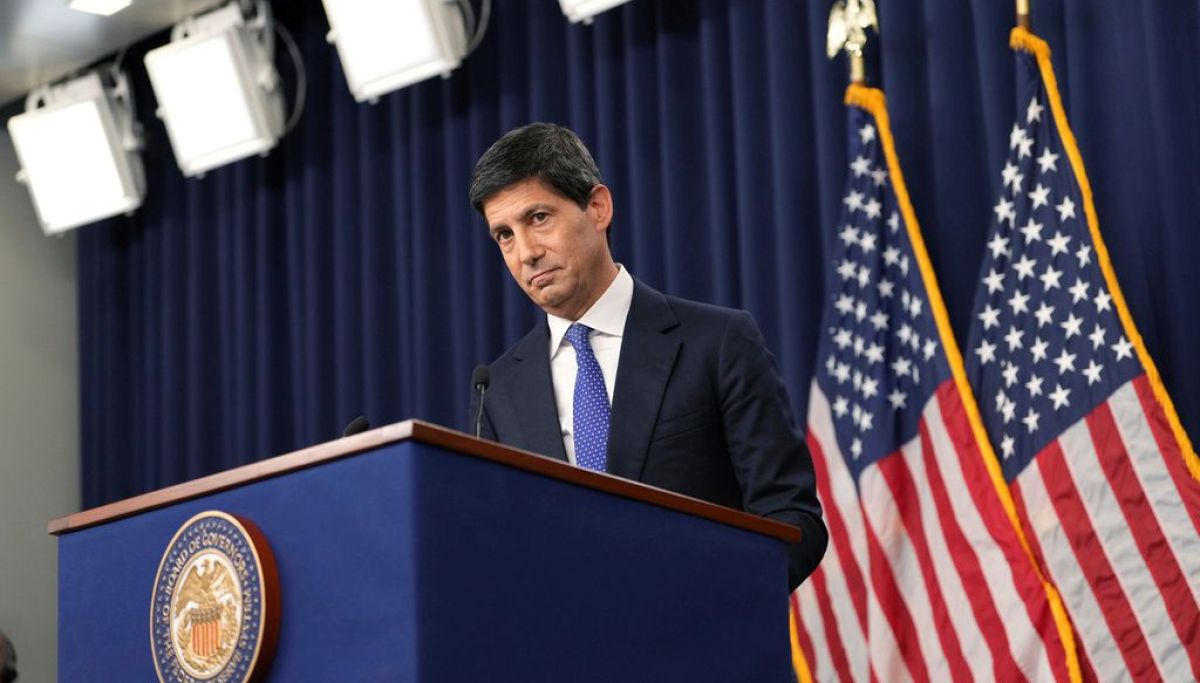
Photo via Washington Examiner

Fed projects era of too-high inflation to last better part of a decade

Read the original at Washington Examiner ↗
Cite

Halaschak, Z. (2026, September 22). Fed projects era of too-high inflation to last better part of a decade. Washington Examiner. https://www.washingtonexaminer.com/policy/finance-and-economy/4736650/fed-too-high-inflation-last-better-part-decade/

Dated when The Aporia collected the article, usually within hours of publication. Check the original for its exact date and byline.

Washington Examiner · collected 2026-09-22 · by Zach Halaschak

Quick Summary

Federal Reserve officials project that inflation will remain above their 2% target until 2029, marking nearly a decade of high prices. At their September meeting, they revised expectations to show headline inflation dropping to 2.3% by the end of next year from its current level of 3.7%. This delay in achieving stable inflation rates is attributed to earlier misjudgments about inflation's transitory nature and subsequent entrenchment, making it a significant political issue affecting elections.
Written by AI on 2026-09-22, from this article's own text only (the story summary below draws on all the coverage).

AI analysis

Story summary

Federal Reserve officials announced in their September meeting that they do not expect inflation to return to their target rate of 2% until 2029, marking nearly a decade of above-target price growth. The Fed's "Summary of Economic Projections" indicates inflation will remain at around 3.7%, currently, and drop slightly to 2.3% by the end of next year before reaching the 2% target in 2029. Johnny Taylor, CEO of Society for Human Resource Management, noted that while today's workforce has never experienced such high inflation, they also haven't seen a period this long without major economic downturns. This extended period of elevated prices poses significant challenges for consumers and businesses alike.

Written for “Inflation Forecast Extended” on 2026-11-02, grounded in this article and the 0 other(s) covering the same event.

Story

📰 Inflation Forecast Extended
Economy/Business · 1 article(s) covering the same event.

Compared with similar articles

This article reads unscored and hedges 19% of its claims. Each row says how that neighbour differs.
CBS News
⚖️ Leans right Hedges 3 of 29 claims Outlet record 66/100
“The articles discuss related events involving the Federal Reserve but describe different aspects: Article A focuses on a rate hike decision and its immediate market impact, while Article B discusses long-term inflation projections made at a later meeting.”
Toronto Star
⚖️ Leans left Hedges 1 of 32 claims Outlet record 64/100
“The articles discuss different aspects of the Federal Reserve's activities and projections, not the same specific event.”
The Guardian
⚖️ Leans left Hedges 4 of 35 claims Outlet record 66/100
“The articles discuss related topics but describe different aspects and timeframes of Fed meetings.”
How this article was measured signals, leaning charts, publisher record, byline, topics and claims

Signals How these are calculated →

Claims extracted
43
sentences that state something as happening or true
Uncertain
19%
8 of 43 hedged ("reportedly", "may", "according to")
Leaning
withheld
no quote in the article backed the model's score
Publisher signals
70/100
Washington Examiner's corrections and hedging, across everything collected from it. Not a measure of accuracy.
Outlets on this story
1
Economy/Business
Same framing elsewhere
1
articles that frame the event the way this one does
Analyzed 2026-09-22 · how these are computed

How this is being covered How these are calculated →

Article leaning vs. publisher reliability
Source leaning vs. consistency

Publisher

Washington Examiner · 3903 article(s) · 7 correction(s) detected
Running correction rate · 7 correction(s)

Who wrote this

Zach Halaschak
20 article(s) here · 1 carrying a prediction
🔮 While they are unlikely able to get Trump to sign bills undoing his own agenda, they could force Republicans to take difficult votes on the tariffs, from which they have been shielded thus far by GOP leadership.
🔮 The Federal Reserve voted to hold its interest rate target steady, a decision that investors mostly anticipated, but that nonetheless had markets on edge because of the off-chance that the central bank could hike rates just before the midterm elections in light of the high rate of inflation.
🔮 Republicans had hoped that the passage of new tax cuts would buoy them in the midterm elections, but their ability to campaign on their signature legislation has been diminished by the war with Iran and high gas prices.
🔮 Voters in Florida, Oklahoma, North Carolina, Wyoming, and other states will all vote on ballot measures in the midterm elections that would lower property tax burdens for homeowners.
🔮 “They cooled off in 2024, and now in 2025 and 2026, food price inflation has overall been about normal, about what we would expect for year-over-year inflation,” Volpe said, noting that despite that, there have been “pain points” for specific food items.
🔮 The report is clearly bad news for the Trump administration, which has been working to reassure voters weary of price hikes, especially given that the November election will determine if Republicans hold the House of Representatives and the Senate.
🔮 A White House memo said the group will look into whether Cook made “false statements in connection with one or more mortgage instruments” and will conduct an in-person hearing in November.
🔮 The Federal Reserve will not publicly disclose communications between its chairman and President Donald Trump unless they are scheduled telephone calls or meetings.
🔮 On one hand, they might price out some potential buyers who may be waiting until they come down some before they buy.
Also by Zach Halaschak
Nothing else under this byline is closely related to this article, so these are simply their most recent.
All 20 articles by Zach Halaschak →

Topics

Democrats Fed Federal Reserve the Cato Institute the Washington Examiner

Subjects

Fed ORG · 7× Kedia PERSON · 3× Democrats NORP · 1× Donald Trump PERSON · 1× Federal Reserve ORG · 1× Jai Kedia PERSON · 1× Jerome Powell PERSON · 1× Joe Biden PERSON · 1× the Cato Institute ORG · 1× the Washington Examiner ORG · 1×

Narrative

Still, Johnny Taylor, the CEO of Society for Human Resource Management, the world’s largest HR association, pointed out during a Monday interview that while a “generation or two” has never experienced inflation like this, they also haven’t experienced such a long period of economic expansion.
framing: assertive · carried by 1 article(s) · first seen 2026-09-22
🔮 Federal Reserve officials revealed at their meeting last week that they don’t think inflation will come back down to normal until 2029.
2026-09-22 · Washington Examiner
Fed projects era of too-high inflation to last better part of a decade · assertive framing

Claims (43 extracted, 8 hedged)

Federal Reserve officials revealed at their meeting last week that they don’t think inflation will come back down to normal until 2029. asserted
inflation → reveal → 2029
The Fed considers 2% inflation to be healthy, and inflation hasn’t been that low since February 2021. asserted
inflation → consider → February
For years now, central bank officials have expressed confidence that they could return inflation to that target, but now, officials think that goal won’t even be reached until 2029, which would mark nearly a decade of unhealthy price growth. uncertain
which → express → growth
At every other meeting, the Fed releases what is known as its “Summary of Economic Projections,” which gives insight into where officials think key macroeconomic indicators like inflation, interest rates, and economic growth will be in the coming years. asserted
indicators → release → years
At the Fed’s September meeting, participants pushed back the timeline for 2% inflation again. asserted
participants → push → inflation
Now, they see headline inflation falling to 2% in 2029, while running slightly above that in 2028. asserted
inflation → see → 2028
The Fed sees inflation falling to 2.3% by the end of next year. asserted
inflation → see → year
For reference, the Fed’s preferred gauge has inflation currently running at 3.7%. asserted
inflation → prefer → %
And the long runway for getting inflation back to normal is also notable given that, for a massive chunk of the population, this is the first time that inflation has been a major economic concern. asserted
inflation → get → population
Too-high inflation in the 1970s and 1980s also took years to vanquish. asserted
inflation → take → years
Inflation first took off in early 2021, with then-Fed Chairman Jerome Powell notoriously referring to the matter as a “transitory” one. asserted
Powell → take → one
Many thought inflation would soon settle back down, but it did not, and the Fed’s response to it has been panned in retrospect. asserted
response → think → retrospect
“I think again that era of monetary policy between 2020 and 2025 is really going to go down in textbooks as the textbook way on how not to deal with inflation,” Jai Kedia, an economist at the Cato Institute, told the Washington Examiner. asserted
Kedia → think → Examiner
“Specifically because of this reason — is that once it’s entrenched, you know it’s very, very hard to bring it back down,” Kedia added. asserted
Kedia → entrench → it
And it became quite entrenched as the years went on, becoming one of the most pressing issues facing the public. asserted
years → become → public
Many attribute high inflation under then-President Joe Biden as the chief reason that President Donald Trump got elected in 2024, and some surmise its continued staying power might be a key reason that Democrats win one or both chambers of Congress in the 2026 midterm elections. uncertain
Democrats → attribute → elections
Headline inflation had moved lower initially during Trump’s second term, but then reignited after the war with Iran began. asserted
war → move → Iran
That wave of inflation, which the country is still grappling with, has been driven largely by a spike in energy prices. asserted
country → grapple → prices
And, as Kedia pointed out, inflation expectations have become rooted in consumer thinking. asserted
expectations → point → thinking
For instance, year-ahead inflation expectations jumped from 4% last month to 4.6% in September, according to a preliminary reading of the University of Michigan’s consumer sentiment index for August. uncertain
expectations → jump → August
That is the highest level since June, and shows most consumers think inflation might get worse a year from now. uncertain
inflation → show → June
The whole economy, and how it is perceived by consumers, has been shaded by these years of high inflation. asserted
it → perceive → inflation
“People have really changed their expectations,” Kedia said. asserted
Kedia → change → expectations
“They now view high inflation as much more likely than they did before the pandemic. asserted
they → view → pandemic
Most Americans have never lived through a sustained period of inflation, short of those people that have very vivid recollections of the 70s and 80s. asserted
that → live → 70s
Some economists also fear that such sentiment could turn out to be self-fulfilling. uncertain
sentiment → fear → ?
If people expect that inflation is going to get worse, they could start acting and spending differently than they would have otherwise, which could exacerbate problems. uncertain
which → expect → problems
Still, Johnny Taylor, the CEO of Society for Human Resource Management, the world’s largest HR association, pointed out during a Monday interview that while a “generation or two” has never experienced inflation like this, they also haven’t experienced such a long period of economic expansion. asserted
they → point → expansion
He pointed out that the last major economic downturn, setting aside the pandemic disruptions, was the 2008 recession. asserted
downturn → point → disruptions
“Call it 2008, 2009, pick a date to ’26,” Taylor told the Washington Examiner. asserted
Taylor → pick → Examiner
“That’s 17 years of an up economy.” asserted
That → ’ → economy
Taylor said he thinks the Fed officials could be correct in that it might take a few more years for inflation to return back to healthy levels. uncertain
inflation → say → levels
“I have a lot of trust in the Fed,” Taylor said. asserted
Taylor → have → Fed
“I think there’s enough diversity of opinion, geographic diversity, other forms of diversity, political diversity, that they’re going to get it right, and they’re doing what they need to do now. asserted
they → think → what
That may cost you a little bit now to tame the economy and make sure that we do get to that 2% 2029 goal. uncertain
we → cost → goal
For that reason, new Fed Chairman Kevin Warsh has been highly critical of such forward guidance and has been pushing for reform in that area of central bank policy. asserted
Warsh → push → policy
Forward guidance became routine starting after the 2008 financial crisis. asserted
guidance → become → crisis
Kedia said the Fed board gives the public “absolutely no clarity” on how they make such projections on inflation or unemployment. asserted
they → say → inflation
“But on the on the narrow question of the 2029 target to bring inflation back down, I think that’s pretty reasonable because it’s been elevated for so long,” Kedia said. asserted
Kedia → bring → inflation
“I don’t see any reason why it would come down within the next couple of years.” asserted
it → see → years
…and 3 more, not listed.

💬Give feedback
🕘History 🎫Support