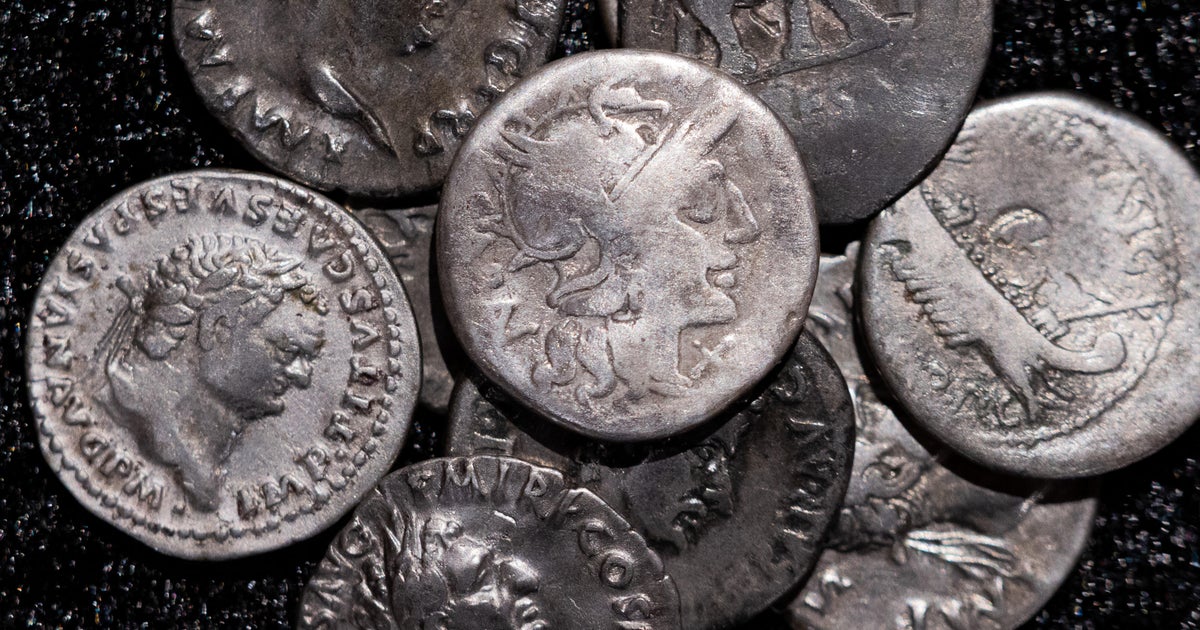
Photo via CBS News

Metal detectorist finds record-breaking trove of ancient Roman coins

Read the original at CBS News ↗
Cite

Metal detectorist finds record-breaking trove of ancient Roman coins. (2026, September 22). CBS News. https://www.cbsnews.com/news/ancient-roman-silver-coins-found-metal-detectorist-germany/

Dated when The Aporia collected the article, usually within hours of publication. Check the original for its exact date and byline.

CBS News · collected 2026-09-22

Quick Summary

Oliver Riedl, an amateur archaeologist using a metal detector near Wesseling south of Cologne, discovered 934 Roman silver denarii coins weighing 3.1 kilograms. This trove is the largest from Emperor Hadrian's time ever found in Germany and includes coins dating back to 148 B.C., with most from the Flavian emperors (A.D. 69–96). Experts believe the coins, likely buried around A.D. 120-150 for safekeeping, represent about six years of a Roman legionary's income.
Written by AI on 2026-09-22, from this article's own text only (the story summary below draws on all the coverage).

AI analysis

Story summary

An amateur archaeologist named Oliver Riedl discovered 934 Roman silver denarii in a field near Wesseling, south of Cologne, Germany, last year. His metal detector kept beeping even after he found several coins initially, indicating there was more buried treasure nearby. Experts were called to the site and uncovered a trove weighing 3.1 kilograms (6.8 pounds) — the largest Roman coin hoard ever found in Germany from Hadrian's time. The collection dates primarily from the Flavian emperors' reigns (A.D. 69–96) but includes coins as old as A.D. 148, with an estimated value equivalent to about a year’s salary for a Roman legionary soldier at that time. On display now at the LVR-LandesMuseum Bonn, experts believe the treasure was deliberately buried in the second quarter of the second century AD for safekeeping due to the absence of banks back then.

Written for “Ancient Roman Coin Find” on 2026-11-03, grounded in this article and the 1 other(s) covering the same event.

Story

📰 Ancient Roman Coin Find
Other · 2 article(s) covering the same event. See how they differ ↓

Compared with similar articles

This article reads unscored and hedges 14% of its claims. Each row says how that neighbour differs.
The Guardian
Hedges 3 of 15 claims Outlet record 66/100
How this article was measured signals, leaning charts, publisher record, byline, topics and claims

Signals How these are calculated →

Claims extracted
21
sentences that state something as happening or true
Uncertain
14%
3 of 21 hedged ("reportedly", "may", "according to")
Leaning
not political
takes no side on a contested political question
Publisher signals
66/100
CBS News's corrections and hedging, across everything collected from it. Not a measure of accuracy.
Outlets on this story
2
Other
Same framing elsewhere
1
articles that frame the event the way this one does
Analyzed 2026-09-22 · how these are computed

How this is being covered How these are calculated →

Article leaning vs. publisher reliability
Source leaning vs. consistency

Publisher

CBS News · 4465 article(s) · 6 correction(s) detected
Running correction rate · 6 correction(s)

Who wrote this

No reporter is named on this article.

Topics

Cologne Germany Roman Wesseling the LVR-LandesMuseum Bonn

Subjects

Roman NORP · 7× Cologne GPE · 3× Wesseling GPE · 3× Germany GPE · 2× Hadrian PERSON · 1× Office for the Preservation of Archaeological Monuments in the Rhineland ORG · 1× Oliver Riedl PERSON · 1× Riedl PERSON · 1× the LVR ORG · 1× the LVR-LandesMuseum Bonn ORG · 1×

Narrative

The Romans established a presence in the region under General Marcus Vipsanius Agrippa to secure their empire's border along the Rhine River, setting up a military outpost which later became Colonia Agrippina - today's Cologne.
framing: assertive · carried by 1 article(s) · first seen 2026-09-22
🔮 Classen said it wasn't clear why the treasure was never recovered before, adding that "perhaps the owner died before that could happen, without being able to pass on the knowledge about the coins.
2026-09-22 · CBS News
Metal detectorist finds record-breaking trove of ancient Roman coins · assertive framing

Claims (21 extracted, 3 hedged)

An amateur archaeologist who discovered several Roman silver coins in a field in western Germany realized he had stumbled upon something bigger when his metal detector kept beeping. asserted
detector → discover → something
Oliver Riedl called the authorities for help, and a group of experts who began digging immediately discovered a total of 934 Roman silver denarii. asserted
who → call → denarii
It is the biggest coin treasure ever found in Germany from the time of Roman Emperor Hadrian, the local office in charge of archaeological monuments said Tuesday. asserted
office → find → monuments
"It was clear to me that there was something bigger buried here," Riedl said, describing how his metal detector continued signaling even after he had found several coins near Wesseling, south of Cologne a year ago. asserted
he → be → Cologne
The hoard of coins, which weighs 3.1 kilograms (6.8 pounds), went on display at the LVR-LandesMuseum Bonn on Tuesday. asserted
which → weigh → Tuesday
The majority of the coins date from the time of the Flavian emperors (A.D. 69–96), and the oldest one was minted in 148 B.C., the museum said in a news release. asserted
museum → date → release
The collection of coins was probably buried deliberately in the second quarter of the second century A.D., according to the LVR Office for the Preservation of Archaeological Monuments in the Rhineland. uncertain
collection → bury → Rhineland
"Of course, we can only speculate about the motives, but it's very likely that someone wanted to keep this money safe. asserted
someone → speculate → money
After all, banks didn't exist back then," Erich Classen, state archaeologist and the director of the office, said in a statement. asserted
Classen → exist → statement
Classen said it wasn't clear why the treasure was never recovered before, adding that "perhaps the owner died before that could happen, without being able to pass on the knowledge about the coins. uncertain
that → say → coins
However, few from the second century are as extensive as the one found in Wesseling, the archaeological office said, adding that it was difficult to estimate the coins' value at the time. asserted
it → find → time
However, the pay of Roman legionaries, which is well documented in written sources, provides a point of reference. asserted
which → document → reference
"At that time, an ordinary soldier in the legion earned 300 denarii a year. asserted
soldier → earn → denarii
However, about half of that was withheld for food and equipment," said Rahel Otte, a research associate at the archaeological office. asserted
Otte → withhold → office
"A legionary would therefore have had to save all of his disposable income for about six years to amass the Wesseling hoard," Otte said. asserted
Otte → have → hoard
She added that it remains unclear exactly who ultimately amassed this considerable fortune. uncertain
who → add → fortune
The Romans established a presence in the region under General Marcus Vipsanius Agrippa to secure their empire's border along the Rhine River, setting up a military outpost which later became Colonia Agrippina - today's Cologne. asserted
which → establish → outpost
Treasures from the Roman era have been found across Europe in recent years. asserted
Treasures → find → years
In February, found two lead ingots that date back to the Roman era, the first of their kind to be found in the region. asserted
that → find → region
In 2024, a worth over $125,000 was found during a construction project in central England. asserted
worth → find → England
Also in 2024, a collection of ancient silver Roman coins was on a small island in the Mediterranean Sea, officials said this week. asserted
officials → say → Sea

💬Give feedback
🕘History 🎫Support