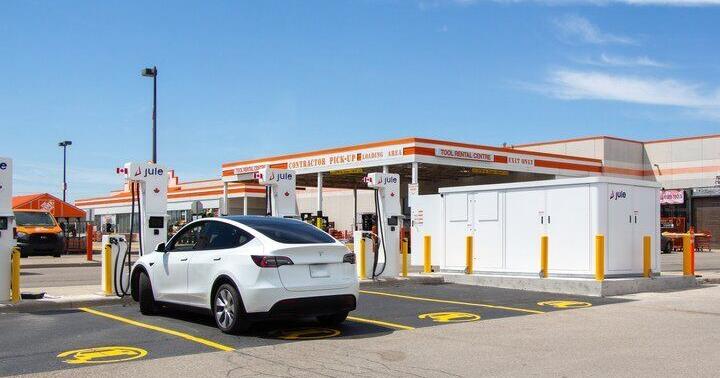
When Monsoon Fu talks about what gas stations can teach us about the finicky business of EV charging, he focuses on something that typically goes unseen.
asserted
that → talk → something
“At any station, no one’s taking gas out of a pipeline,” observes the director of product and innovation for the Toronto fast-charging firm Jule Power.
asserted
director → take → firm
That buried structure offers a key insight into Jule’s strategy for cutting the time it takes to charge an EV from an hour (as is the case with many public chargers) to 15 or 20 minutes.
asserted
it → offer → minutes
The company tethers a large-format battery to its Level 3 EV charging stations — a pairing that allows it to provide rapid service without unduly stressing the local electrical grid.
asserted
it → tether → grid
Jule’s large-format battery stores energy drawn from the local utility, which EV drivers can then access if their timeline doesn’t accommodate waiting around for a Level 2 charger, which dispatches energy at a more leisurely pace.
asserted
which → store → pace
The firm’s growing network of large-format batteries, in turn, doubles as a source of inexpensive decentralized power, available to the companies that lease its systems.
asserted
that → grow → systems
With the increased use of AI and ongoing electrification, demand for electricity is set to skyrocket.
asserted
demand → increase → electricity
(The IESO estimates demand in Ontario could increase by up to 60 per cent by 2050.)
uncertain
demand → estimate → 2050
Decentralized power sources, such as large-scale batteries configured to draw power during low-demand (and thus low-cost) periods could help municipalities add capacity to the local electrical grid while deferring expensive infrastructure upgrades.
uncertain
municipalities → configure → upgrades
And Jule’s made-in-Canada technology, developed with the aim of strengthening local grids and safeguarding Canadian data addresses another key stressor facing the country in this power-hungry age: domestic sovereignty.
asserted
technology → make → age
Amping up the charging industry
Despite the phasing out of various provincial and federal inducements, EV sales in Canada for 2026 exceeded 92,000 vehicles between February and June, up sharply from about 65,000 from the year previous, according to StatCan data.
uncertain
sales → ampe → data
The latest figures indicate that EVs now account for about one in nine new vehicles sold in Canada.
asserted
EVs → indicate → Canada
As gas prices continue to soar, the window to accelerate the electrification of Canada’s passenger vehicle market is wide open.
asserted
window → continue → market
Fully seizing that opportunity will require making improvements to charging infrastructure, particularly when it comes to issues such as outages, accessibility and extended charging times, all of which can deter consumers from embracing this technology.
asserted
all → seize → technology
Owners who live in houses with driveways and sufficient electrical power can slowly charge their vehicles overnight.
asserted
who → live → vehicles
But the same isn’t true for people whose homes don’t have driveways or those who live in apartment buildings without charge points in the parking garage.
asserted
who → have → garage
Range anxiety may prevent ride-share operators and taxi drivers from considering EVs, even if they recognize the financial and environmental benefits.
uncertain
they → prevent → benefits
Although the range of EV batteries continues to increase, refuelling on a long drive may still not be all that straightforward: not every public charger provides fast charging, which can mean lengthy delays.
uncertain
which → continue → delays
“There’s a broad industry consensus that integration of storage can be a hugely effective tool,” says Travis Allan, president and CEO of the Canadian Charging Infrastructure Council, the industry body that represents the various EV charging networks operating in Canada.
asserted
that → ’ → Canada
Such pairings, he adds, are well suited to remote communities that have less energy capacity in their local grids, as well as regions where electricity rates spike during periods of high demand — a conservation policy
asserted
rates → add → demand
that can “ruin the economics of your charging station
asserted
that → ruin → station
As of March 2026, Canada had almost 40,000 public charging ports in 14,743 locations, with most of the year-over-year growth coming from new fast-charger (Level 3) installations, especially in B.C. and Quebec, according to NRCan data.
uncertain
most → have → data
(The market leaders are Tesla, Flo and Hypercharge, while some gas retailers, such as Shell, Petro-Canada and Circle K, are actively building their own networks.
asserted
retailers → build → networks
However, where fast chargers place enormous stress on the local utility (as well as the vehicle battery), Jule’s systems reduce grid surges.
asserted
systems → place → surges
As Fu says, “We don’t want to disturb the grid by connecting one charger that’s equivalent to around 30 to 50 houses turning on most of their load at one time.”
asserted
houses → say → time
Leveraging battery storage
For Jule, battery storage was the entry point to this market.
asserted
storage → leverage → market
In 2009, former General Motors manager Carmine Pizzurro founded the company, then called eCamion, to develop battery storage and software solutions.
asserted
Pizzurro → found → storage
In response to demands from utility clients, it then shifted to developing larger-format grid storage batteries that could be used to hold some power in reserve for peak demand periods.
uncertain
that → shift → periods
“Back then there was almost no technology on the market,” says Fu.
asserted
Fu → be → market
However, he adds, utilities tend to move slowly, so in 2018, the company turned toward the more dynamic EV charging sector.
asserted
company → add → sector
Jule established funding and research partnerships with The Atmospheric Fund, MaRS and the University of Toronto to develop a product that married its battery storage units to fast chargers with a novel direct current (DC) connection that minimizes energy loss.
asserted
that → establish → loss
That involved solving a technical challenge: they needed to develop a way of maintaining a safe internal temperature for the battery storage module, which has to rapidly dispatch a large quantity of power into an EV — a transfer that generates heat and friction within the vehicle’s battery.
asserted
that → involve → battery
“The technology has improved significantly over the past 10 years, but the potential occurrence of a fire in a battery system is always there because the electrolyte that is in the battery is very volatile,” says Carlos Da Silva, a PhD mechanical engineer who heads U of T’s Electrification Hub and has worked with Jule on its batteries.
asserted
who → improve → batteries
To mitigate that risk, Da Silva’s researchers worked with the firm to develop sensors and software systems that monitor both the internal and external temperatures of the battery and then make adjustments so the components remain at a steady level, around 25 degrees Celsius.
asserted
components → mitigate → level
Their modifications are designed to contain overheating lithium cells, which are the modular components of large-scale batteries, says Da Silva.
asserted
Silva → design → batteries
That this safety-related innovation is the result of Canadian R&D is notable.
asserted
is → relate → R&D
Jule is also prioritizing a Canadian supply chain, using a local factory to produce its components.
asserted
Jule → prioritize → components
“We design and manufacture battery-integrated fast-charging systems — including energy storage, power-conversion equipment, charger controls and the software that manages them,” says Fu.
asserted
Fu → design → them
“Developing these layers as one platform lets us adapt each installation to local grid capacity, improve reliability and resolve problems more quickly.
asserted
us → develop → problems
To date, Jule has installed more than 150 fast-charger-battery systems in 57 locations, including several Ontario parks, Loblaw supermarkets and the University of Toronto.
asserted
Jule → instal → Toronto
…and 11 more, not listed.
 The Aporia