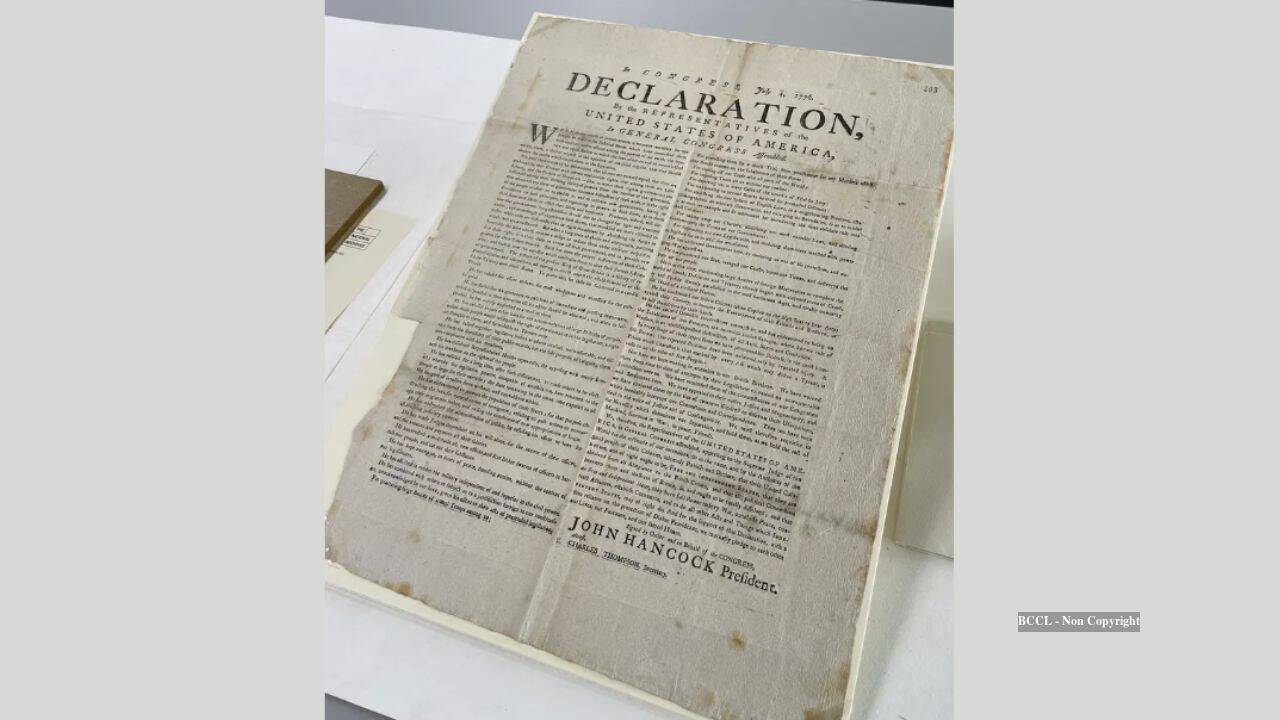
A volunteer sorting old Royal Navy papers at The National Archives in London has uncovered a rare 1776 printing of the US Declaration of Independence, found among letters sent by a British captain after capturing an American privateer ship.
asserted
volunteer → sort → ship
The document is one of only 11 surviving copies printed in Exeter, New Hampshire, and is now the only known example outside the United States.
asserted
document → survive → States
Discovered in May 2026 by volunteer Michael Scurr while cataloguing Admiralty correspondence, the fragile broadside had travelled across the Atlantic as wartime evidence before resting quietly in a box of 18th-century naval letters for more than two centuries, according to The National Archives.
uncertain
broadside → discover → Archives
A chance find in a box of captains’ letters
The discovery came as part of the America 250 project, which is cataloguing Royal Navy admirals’ and captains’ letters from the American Revolutionary War to coincide with the 250th anniversary of US independence.
asserted
which → come → independence
Michael Scurr, a volunteer on the project, was working through a box of correspondence from Captain Thomas Fitzherbert of HMS Raisonable when he noticed a reference to documents seized from a captured American vessel.
asserted
he → work → vessel
One item, described simply as “another paper,” turned out to be the Exeter printing of the Declaration.
asserted
item → describe → Declaration
Handling a document that had helped announce the birth of a new nation, in the same year that the United States is marking its 250th anniversary, underlined how much history can still be hidden in plain sight within vast archival collections.
asserted
history → handle → collections
His find shows how volunteers, working steadily through uncatalogued or under-examined records, can change what we know about major historical events.
asserted
we → show → events
The Exeter Declarations and why they are rare
The Declaration of Independence was first adopted by the Continental Congress in Philadelphia on 4 July 1776.
asserted
Declaration → adopt → July
In the days that followed, printers across the Thirteen Colonies rushed to produce their own editions, spreading the news of independence as widely as possible.
asserted
printers → follow → independence
One of these printers was Robert Luist Fowle in Exeter, New Hampshire, who produced a small run of the text between 16 and 19 July 1776 for his newspaper, the New Hampshire Gazette or Exeter Morning Chronicle.
asserted
who → produce → newspaper
These “Exeter Declarations” were printed quickly, on modest paper, for immediate distribution rather than long-term preservation.
asserted
Declarations → print → distribution
Over time, most copies were discarded, damaged or lost.
asserted
copies → discard → time
Today, only 11 are known to survive, all held in US institutions until this discovery.
asserted
all → know → discovery
The London copy is therefore unique not only for its rarity but for its location, offering a tangible link between the American Revolution and the British naval and governmental records that documented the conflict from the other side.
asserted
that → offer → side
How a Declaration ended up in British hands
asserted
ended → end → hands
The story of how this particular copy reached London begins with an American privateer named Dalton, a 20-gun brigantine commissioned by the Continental Congress to attack British shipping.
asserted
copy → reach → shipping
In late 1776, the Dalton sailed from Newburyport, Massachusetts, with a mixed crew of about 120 men, including Americans, English, Irish, Scottish, French and Danish sailors, as well as at least one Black crew member, Daniel Cottle.
asserted
Dalton → sail → Americans
During a stop on the Piscataqua River in New Hampshire, someone on board, most likely an officer, acquired a freshly printed Exeter Declaration.
asserted
someone → acquire → Declaration
On Christmas Eve 1776, the Dalton was hunting for British prizes off the coast of Portugal when it encountered HMS Raisonable, a much larger 64-gun Royal Navy ship.
asserted
it → hunt → Raisonable
After a seven-hour chase, the Dalton surrendered.
asserted
Dalton → surrender → chase
Captain Fitzherbert recorded the capture in his log and took the American crew as prisoners.
asserted
Fitzherbert → record → prisoners
He then ordered one of his lieutenants to bring the Dalton, its senior officers and its papers into Plymouth for prize proceedings.
asserted
He → order → proceedings
Prize papers, procedure and a deliberate exception
Under British naval practice at the time, all papers found on a captured enemy ship had to be seized and presented to a prize court to determine whether the vessel and its cargo legally belonged to the enemy.
asserted
vessel → find → enemy
The lieutenant acting as prize-captain swore that the only documents taken from the Dalton were its privateering commission and instructions from Congress.
asserted
documents → act → Congress
We now know that was not the full story.
asserted
that → know → ?
Captain Fitzherbert kept the Declaration for himself.
asserted
Fitzherbert → keep → himself
He made copies of the Dalton’s commission and instructions and sent those to the Admiralty Secretary in Whitehall, along with a brief note mentioning signals and “another paper.”
asserted
He → make → signals
By singling it out for immediate dispatch, Fitzherbert seems to have recognised its significance, even if Britain did not yet acknowledge the United States as a sovereign nation.
asserted
Britain → single → nation
From that point, the document remained within British government records, passing from the Admiralty to the Public Record Office and finally to The National Archives, where it lay unnoticed until 2026.
asserted
it → remain → 2026
The fate of the Dalton’s crew adds another layer to the story.
asserted
fate → add → story
After their capture, the sailors were imprisoned first on HMS Belleisle in Plymouth harbour and later at the Old Mill Prison, which by the end of 1779 held nearly 300 American prisoners.
asserted
which → imprison → prisoners
Among them was 19-year-old Charles Herbert of Newburyport, who kept a diary describing the harsh conditions and several escape attempts, including an elaborate tunnel dug beneath the prison.
asserted
who → keep → prison
Herbert’s account reveals how the ideals of the Declaration played out in the lives of ordinary people.
asserted
ideals → reveal → people
These men had volunteered to serve on a ship authorised by the Continental Congress, many of them attacking the shipping of their own nations of birth.
asserted
many → volunteer → birth
Some were free Black sailors, others were immigrants or transient workers drawn into the conflict by opportunity, ideology or circumstance.
asserted
others → draw → opportunity
Their experiences of capture, imprisonment and eventual release form a human counterpoint to the grand political claims of the document they carried.
uncertain
they → form → document
Once the Declaration was identified, collection care specialists at The National Archives undertook delicate conservation work.
asserted
specialists → identify → work
The document had been bound into a volume of Fitzherbert’s letters, attached with adhesive.
asserted
document → bind → adhesive
Senior conservator Jillian Harrold used an ultrasonic humidifier to introduce moisture in a controlled way, softening the glue so the broadside could be gently separated with a spatula.
uncertain
broadside → use → spatula
…and 16 more, not listed.
 The Aporia