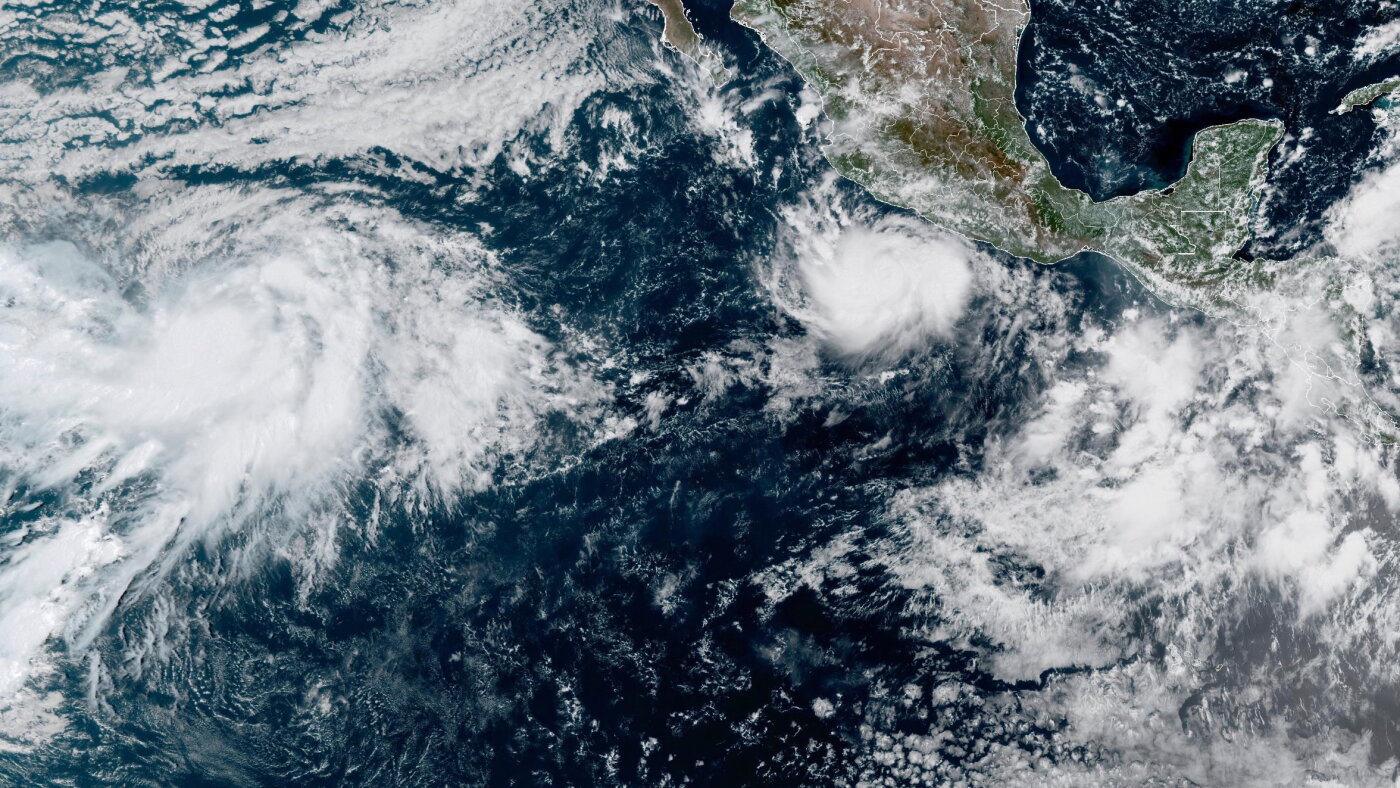
Photo via BBC News

'Extremely dangerous' Hurricane Polo intensifies to rare category 5 storm

Read the original at BBC News ↗
Cite

Livesay, B. (2026, September 23). 'Extremely dangerous' Hurricane Polo intensifies to rare category 5 storm. BBC News. https://www.bbc.co.uk/news/articles/ckddvlrlr5qeo?at_medium=RSS&at_campaign=rss

Dated when The Aporia collected the article, usually within hours of publication. Check the original for its exact date and byline.

BBC News · collected 2026-09-23 · by Brandon Livesay

Quick Summary

Hurricane Polo has intensified to a rare category 5 storm off Mexico's coast with sustained winds of up to 180 mph, making it one of the most powerful storms this season. NOAA warns that while Polo is not expected to make landfall, slow-moving torrential rains could cause deadly flooding and mudslides along southwestern coastal areas, particularly in Jalisco, Colima, and Michoacan states. The storm's strength is attributed to extremely warm ocean waters caused by the current El Niño climate phenomenon, which is now the strongest on record since 2015.
Written by AI on 2026-09-23, from this article's own text only (the story summary below draws on all the coverage).

AI analysis

Story summary

Hurricane Polo, rapidly intensifying to a Category 5 storm with maximum sustained winds of 165 mph (265 km/h), became one of the most powerful Pacific cyclones in decades. Centered approximately 346 kilometers south of Zihuatanejo, Mexico, it was expected to skirt the southwestern coast without making landfall but could cause significant flooding and mudslides inland due to heavy rainfall forecasts. The National Hurricane Center warned that coastal states like Guerrero and Michoacán might receive up to 12 inches (30 cm) of rain by Thursday, raising flood risks. Researchers linked Polo's unusual strength to the strong El Niño weather pattern, which has fueled extreme conditions globally this year.

Written for “Hurricane Polo Threats Mexico USA” on 2026-11-02, grounded in this article and the 28 other(s) covering the same event.

Story

📰 Hurricane Polo Threats Mexico USA
Environment · 29 article(s) covering the same event. Compare every outlet's account →

Compared with similar articles

This article reads unscored and hedges 12% of its claims. Each row says how that neighbour differs.
Toronto Star
Hedges 5 of 31 claims Outlet record 64/100
Toronto Star
Hedges 1 of 3 claims Outlet record 64/100
NPR
Hedges 5 of 31 claims Outlet record 60/100
The Independent
Hedges 4 of 14 claims Outlet record 59/100
CBC News
Hedges 6 of 33 claims Outlet record 60/100
Toronto Star
Hedges 1 of 2 claims Outlet record 64/100
Global News
Hedges 1 of 13 claims Outlet record 63/100
The Independent
Hedges 4 of 14 claims Outlet record 59/100
New York Post
Hedges 3 of 15 claims Outlet record 66/100
New York Post
Hedges 1 of 12 claims Outlet record 66/100
How this article was measured signals, leaning charts, publisher record, byline, topics and claims

Signals How these are calculated →

Claims extracted
17
sentences that state something as happening or true
Uncertain
12%
2 of 17 hedged ("reportedly", "may", "according to")
Leaning
not political
takes no side on a contested political question
Publisher signals
68/100
BBC News's corrections and hedging, across everything collected from it. Not a measure of accuracy.
Outlets on this story
29
Environment
Same framing elsewhere
1
articles that frame the event the way this one does
Analyzed 2026-09-23 · how these are computed

How this is being covered How these are calculated →

Article leaning vs. publisher reliability
Source leaning vs. consistency

Publisher

BBC News · 4845 article(s) · 6 correction(s) detected
Running correction rate · 6 correction(s)

Who wrote this

Brandon Livesay
6 article(s) here · 1 carrying a prediction
🔮 - Published Iran has said it will wait for an official response from US negotiators after President Donald Trump rejected a proposal to reopen the Strait of Hormuz to commercial shipping within seven days.
🔮 "The incident is expected to be ongoing throughout the night," the statement said.
🔮 The storm is predicted to skirt the coast of south-western Mexico, but is not expected to make landfall, a warning from NOAA said.
🔮 - Published An artificial intelligence researcher who quit AI firm Anthropic has said people working on the technology were "genuinely frightened" about the speed of its advancements and what it could mean for humanity.
🔮 The revenge dress is expected to fetch a considerably higher price.
2026-09-11 · assertive framing · Princess Diana's 'revenge dress' goes up for auction
Also by Brandon Livesay
Nothing else under this byline is closely related to this article, so these are simply their most recent.
All 6 articles by Brandon Livesay →

Topics

El Niño Hurricane Hunter Hurricane Polo Mexico NOAA

Subjects

NOAA ORG · 5× Mexico GPE · 4× Claudia Sheinbaum PERSON · 1× Colima GPE · 1× Jalisco GPE · 1× Miami ORG · 1× Michoacan GPE · 1× National Hurricane Center ORG · 1× Sheinbaum PERSON · 1× the US National Oceanic and Atmospheric Administration ORG · 1×

Narrative

A Hurricane Hunter aircraft, operated by the US National Oceanic and Atmospheric Administration (NOAA), flew into the storm on Tuesday and recorded sustained wind speeds near 180 mph (285 km/h), with stronger gusts. NOAA's Miami-based National Hurricane Center called the storm "extremely dangerous" and said its intensification over 24 hours was "truly remarkable".
framing: assertive · carried by 1 article(s) · first seen 2026-09-23
🔮 The storm is predicted to skirt the coast of south-western Mexico, but is not expected to make landfall, a warning from NOAA said.

Claims (17 extracted, 2 hedged)

- Published Hurricane Polo has rapidly intensified off the coast of Mexico to become one of the most powerful storms of the season in the Pacific Ocean. asserted
Polo → publish → Ocean
A Hurricane Hunter aircraft, operated by the US National Oceanic and Atmospheric Administration (NOAA), flew into the storm on Tuesday and recorded sustained wind speeds near 180 mph (285 km/h), with stronger gusts. NOAA's Miami-based National Hurricane Center called the storm "extremely dangerous" and said its intensification over 24 hours was "truly remarkable". asserted
intensification → operate → hours
The slow-moving storm is fuelling up on extremely warm waters caused by the El Niño climate phenomenon and is the season's third category 5 storm, the highest level on the Saffir-Simpson scale. asserted
storm → move → scale
The storm is predicted to skirt the coast of south-western Mexico, but is not expected to make landfall, a warning from NOAA said. asserted
warning → predict → NOAA
As it slowly drifts northwest, Polo will drive torrential rainfall in parts of Mexico's south-west coast - which could lead to deadly flooding and mudslides, NOAA said. uncertain
NOAA → drift → flooding
Rainfall totals of up to 6in (15cm) are forecast, with 8in possible in some areas. asserted
in → forecast → areas
Residents have also been warned of large ocean swells and life-threatening surf conditions for the next few days. asserted
Residents → warn → days
"So far, the information we have is that (Polo) will not make a direct landfall on the coast," Mexico's President Claudia Sheinbaum said on Tuesday, but she warned residents along the Pacific coast to be vigilant. asserted
she → have → coast
Sheinbaum highlighted the states of Jalisco, Colima and Michoacan as being at risk. asserted
Sheinbaum → highlight → risk
Data from the Hurricane Hunter aircraft indicated that Polo could still strengthen and would likely stay a category 5 storm for the next few days, because of what NOAA called a "very conducive" environment of extremely warm ocean waters feeding the storm. uncertain
NOAA → indicate → storm
Scientists monitoring the ocean temperatures say the current El Niño climate phenomenon is now the strongest on record. asserted
phenomenon → monitor → record
Daily sea surface temperatures in a key region of the central-eastern Pacific were 3.05C above average on 19 September - exceeding the previous record of 3.02C set during the very strong El Niño of 2015. asserted
temperatures → exceed → 2015
Some longer-term measures of El Niño have not yet hit record levels but this is likely to change, with the peak not expected until later this year. asserted
peak → hit → year
Warmer ocean waters mean storms can pick up more energy, leading to higher wind speeds. asserted
storms → mean → speeds
El Niño is a naturally-occurring pattern, which happens about every two to seven years and tends to last for around a year. asserted
which → occur → year
Trade winds that typically blow from east to west across the Pacific Ocean can weaken or even reverse, allowing warm water to spread eastwards. asserted
water → blow → Ocean
Heat is then released from the ocean into the atmosphere which can boost global temperatures and drive changes in weather patterns around the world. asserted
which → release → world

💬Give feedback
🕘History 🎫Support