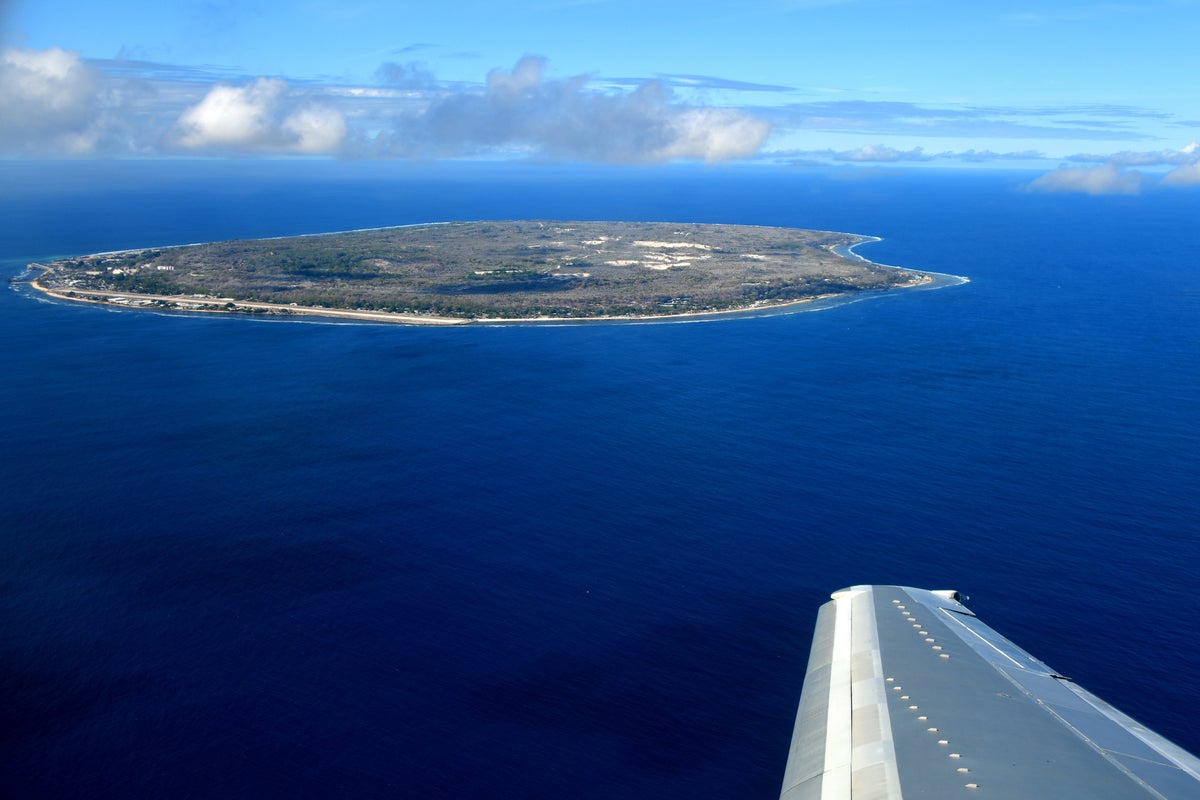
The tiny South Pacific island nation of Nauru, its president said, had changed its name — and reclaimed its heritage in the process.
asserted
president → say → process
President David Adeang addressed the 81st session of the United Nations General Assembly, the world's largest gathering of leaders on behalf of his nation.
asserted
Adeang → address → nation
“I have travelled far,” he said Tuesday at the U.N. General Assembly in New York.
asserted
he → travel → York
What was known to the world for many years as Nauru, Adeang said, was returning to the name and pronunciation of its past: Naoero.
asserted
Adeang → know → past
“There are moments in the life of a nation when its people are called to remember who they have always been,” he added.
asserted
he → be → nation
Though the names are similar and, in essence, the same word, the shift in spelling and pronunciation represents the nation's effort to recast — rebrand, even — itself for its own people as much as for the outside world.
asserted
shift → represent → world
He called it not a change but an effort to “affirm a truth.”
asserted
He → call → truth
“For many years, the world has known our country as Nauru.
asserted
world → know → Nauru
Nauru is how our name sounded to those who found it hard to say, and the world kept it,” Adeang said.
asserted
Adeang → sound → it
“But it is not the name our people used among themselves.
asserted
people → use → themselves
The nation, an eight-square-mile island with about 12,000 people and the world’s third-smallest country, became independent in 1968 after longtime colonial rule under the United Kingdom, New Zealand, Australia and Germany.
asserted
nation → become → Kingdom
It announced the renaming in August after signalling its intent in February.
asserted
It → announce → February
The country’s international code is changing from NRU to NRO, and its people will be known as dei-Naoero instead of Nauruan.
asserted
people → change → Nauruan
Commonly known abroad by the pronunciation of Now-roo, the new name is spoken as Now-ero.
asserted
name → know → ero
Across the past century, other nations have renamed themselves or tweaked their names for various reasons, from modernisation to rejection of colonialism.
asserted
nations → rename → colonialism
The African nation of Eswatini changed its name from Swaziland in 2018.
asserted
nation → change → 2018
In Africa, Dahomey became Benin after a 1975 coup, and Rhodesia became Zimbabwe in 1980 after shedding colonial rule.
asserted
Rhodesia → become → rule
Siam became Thailand in 1939 to foster ethnic unity and shed a foreign label.
asserted
Siam → become → label
Turkey, meanwhile, has been officially named Turkiye since 1920 but requested in 2022 that the United Nations use the spelling and pronunciation as its name in English as well — in part to avoid confusion by underscoring that the bird wasn't the word.
asserted
bird → name → confusion
The list goes on.
asserted
list → go → ?
Persia became Iran.
asserted
Persia → become → ?
Burma became Myanmar.
asserted
Burma → become → ?
Adeang's remarks Tuesday reflected this as he carefully pronounced the name to differentiate it from its former pronunciation.
asserted
he → reflect → pronunciation
“We do not make this choice to erase our past.
asserted
We → make → past
We make it because we honour it,” he said.
asserted
he → make → it
“That name carries the memory of our ancestors, our language, and our identity.
asserted
name → carry → ancestors
Today, we restore Naoero.”
asserted
we → restore → Naoero
And then, after completing his address about the issues that face his people — rising seas, economics, respect on the global stage — he concluded his address with three words:
“Say our name.”
asserted
he → complete → name
 The Aporia