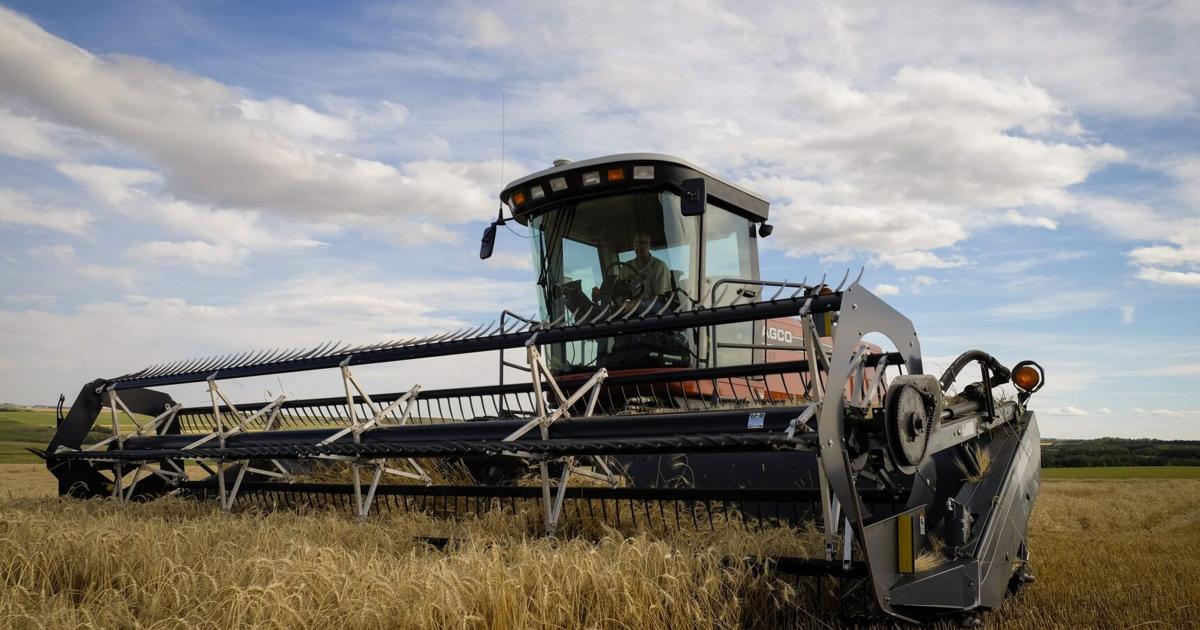
Photo via Toronto Star

How Canada’s food industry can lead the way in expanding global trade

Read the original at Toronto Star ↗
Cite

Johnston, C., & Contributors, C. K. (2026, September 23). How Canada’s food industry can lead the way in expanding global trade. Toronto Star. https://www.thestar.com/opinion/contributors/how-canada-s-food-industry-can-lead-the-way-in-expanding-global-trade/article_e29b783a-acba-4ad9-bd67-594c07c43f47.html

Dated when The Aporia collected the article, usually within hours of publication. Check the original for its exact date and byline.

Toronto Star · collected 2026-09-23 · by Craig Johnston, Craig Klemmer Contributors

Quick Summary

A recent report by Farm Credit Canada suggests that Canadian food processors have an opportunity to expand their export markets beyond the United States. Currently, three-quarters of Canadian food and beverage exports ($35 billion) go to the U.S., but the FCC proposes increasing exports to other nations by $10 billion. The article outlines a strategy for achieving this goal through retooling for new international market specifications, enhancing productivity with AI and automation, and leveraging existing free trade agreements to access 51 countries and over 1.5 billion consumers. Key opportunities lie in European markets worth nearly $5 billion and Asian markets estimated at $4.3 billion for specific products like meat, seafood, and vegetable oils.
Written by AI on 2026-09-23, from this article's own text only (the story summary below draws on all the coverage).

AI analysis

Story summary

Canada's food industry relies heavily on trade with the United States, which accounted for three-quarters of Canada’s food and beverage exports worth about $35 billion in 2023. A recent report by Farm Credit Canada (FCC) suggests expanding into other markets to diversify this dependency. The FCC proposes a goal of increasing exports by roughly $10 billion, leveraging existing trade agreements. This pivot would involve Canadian food processors adapting their products—such as reformulating, repackaging, and certifying goods—to meet the requirements of buyers in Europe and other regions.

Written for “Canadian Food Industry Trade Expansion” on 2026-11-01, grounded in this article and the 0 other(s) covering the same event.

Story

📰 Canadian Food Industry Trade Expansion
Economy/Business · 1 article(s) covering the same event.

Compared with similar articles

This article reads unscored and hedges 3% of its claims. Each row says how that neighbour differs.
The Independent
⚖️ Leans strongly left Hedges 4 of 14 claims Outlet record 59/100
“The articles discuss different impacts of trade disputes between Canada and the US: one on Canada's food industry broadly, and another on a specific California winery.”
The Straits Times
⚖️ Leans right Hedges 3 of 14 claims Outlet record 66/100
“The articles discuss different aspects of Canada's trade relationship with the US, but do not describe the same specific incident or occurrence.”
Toronto Star
Hedges 1 of 29 claims Outlet record 64/100
“The articles discuss different aspects of Canada's international trade strategies, one focusing on expanding global trade beyond the U.S., while the other addresses the misconception that Europe can save Canada from its trade issues with the U.S.”
CBC News
Hedges 4 of 34 claims Outlet record 74/100
“Article A discusses broader trade opportunities for Canadian food industry beyond US reliance, while Article B reports on a specific upcoming import ban by the U.S. affecting Canadian products.”
How this article was measured signals, leaning charts, publisher record, byline, topics and claims

Signals How these are calculated →

Claims extracted
33
sentences that state something as happening or true
Uncertain
3%
1 of 33 hedged ("reportedly", "may", "according to")
Leaning
not political
takes no side on a contested political question
Publisher signals
64/100
Toronto Star's corrections and hedging, across everything collected from it. Not a measure of accuracy.
Outlets on this story
1
Economy/Business
Same framing elsewhere
1
articles that frame the event the way this one does
Analyzed 2026-09-23 · how these are computed

How this is being covered How these are calculated →

Article leaning vs. publisher reliability
Source leaning vs. consistency

Publisher

Toronto Star · 11011 article(s) · 28 correction(s) detected
Running correction rate · 28 correction(s)
2026-10-26
Correction
2026-10-24
Correction
2026-10-07
Correction
2026-09-24
Correction

Who wrote this

Craig Johnston
1 article(s) here · 1 carrying a prediction
🔮 Adoption of artificial intelligence and automation will help boost a sector plagued by persistent labour shortages.
The only article under this byline in the corpus.
Craig Klemmer Contributors
1 article(s) here · 1 carrying a prediction
🔮 Adoption of artificial intelligence and automation will help boost a sector plagued by persistent labour shortages.
The only article under this byline in the corpus.

Topics

Canada Canadian FCC Farm Credit Canada the United States

Subjects

Canada GPE · 6× Canadian NORP · 3× FCC ORG · 2× American NORP · 1× Canadians NORP · 1× European NORP · 1× European Free Trade Association ORG · 1× Farm Credit Canada ORG · 1× the United Kingdom GPE · 1× the United States GPE · 1×

Narrative

To that end, a recent report by Farm Credit Canada (FCC) proposes a bold goal: Maximize opportunities already present in our existing trade agreements by dramatically expanding exports to other nations by roughly $10 billion.
framing: assertive · carried by 1 article(s) · first seen 2026-09-23
🔮 Adoption of artificial intelligence and automation will help boost a sector plagued by persistent labour shortages.
2026-09-23 · Toronto Star
How Canada’s food industry can lead the way in expanding global trade · assertive framing

Claims (33 extracted, 1 hedged)

Canada’s relationship with the United States has long been the bedrock of international trade for our food manufacturing sector. asserted
relationship → manufacture → sector
In 2023, three-quarters of our food and beverage exports went south of the border, generating about $35 billion. asserted
quarters → go → billion
The current trade dispute is not just a wake-up call about relying too heavily on one market; it’s an unprecedented opportunity for Canadian food processors to lead our country toward a more balanced trade model. asserted
processors → wake → model
To that end, a recent report by Farm Credit Canada (FCC) proposes a bold goal: Maximize opportunities already present in our existing trade agreements by dramatically expanding exports to other nations by roughly $10 billion. asserted
report → propose → billion
This is an achievable goal for our food processors — the hard-working, unsung Canadians who turn our raw agricultural products into packaged goods for our grocery store shelves as well as our export channels. asserted
who → work → shelves
They are in a prime position to lead a pivot for Canada’s entire food and agriculture value chain by making three key changes. asserted
They → lead → changes
• It starts with retooling for new markets. asserted
It → start → markets
That means adjusting formulations, packaging and certifications to meet the specifications required by buyers in Europe, Asia and beyond, rather than automatically defaulting to American requirements. asserted
That → mean → requirements
• It also means aggressively addressing the sector’s productivity growth, which has been declining for the past two decades. asserted
which → mean → decades
Adoption of artificial intelligence and automation will help boost a sector plagued by persistent labour shortages. asserted
Adoption → help → shortages
So will recruitment of workers highly skilled in technology. asserted
recruitment → skille → technology
This productivity boost could mean better prices for Canadian customers as well as a more adaptable supply chain for export. uncertain
boost → mean → export
• The final step is devoting more attention to the 15 free trade agreements Canada already has in place, giving us access to 51 countries and over 1.5 billion consumers. asserted
Canada → devote → countries
Canada has built much of the policy foundation needed to support export diversification. asserted
Canada → build → diversification
Our current network of free trade agreements gives our exporters preferred access to key markets around the world. asserted
network → give → world
Europe has the largest potential for Canadian food manufacturers, an opportunity estimated at nearly $5 billion. asserted
Europe → have → billion
Canada already has a strong foundation there through the Canada-European Union Comprehensive Economic and Trade Agreement, as well as trade agreements with the United Kingdom and European Free Trade Association countries. asserted
Canada → have → Kingdom
Asia represents an estimated $4.3-billion opportunity for value-added meat products, seafood, prepared foods, and vegetable oils, such as canola. asserted
Asia → represent → canola
Realizing this potential will require targeted market development, stronger buyer relationships, and continued investment in Canada’s reputation for safe, high-quality food. asserted
Realizing → realize → food
Redirecting exports isn’t just about finding an overseas buyer. asserted
Redirecting → redirect → buyer
It means building relationships, infrastructure, logistics, and brand recognition to successfully compete overseas. asserted
It → mean → relationships
Food processors who do this are creating a template others can follow as new trade agreements are reached with more countries. asserted
agreements → do → countries
Not every manufacturer will move at the same speed. asserted
manufacturer → move → speed
Animal feed, for instance, has real potential to be redirected toward new buyers relatively quickly. asserted
feed → have → buyers
Vegetable oils are a tougher sell and will need a more aggressive, longer-term push into new markets. asserted
oils → need → markets
Realistic, sector-by-sector targets matter more than a single blanket goal. asserted
targets → matter → goal
Investment and collaboration None of this will happen in isolation. asserted
None → happen → isolation
While the food processors can lead the charge, it will take investment and collaboration across the entire food system. asserted
it → lead → system
Farmers, manufacturers, lenders, innovators, grocers, transportation companies, researchers, educators, governments, and crown corporations like FCC each hold a piece of the puzzle. asserted
Farmers → hold → puzzle
The tariff fight isn’t going away soon. asserted
fight → go → ?
But it also marks a beginning. asserted
it → mark → beginning
The next decade of Canada’s food system will be shaped by the choices made today. asserted
decade → shape → choices
Canadian food processors who invest now in new markets, new capacity and new relationships won’t just be riding out the storm, they will build a blueprint for others to follow. asserted
others → invest → blueprint

💬Give feedback
🕘History 🎫Support