
Photo via The Guardian

Ancient wall found beneath Paris could confirm site of first settlement

Read the original at The Guardian ↗
Cite

Paris, A. F. P. i. (2026, September 23). Ancient wall found beneath Paris could confirm site of first settlement. The Guardian. https://www.theguardian.com/world/2026/sep/23/ancient-wall-paris-first-settlement-archaeology-roman

Dated when The Aporia collected the article, usually within hours of publication. Check the original for its exact date and byline.

The Guardian · collected 2026-09-23 · by Agence France-Presse in Paris

Quick Summary

France’s culture ministry announced a significant archaeological discovery in Paris: an ancient wall dating from the Gallo-Roman period, found beneath Notre Dame Cathedral on Île de la Cité. The 20-meter stretch of stone-and-wood structure could confirm the site as the original settlement of Lutetia, the ancient name for Paris. Carbon dating places the charred remnants of this wall between 200BC and 10BC, coinciding with the Battle of Lutetia against Roman forces in 52BC. The culture minister highlighted that while further verification is needed, the find represents a major breakthrough in understanding early Gallic history.
Written by AI on 2026-09-23, from this article's own text only (the story summary below draws on all the coverage).

AI analysis

Story summary

In Paris, an ancient 65-foot wall dating back to 10-200 B.C. was discovered beneath a hotel on the Ile de la Cite this summer. The discovery could confirm that the island was indeed the center of Lutetia, the Roman settlement in Paris. Carbon dating estimates place the find near the time of the Battle of Lutetia in 52 B.C., supporting its significance to understanding Gallic history. While traditionally considered central to Lutetia, some theories suggest Nanterre might have been the original site based on archaeological research. Culture Minister Catherine Pegard called it "one of the most important remains ever discovered for understanding Gallic Lutetia," though scientific verification is still pending.
Written for “Ancient Wall Found Under Paris” on 2026-11-04, grounded in this article and the 1 other(s) covering the same event.

Story

📰 Ancient Wall Found Under Paris
Other · 2 article(s) covering the same event. See how they differ ↓

Compared with similar articles

This article reads unscored and hedges 30% of its claims. Each row says how that neighbour differs.
CBS News
Hedges 3 of 12 claims Outlet record 65/100
How this article was measured signals, leaning charts, publisher record, byline, topics and claims

Signals How these are calculated →

Claims extracted
10
sentences that state something as happening or true
Uncertain
30%
3 of 10 hedged ("reportedly", "may", "according to")
Leaning
not political
takes no side on a contested political question
Publisher signals
66/100
The Guardian's corrections and hedging, across everything collected from it. Not a measure of accuracy.
Outlets on this story
2
Other
Same framing elsewhere
1
articles that frame the event the way this one does
Analyzed 2026-09-23 · how these are computed

How this is being covered How these are calculated →

Article leaning vs. publisher reliability
Source leaning vs. consistency

Publisher

The Guardian · 2944 article(s) · 6 correction(s) detected
Running correction rate · 6 correction(s)

Who wrote this

Agence France-Presse in Paris
1 article(s) here · 1 carrying a prediction
🔮 “We may be looking at one of the most important remains ever discovered for understanding Gallic Lutetia,” the culture minister, Catherine Pégard, said in a statement on Wednesday.
The only article under this byline in the corpus.

Topics

France Gallic Lutetia Paris the Battle of Lutetia

Subjects

Paris GPE · 4× Lutetia GPE · 3× Gallic NORP · 2× Caesar PERSON · 1× Catherine Pégard PERSON · 1× France GPE · 1× French NORP · 1× Julius Caesar’s PERSON · 1× Nanterre GPE · 1× Parisii NORP · 1×

Narrative

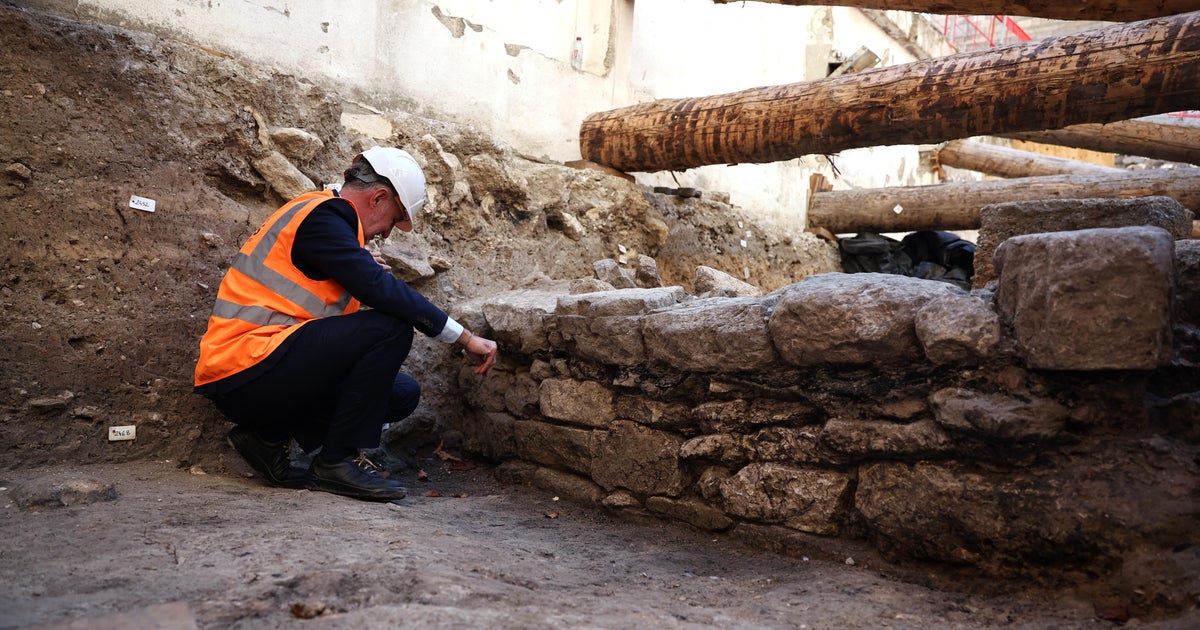
A roughly 20-metre (65ft) stretch of wall dating from the Gallo-Roman period was discovered in Paris this summer beneath a building on the Île de la Cité, near Notre Dame Cathedral in the heart of the French capital.
framing: mixed · carried by 1 article(s) · first seen 2026-09-23
🔮 “We may be looking at one of the most important remains ever discovered for understanding Gallic Lutetia,” the culture minister, Catherine Pégard, said in a statement on Wednesday.

Claims (10 extracted, 3 hedged)

An ancient wall discovered beneath Paris has been described as a “major breakthrough” by France’s culture ministry, with the archaeological find possibly confirming the location of the city’s original settlement. uncertain
find → discover → settlement
A roughly 20-metre (65ft) stretch of wall dating from the Gallo-Roman period was discovered in Paris this summer beneath a building on the Île de la Cité, near Notre Dame Cathedral in the heart of the French capital. asserted
stretch → date → capital
The stone-and-wood structure is thought to be a fragment of the ramparts of Lutetia – the ancient name for Paris – built by the Gallic Parisii tribe who lived along the River Seine in the iron age. asserted
who → think → age
The Île de la Cité has traditionally been regarded as the centre of Lutetia, but a rival theory, backed by some archaeological research, contends that it was in Nanterre, a suburb to the west. asserted
it → regard → west
“We may be looking at one of the most important remains ever discovered for understanding Gallic Lutetia,” the culture minister, Catherine Pégard, said in a statement on Wednesday. uncertain
minister → look → Wednesday
“Scientific caution still requires that we verify its function and its chronology, but the convergence of evidence is particularly remarkable at this stage. asserted
convergence → require → stage
Lutetia was first mentioned in book seven of Julius Caesar’s Gallic Wars series, where it was said to be on an island in the River Seine – a vague description that has given rise to many theories about its location. asserted
that → mention → location
The wall, uncovered in the course of excavations beneath the Hôtel-Dieu hospital, bears traces of fire, which may correspond to Caesar’s account that the Gauls set fire to their town before the Battle of Lutetia against the Romans. uncertain
Gauls → uncover → Romans
Carbon dating of the charred evidence dated the find to between 200BC and 10BC, the ministry said in its statement – a timeframe that covers the Battle of Lutetia, in 52BC. asserted
that → date → 52BC
The Île de la Cité is the largest island in the Seine in the Paris region and became the centre of the Roman settlement of Lutetia. asserted
Cité → become → Lutetia
💬Give feedback · no sign-in needed

No sign-in needed for now. Your note is sent without a name, so it cannot be answered.

🕘History 🎫Support