Photo via Deutsche Welle

As the EU advances free trade with Southeast Asia, why is there no ASEAN-wide deal?

Read the original at Deutsche Welle ↗
Cite

Hutt, D. (2026, September 23). As the EU advances free trade with Southeast Asia, why is there no ASEAN-wide deal? Deutsche Welle. https://www.dw.com/en/as-the-eu-advances-free-trade-with-southeast-asia-why-is-there-no-asean-wide-deal/a-79388278?maca=en-rss-en-world-4025-rdf

Dated when The Aporia collected the article, usually within hours of publication. Check the original for its exact date and byline.

Deutsche Welle · collected 2026-09-23 · by David Hutt

Quick Summary

The European Union is finalizing free trade agreements with several Southeast Asian nations, aiming to complete deals with six out of eleven ASEAN states by early 2027. Current agreements are in place with Singapore and Vietnam, while negotiations continue with Indonesia, Thailand, Malaysia, and the Philippines. The EU-Southeast Asia goods trade reached €274.9 billion ($313.7 billion) last year, a significant increase from €177.9 billion recorded in 2016. This heightened economic engagement is driven by Brussels' push to expand into new markets and build resilient supply chains amid geopolitical tensions and China's decreasing attractiveness for multinational firms.
Written by AI on 2026-09-23, from this article's own text only (the story summary below draws on all the coverage).

AI analysis

Story summary

The European Union is advancing free trade agreements with several Southeast Asian nations, aiming to complete deals with six out of eleven ASEAN states by mid-2027. Free trade agreements are already in place with Singapore and Vietnam, while negotiations with Indonesia have concluded, targeting a signing in October 2023 and implementation by early 2027. Talks with Thailand and Malaysia are progressing rapidly, expected to be finalized by the end of 2024 or early 2025. Additionally, the EU and the Philippines recently announced substantial agreement on their free trade deal, likely concluding in months. Chris Humphrey, executive director of the EU-ASEAN Business Council, noted that EU engagement with ASEAN has reached an all-time high, with goods trade between them increasing to €274.9 billion ($313.7 billion) last year from around 6% higher than pre-deal levels.

Written for “EU Free Trade Southeast Asia” on 2026-11-03, grounded in this article and the 0 other(s) covering the same event.

Story

📰 EU Free Trade Southeast Asia
Economy/Business · 1 article(s) covering the same event.

Compared with similar articles

This article reads unscored and hedges 7% of its claims. Each row says how that neighbour differs.
The Straits Times
Hedges 0 of 6 claims Outlet record 66/100
“Article A describes the EU and Philippines reaching a substantial agreement on a free-trade deal, while Article B discusses broader trends in EU's advancing free trade with multiple Southeast Asian nations including but not limited to the Philippines.”
Toronto Star
Hedges 0 of 2 claims Outlet record 64/100
“Article A reports on the signing of a new free trade deal between the EU and the Philippines, while Article B discusses broader trends in EU-Southeast Asia trade agreements including multiple nations, not just the specific Philippines agreement.”
South China Morning Post
Hedges 0 of 4 claims Outlet record 62/100
“Article A discusses EU's bilateral deals with multiple Southeast Asian nations, while Article B specifically mentions a breakthrough in EU-Philippines trade talks.”
How this article was measured signals, leaning charts, publisher record, byline, topics and claims

Signals How these are calculated →

Claims extracted
27
sentences that state something as happening or true
Uncertain
7%
2 of 27 hedged ("reportedly", "may", "according to")
Leaning
not political
takes no side on a contested political question
Publisher signals
95/100
Deutsche Welle's corrections and hedging, across everything collected from it. Not a measure of accuracy.
Outlets on this story
1
Economy/Business
Same framing elsewhere
1
articles that frame the event the way this one does
Analyzed 2026-09-23 · how these are computed

How this is being covered How these are calculated →

Article leaning vs. publisher reliability
Source leaning vs. consistency

Publisher

Deutsche Welle · 566 article(s) · 0 correction(s) detected
No corrections detected for this publisher. That may mean careful reporting, or simply that nothing has been checked.

Who wrote this

David Hutt
6 article(s) here · 1 carrying a prediction
🔮 The EU and several Southeast Asian nations are nearing the finish line on bilateral trade deals, and if the current deadlines hold, the European bloc will have agreements in place with six out of 11 ASEAN states by the middle of next year.
🔮 The region's electricity demand is forecast to grow by an average of 5.3% a year between 2026 and 2030.
2026-09-21 · assertive framing · Nuclear power is back on Southeast Asia's energy agenda
🔮 Malaysian Prime Minister Anwar Ibrahim has spent much of his time in office insisting that Kuala Lumpur will not be forced to choose between the United States and China.
🔮 Vietnam's government announced in March 2025 that it would allow SpaceX to launch Starlink on a controlled trial basis, waiving the usual restrictions on foreign ownership.
🔮 Of the 820,000 names submitted by Bangladesh, Myanmar said it had verified around 308,000 as former residents but would not repatriate them until security conditions improve in civil war-torn Rakhine State.
2026-08-25 · assertive framing · Myanmar: Why Rohingya refugees can't return
🔮 This lack of restraint leads to unthinkable actions.” Tougher legislation alone may struggle to solveThailand's problem.
2026-08-21 · assertive framing · How do teenagers keep accessing guns in Southeast Asia?
Also by David Hutt
Myanmar: Why Rohingya refugees can't return
2026-08-25 · Deutsche Welle
Nothing else under this byline is closely related to this article, so these are simply their most recent.
All 6 articles by David Hutt →

Topics

ASEAN China European Singapore Southeast Asian

Subjects

ASEAN ORG · 8× China GPE · 4× European NORP · 4× Humphrey PERSON · 2× Southeast Asian NORP · 2× the United States GPE · 2× Indonesia GPE · 1× Jakarta GPE · 1× Singapore GPE · 1× Vietnam GPE · 1×

Narrative

Yet, even without an immediate prospect of a full region-to-region agreement, completing the current bilateral deals would give the EU preferential trade arrangements with most of ASEAN's largest economies and demonstrate that Southeast Asia has moved higher up Brussels' trade agenda. For Humphrey, however, that should be the starting point rather than the endpoint.
framing: assertive · carried by 1 article(s) · first seen 2026-09-23
🔮 The EU and several Southeast Asian nations are nearing the finish line on bilateral trade deals, and if the current deadlines hold, the European bloc will have agreements in place with six out of 11 ASEAN states by the middle of next year.

Claims (27 extracted, 2 hedged)

The EU and several Southeast Asian nations are nearing the finish line on bilateral trade deals, and if the current deadlines hold, the European bloc will have agreements in place with six out of 11 ASEAN states by the middle of next year. asserted
bloc → near → year
Negotiations with Indonesia have concluded, and Jakarta aims to sign the agreement in October, with implementation targeted for early 2027. asserted
implementation → conclude → 2027
Talks with Thailand, relaunched in 2023, have reached nine negotiating rounds, while Malaysia resumed negotiations in early 2025 after a 13-year pause. asserted
Malaysia → relaunche → pause
Both are expected to be finalized by the end of the year or early 2027. asserted
Both → expect → year
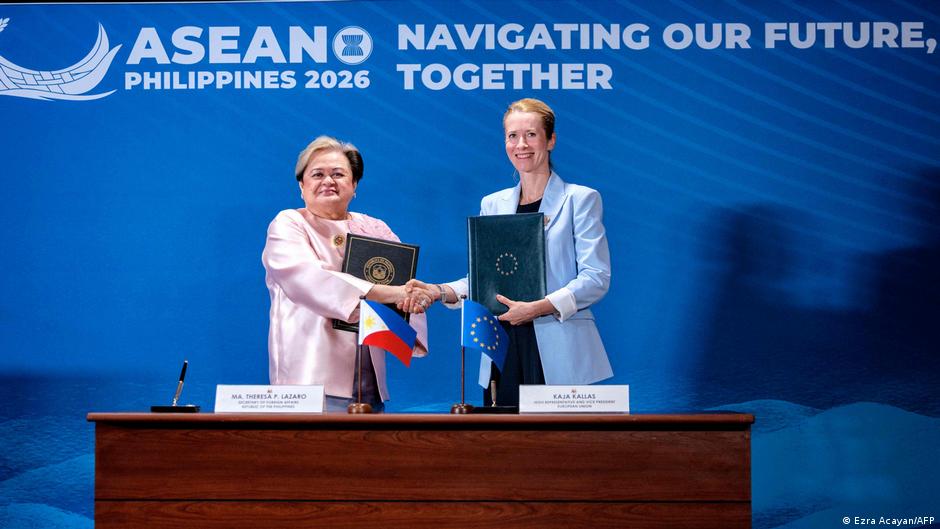
Earlier this week, the EU and the Philippines announced that they had reached "substantial agreement" on their free trade agreement, putting it on course for formal conclusion in the coming months. asserted
they → announce → months
Trade up by more than half in single decade Speaking to DW, Chris Humphrey, executive director of the EU-ASEAN Business Council, described EU engagement with ASEAN on trade and investment issues as "at an all-time high." asserted
Humphrey → speak → high
EU-Southeast Asia goods trade reached €274.9 billion ($313.7 billion) last year, up around 6% from the previous year and more than 50% from the €177.9 billion recorded in 2016, according to EU data. uncertain
trade → reach → data
This week, Manila hosted both the ASEAN–EU Business Summit and the 22nd meeting of ASEAN economic ministers and the EU's trade commissioner. asserted
Manila → host → ministers
The two blocs pledged greater cooperation to protect themselves from rising geopolitical tensions, including unilateral trade actions and regional conflicts, that "collectively threaten the rules-based international order." asserted
that → pledge → order
Brussels is expanding its network of trade agreements globally as it looks to expand to new markets and form more resilient supply chains. asserted
it → expand → chains
Southeast Asia, in turn, sits at the center of supply chains for semiconductors, electronics, electric vehicles and batteries, with investment pouring into data centers, renewable energy and digital services. asserted
investment → sit → centers
An article published this month by the International Monetary Fund said ASEAN's 11 economies already form a $4.5 trillion bloc, growing at more than 4.5% a year. asserted
economies → publish → %
Such economic expansion, combined with multinational firms' efforts to diversify production beyond China, has made access to Southeast Asian markets more attractive for European companies. asserted
access → combine → companies
Alfred Gerstl, an expert on Indo-Pacific international relations at the University of Vienna, told DW that geopolitical and geo-economic changes are also accelerating cooperation between the two regions. asserted
changes → tell → regions
US President Donald Trump's "protectionist and erratic trade policies" have acted as a crucial catalyst, he said, while the EU's strategy of "de-risking from China" and diversifying supply chains boosted Southeast Asia's strategic importance. asserted
strategy → act → importance
A stronger partnership with European nations also plays in favor of Southeast Asia governments, who have long tried to maintain broad economic relationships with competing powers rather than becoming excessively dependent on China, the United States or any other single partner. asserted
who → play → China
EU companies push for an ASEAN-wide deal asserted
companies → push → deal
The EU-ASEAN Business Council, said Humphrey, is calling for a region-to-region economic framework with a clear pathway to an eventual region-to-region free trade deal, "something European business has consistently called for. asserted
business → say → something
" "This would adopt a modular approach, perhaps starting with a region-to-region Digital Trade Agreement and an Investment Protection Agreement," Humphrey told DW. asserted
Humphrey → adopt → DW
The idea is not exactly new — the EU and ASEAN launched negotiations for a region-to-region agreement in 2007, but the talks bogged down over enormous differences between ASEAN economies and disagreements over the agreement's scope. asserted
talks → launch → scope
The talks were put on ice by mutual agreement in 2009, after which Brussels switched to negotiating bilateral deals with individual ASEAN members. asserted
Brussels → put → members
The main difficulty preservers to this day, as ASEAN includes Singapore, one of the world's wealthiest economies, alongside developing and least-developed members, making it difficult to agree on common commitments acceptable to Brussels. " asserted
it → preserver → Brussels
In addition, meeting the EU's high social, labor and environmental standards is difficult for the less-developed ASEAN members," said Gerstl. asserted
Gerstl → meet → members
Is the Commission ready to up the stakes? asserted
Commission → up → stakes
Yet, even without an immediate prospect of a full region-to-region agreement, completing the current bilateral deals would give the EU preferential trade arrangements with most of ASEAN's largest economies and demonstrate that Southeast Asia has moved higher up Brussels' trade agenda. For Humphrey, however, that should be the starting point rather than the endpoint. asserted
that → complete → Humphrey
The concern, he said, is the European Commission might not be willing to move towards region-to-region agreements. uncertain
Commission → say → agreements
"With 2027 marking the 50th Anniversary of EU-ASEAN relations, we remain hopeful that the Commission will take this milestone seriously and ramp up work on a region-to-region economic architecture," he told DW. "Failing to do so will only make ASEAN think that the EU does not take the region seriously." asserted
EU → mark → region

💬Give feedback
🕘History 🎫Support