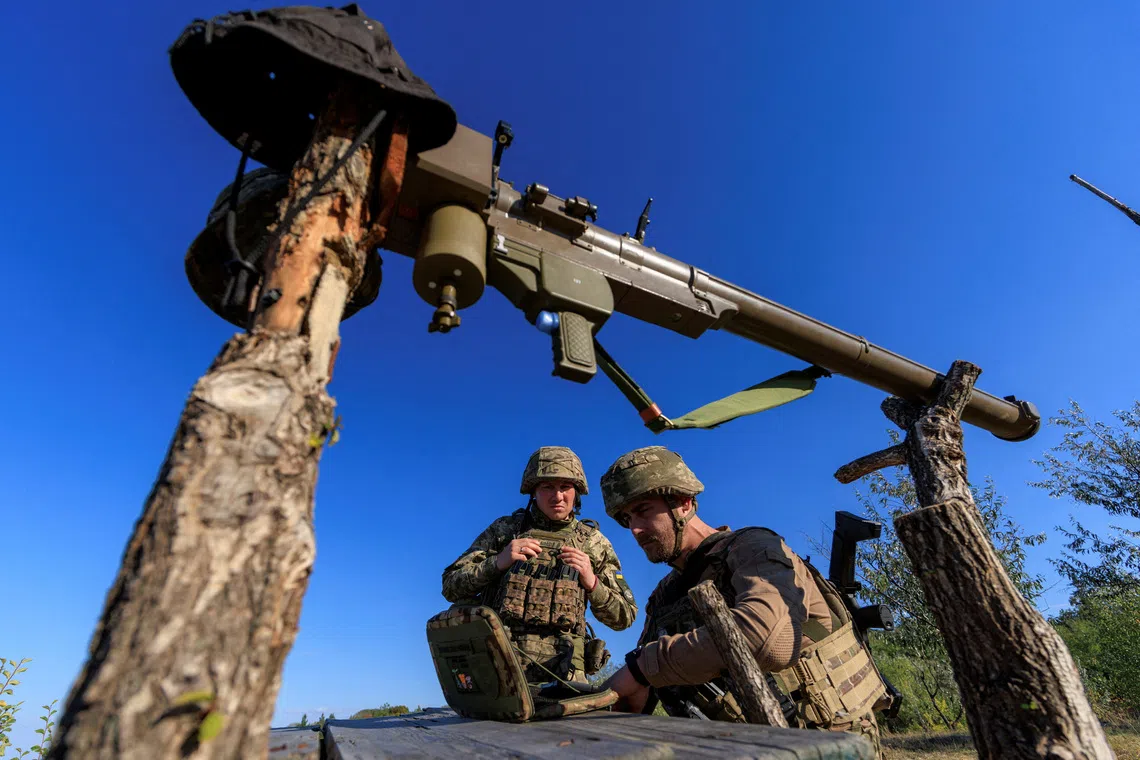
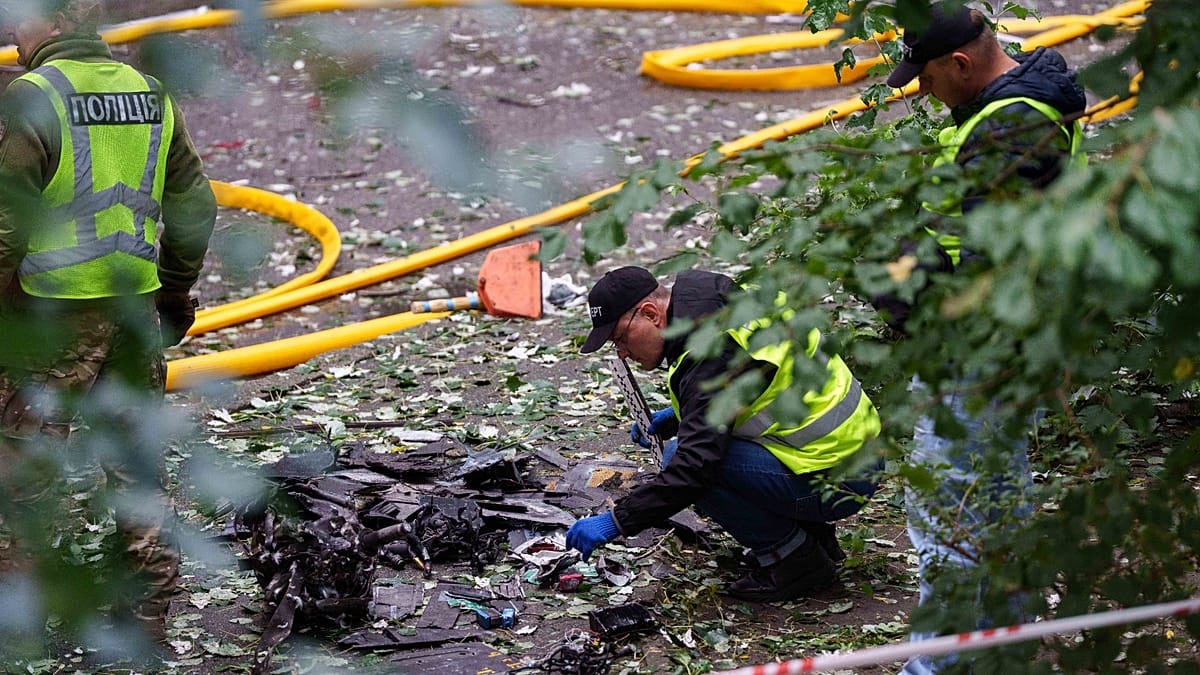
Photo via The Guardian

The long-range drone war: Ukraine and Russia scramble for supremacy in the skies

Read the original at The Guardian ↗
Cite

Kochetova, D. S. i. e. U. W. p. b. J. (2026, September 24). The long-range drone war: Ukraine and Russia scramble for supremacy in the skies. The Guardian. https://www.theguardian.com/world/2026/sep/24/ukraine-russia-war-long-range-air-war-arms-race

Dated when The Aporia collected the article, usually within hours of publication. Check the original for its exact date and byline.

The Guardian · collected 2026-09-24 · by Dan Sabbagh in eastern Ukraine. With photographs by Julia Kochetova

Quick Summary

The article reports on Ukraine's use of FP-2 drones for nighttime attacks deep inside Russian-occupied territory in Luhansk. These small monoplanes carry over 100kg of explosives and can travel up to 200 miles, showcasing the evolving nature of the conflict from conventional warfare to drone-based strikes. While Ukrainian forces have developed significant drone capabilities, Russia has also advanced its own drone technology with jet-powered models, making the balance of power uncertain but shifting towards more sophisticated long-range attacks by both sides.
Written by AI on 2026-09-24, from this article's own text only (the story summary below draws on all the coverage).

AI analysis

Story summary

In eastern Ukraine, Ukraine and Russia are engaging in a high-stakes battle for control of the skies using advanced drones. The conflict has escalated from traditional tanks and artillery to sophisticated unmanned aerial vehicles (UAVs). Ukrainian forces deploy small but powerful drone crafts such as the Fire Point FP-2, which have a 6-meter wingspan and carry over 100kg of explosives, targeting occupied areas like Luhansk, located about 200 miles away from their base. These drones are launched with jet boosters, increasing their range and destructive potential.

Initially capable of conducting just one mission per week, the Ukrainian 413 Raid drone regiment has significantly ramped up its operational capacity to perform “10 times more” missions, demonstrating Ukraine's rapid advancement in drone warfare technology. This development highlights a broader shift in military tactics towards long-range strikes that can bypass frontline defenses and hit strategic targets deep within enemy territory, thereby altering the dynamics of the ongoing conflict.

Written for “Drone War Ukraine Russia” on 2026-11-03, grounded in this article and the 0 other(s) covering the same event.

Story

📰 Drone War Ukraine Russia
World · 1 article(s) covering the same event.

Compared with similar articles

This article reads unscored and hedges 14% of its claims. Each row says how that neighbour differs.
The Guardian
⚖️ Leans right Hedges 0 of 19 claims Outlet record 66/100
“Article A describes a specific drone attack on Moscow during election day, while Article B discusses Ukrainian drones preparing for an attack mission into occupied Luhansk, referring to a different time and location.”
Toronto Star
Hedges 0 of 2 claims Outlet record 64/100
“The articles describe different stages or types of drone attacks rather than a single specific incident.”
New York Post
Hedges 0 of 18 claims Outlet record 66/100
“The articles describe different drone attacks occurring on separate dates and involving distinct locations (Zaporizhzhia and Luhansk).”
The Straits Times
⚖️ Leans left Hedges 2 of 28 claims Outlet record 66/100
“The articles describe different events: one focuses on Russian jet-powered drones straining Ukraine's air defenses near Kyiv, while the other describes Ukrainian drones preparing for an attack mission into occupied Luhansk.”
New York Post
⚖️ Leans left Hedges 1 of 13 claims Outlet record 66/100
“The articles describe different operations: Article A mentions Ukrainian drones attacking occupied Luhansk, while Article B describes a separate operation involving ground robots in Donetsk.”
Daily Mail
Hedges 2 of 107 claims Outlet record 69/100
“Article A describes an attack mission by Ukrainian drones, while Article B recounts a British soldier's experience being injured by what he thought was a drone in Ukraine.”
ABC News (AU)
⚖️ Leans strongly right Hedges 2 of 36 claims Outlet record 68/100
“The articles describe different events occurring at distinct times and locations involving Ukraine's drone operations and a subsequent debris finding in Germany.”
Al Jazeera
⚖️ Leans right Hedges 2 of 16 claims Outlet record 60/100
“Article A reports on a mass drone attack targeting Moscow that occurred on a specific date with casualties and damage, while Article B describes an operational scenario of Ukrainian drones attacking Luhansk over 200 miles away.”
Al Jazeera
Hedges 0 of 2 claims Outlet record 60/100
“Article A describes a specific attack on Moscow by over 1,000 Ukrainian drones, while Article B discusses broader strategies and preparations for drone warfare in Ukraine, without mentioning the same specific incident.”
Euronews
Hedges 0 of 9 claims Outlet record 60/100
“Article A describes Ukrainian drone attacks on occupied Luhansk, while Article B reports Russian drone strikes in Kyiv that killed a teenager and injured others.”
How this article was measured signals, leaning charts, publisher record, byline, topics and claims

Signals How these are calculated →

Claims extracted
65
sentences that state something as happening or true
Uncertain
14%
9 of 65 hedged ("reportedly", "may", "according to")
Leaning
not political
takes no side on a contested political question
Publisher signals
66/100
The Guardian's corrections and hedging, across everything collected from it. Not a measure of accuracy.
Outlets on this story
1
World
Same framing elsewhere
1
articles that frame the event the way this one does
Analyzed 2026-09-24 · how these are computed

How this is being covered How these are calculated →

Article leaning vs. publisher reliability
Source leaning vs. consistency

Publisher

The Guardian · 2862 article(s) · 6 correction(s) detected
Running correction rate · 6 correction(s)

Who wrote this

Dan Sabbagh in eastern Ukraine. With photographs by Julia Kochetova
1 article(s) here · 1 carrying a prediction
🔮 If, he says, there was only one crew that could run two missions a week when they started, today he says “we can do 10 times more, or even more”.
The only article under this byline in the corpus.

Topics

Moscow Raid Russia Ukraine Ukrainian

Subjects

Ukraine GPE · 5× Ukrainian NORP · 4× Russia GPE · 3× Moscow GPE · 2× Russian NORP · 2× Skipper PERSON · 2× 413 Raid ORG · 1× Luhansk GPE · 1× Raid ORG · 1× the Unmanned System Forces ORG · 1×

Narrative

But just as Ukraine has developed its drone and missile capability to almost match Russia’s – after its cities were subject at times to hundreds of drone strikes a day – Moscow has transformed its drone arsenal with a jet-powered revolution.
framing: assertive · carried by 1 article(s) · first seen 2026-09-24
🔮 If, he says, there was only one crew that could run two missions a week when they started, today he says “we can do 10 times more, or even more”.

Claims (65 extracted, 9 hedged)

Finally, in the dead of night, the threat above has passed. asserted
threat → pass → night
The rain has eased and the Ukrainian drones are ready, prepared by a ground crew shrouded in hard-to-detect green and red lights. asserted
drones → ease → lights
A small succession of Ukrainian Fire Point FP-2 craft, miniature monoplanes with a 6-metre wingspan and more than 100kg of explosive, line up for an attack mission into occupied Luhansk, over 200 miles away. asserted
succession → line → Luhansk
The jet sound reverberates, almost painfully. asserted
sound → reverberate → ?
A burst of fire lurches into the distance, the last of which signifies it is time for Ukraine’s 413 Raid drone regiment to pack and go. asserted
regiment → lurch → which
It is a scene that is now played out nightly by dozens of Ukrainian crews, reflecting a fast-changing conflict that began with tanks, then artillery, but is now pivoting beyond a first generation of drones. asserted
that → play → drones
Death and destruction are delivered by new weapons in growing volumes, hundreds of miles beyond the frontline, and at targets that are military, industrial and economic but that affect civilians too. asserted
that → deliver → civilians
But just as Ukraine has developed its drone and missile capability to almost match Russia’s – after its cities were subject at times to hundreds of drone strikes a day – Moscow has transformed its drone arsenal with a jet-powered revolution. asserted
Moscow → develop → revolution
The balance of power remains uncertain. asserted
balance → remain → power
Raid is a specialist drone unit, created two years ago, and has been operating Ukrainian-designed and -built FP-2 attack drones since last autumn, according to Skipper, a former corporate IT worker with a master’s in computer science who is now one of its commanders. uncertain
who → create → commanders
If, he says, there was only one crew that could run two missions a week when they started, today he says “we can do 10 times more, or even more”. uncertain
we → say → more
Speaking in a car as the rain pelts down, Skipper cautions there is “a flipside” when asked if long-distance wars are easier to fight because nobody has to be killed visibly. asserted
nobody → speak → car
“They can do it as well,” he says – Raid’s crew are targets too. asserted
crew → do → it
“Maybe you don’t see the enemy with your own eyes, but still it’s a very dangerous game,” he adds. asserted
he → see → eyes
The FP-2 was only first publicly acknowledged by Ukraine last September. asserted
FP-2 → acknowledge → Ukraine
It is designed to attack hardened targets at a mid-range, to disrupt Russian logistics to the frontline. asserted
It → design → frontline
The success of Raid and others engaged in mid-strike bombing has helped grind the pace of the invaders’ advance to a near halt. asserted
success → engage → halt
Russia gained a modest 90 square kilometres of Ukraine in August, compared with 505 sq km a year earlier, and western officials estimate it is losing 6,000 more soldiers a month than it can recruit. asserted
it → gain → soldiers
In Ukraine’s sprawling military, the specialist drone units of the Unmanned System Forces, including Raid regiment, work and overlap with army units working closer to the frontline and special forces. asserted
units → sprawl → frontline
A major attack, such as the attack that disabled the Moscow refinery about 300 miles from the border on 20 September, involves several working at once. asserted
several → disable → September
A long-range attack could involve launching up to 300 drones, though the target is to be able to launch 1,000 a night, in what soldiers describe as an “orchestra”, where cheap drones identify an air corridor towards the final target. uncertain
drones → involve → target
The long-range, $75,000 FP-1, sister to the FP-2, has been used to repeatedly attack warehouses, refineries and other military-economic sites at a depth of 1,800 miles inside Russia, causing the country’s crude oil production to fall by 7.7% in a year, according to figures from the International Energy Agency, and interest rates to remain at 14%. uncertain
rates → use → %
“Both sides are getting better at translating deep strikes into economic effects,” says Sidharth Kaushal, of the Royal United Services Institute. asserted
Kaushal → get → Institute
Mission planning is rarely shown, but a short-range drone unit operating in the eastern Donetsk front – Unit 17, Special Operations Centre – is happy to show their war work from their dacha. asserted
unit → show → dacha
Znakhar, 33, a software coder before the full Russian invasion, is one of a squad of English-speaking men in their early 30s. asserted
Znakhar → speak → 30s
During the day, he clicks on fresh, static targets – artillery, electronic jamming systems – that have been added to a common system from western satellites or Ukrainian reconnaissance drones, studying their pictures for extra information. asserted
that → click → information
At night, the crew use a $25,000 Sych drone, which looks like a large model aeroplane. asserted
which → use → aeroplane
If the rain holds off, they can fly two to six bombing runs, dozens of miles behind enemy lines. asserted
they → hold → lines
Znakhar, whose call sign means healer or herbalist, draws up an initial flight path in seconds with a few clicks on a map, then adjusts the route to avoid population centres, high ground and known interceptor drone launch sites. asserted
sign → mean → centres
What’s changed recently? asserted
What → change → ?
“More drones,” he says. asserted
he → say → drones
Colleagues such as Ananas, 30, head out at night, taking more precautions than they did when the unit started drone work two years ago, preparing launches underground where once they could work in a field. uncertain
they → head → field
He studied architecture, then worked as a 3D artist in a video game studio. asserted
He → study → studio
“I play a lot of video games,” he says, “so I’m good with a gamepad. asserted
I → play → gamepad
It’s a big plus because now I’m a pilot.” asserted
I → ’ → ?
It’s a narrowing of the gap between fiction and reality. asserted
It → ’ → fiction
On the other side, Moscow always has ballistic and cruise missiles available, allowing it to bomb anywhere inside Ukraine since February 2022. asserted
it → have → February
It imported delta-winged Shahed drones from Iran in the war’s first year to boost its long-range attack numbers, and developed a family of cheap battlefield drones plus its own version of the Shahed. asserted
It → import → Shahed
But since May there has been a notable set of upgrades, allowing Russian forces to strike Ukraine more effectively with fast, jet-engined drones, allied with a new ruthlessness of targeting. uncertain
forces → allow → targeting
“Russia never stops,” Serhii Beskrestnov, Volodymyr Zelenskyy’s defence technology adviser, said during an interview in Kyiv punctuated by an air raid and explosions in the distance. asserted
Beskrestnov → stop → distance
…and 25 more, not listed.

💬Give feedback
🕘History 🎫Support