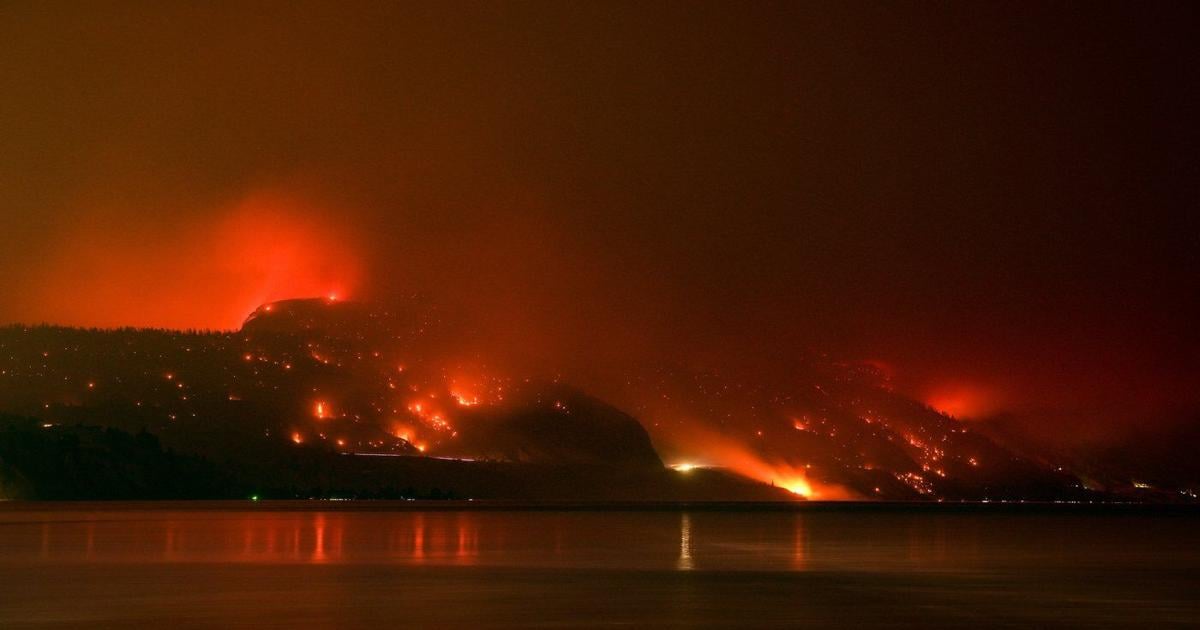
Doug MacLeod could see the danger bearing down on him.
uncertain
danger → see → him
In early August, the forestry contractor was marking trails for heavy equipment to plow fire breaks on the mountainside above Faulder, a community near Summerland in British Columbia’s southern Okanagan valley.
asserted
contractor → mark → valley
He had tied only a single piece of flagging tape when he saw the Bald Range wildfire roaring through the forests toward him.
asserted
wildfire → tie → him
“This is death coming over the mountain,” Mr. MacLeod remembers thinking.
asserted
MacLeod → come → mountain
He abandoned flagging and started pounding on residents’ doors, urging them to flee.
asserted
He → abandon → them
He watched as fire ripped across the valley and cut off Fish Lake Road, the only viable route out of the area.
asserted
fire → watch → area
Knowing he and dozens of residents were now trapped, Mr. MacLeod leaned on his training and decades of wildfire experience to give those around him the best possible chance to survive.
asserted
MacLeod → know → chance
He picked a grassy meadow as far from the tree line as he could get.
uncertain
he → pick → line
If the fire went over them, he told people, they would lie face down, hands over their heads, pressing their lips into small air pockets scraped into the dirt.
asserted
they → go → dirt
It would be a last-ditch effort to avoid death.
asserted
It → avoid → death
They could survive, he thought, but there would be injuries.
uncertain
he → survive → ?
Luckily, a wind shift in the nick of time allowed BC Wildfire Service helicopters to land and start what became a huge air-lift rescue effort.
asserted
what → allow → time
It could have been much worse, Mr. MacLeod said.
uncertain
MacLeod → say → ?
The fire’s behaviour was unlike anything Mr. MacLeod had ever seen.
asserted
MacLeod → see → anything
After nearly 50 years of working in forests, he understood the growing hazard, driven by years-long drought and decades of unchecked forest ingrowth, before the Bald Range fire exploded.
asserted
fire → work → ingrowth
But the scale of the danger is largely invisible to most Canadians until it’s too late.
asserted
it → ’ → Canadians
Though some wildfire hazard mapping is publicly available in B.C., there is a patchwork of incomplete data.
asserted
mapping → be → data
“I think people got to be aware of what’s around them, and communities have to be aware of what’s around them,” Mr. MacLeod said.
asserted
MacLeod → think → them
Experts warn that a failure by governments to make detailed hazard mapping publicly available has left towns and cities across the country more vulnerable to the threat of extreme wildfires.
asserted
mapping → warn → wildfires
Without the information, communities continue to build new housing in high-hazard areas even as critical mitigation efforts are frequently delayed.
asserted
efforts → continue → areas
In light of these concerns, a Senate committee is calling for a new national hazard mapping strategy – and public data similar to what is already available in the United States.
asserted
what → call → States
But some critics worry governments may not be up to the complicated task.
uncertain
governments → worry → task
And even when there is an earnest effort to improve public data, officials can face significant backlash as property owners fear financial consequences.
asserted
owners → be → consequences
Fire officials in Oregon were forced to largely abandon detailed hazard mapping after trying to make better information publicly available.
asserted
information → force → mapping
There is no denying the trendline: Climate change is driving wildfires that are faster and hotter than ever before, and disasters like the Bald Range fire are becoming more common.
asserted
disasters → be → fire
Are Canadians ready to open their eyes to the risk?
asserted
Canadians → open → risk
Hoping to avoid such staggering losses in the future, state legislators also decided to tie each property’s hazard rating to legislated requirements for the property owners.
asserted
legislators → hop → owners
New construction would have to meet a stricter, more fire-resistant building code.
asserted
construction → have → code
And landowners were handed retroactive requirements to do mitigation work like removing or pruning back trees on at-risk properties, efforts proven to help improve a home’s chances of surviving a wildfire.
asserted
landowners → hand → wildfire
Despite being backed up by sound science, the effort blew up in officials’ faces as livid homeowners accused the state of driving up insurance rates and driving down property values.
“We got death threats.
asserted
We → back → threats
We had to cancel meetings.
asserted
We → have → meetings
Our state police said, ‘This [threat] is too credible.
asserted
threat → say → ?
You can’t go to these particular communities,’” Mr. Dunn said.
asserted
Dunn → go → communities
Under pressure, the state quickly withdrew the new requirements for homeowners.
asserted
state → withdraw → homeowners
The maps themselves were temporarily taken down and eventually replaced with simplified versions.
asserted
maps → take → versions
“What happened was a monumental public backlash, unlike anything we’ve seen in recent policy here,” Mr. Dunn said.
asserted
Dunn → happen → policy
“The public response was so entrenched in misinformation, misunderstandings that it was just not surmountable, and so the legislature pulled away.”
asserted
legislature → pull → misinformation
Most frustratingly for Mr. Dunn, the claim that the maps were driving up insurance rates or causing homeowners to lose coverage altogether was untrue.
uncertain
homeowners → drive → coverage
Insurance companies in both the Canada and the U.S. have their own sophisticated risk modelling, Mr. Dunn said.
asserted
Dunn → have → modelling
They already know better than most homeowners what risks a particular home faces.
asserted
home → know → risks
…and 51 more, not listed.
 The Aporia