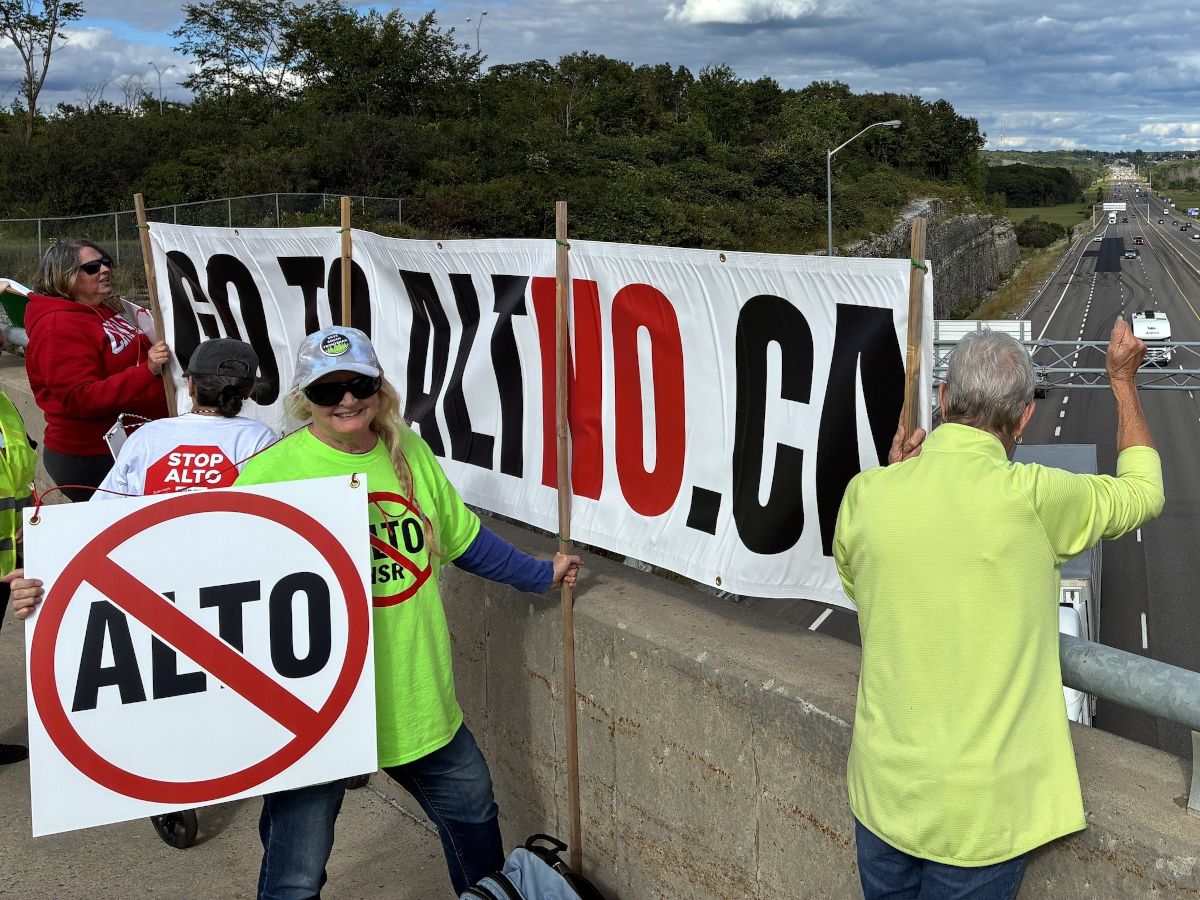
A government that can take your land before buying it is not merely building a railway.
asserted
that → take → railway
It’s testing the limits of property rights.
asserted
It → test → rights
In 2025, the federal government announced plans for a new high-speed rail line, called Alto, to connect Toronto, Ottawa, Montreal and Quebec City.
asserted
government → announce → Toronto
Funded primarily by taxpayers, cost estimates range between $60 billion and $90 billion.
asserted
estimates → fund → billion
To clear the path, in 2022, the government created a Crown corporation to oversee the Alto project and later designated it a “transformative project” to expedite regulatory and environmental reviews.
asserted
government → clear → reviews
Those developments create political momentum.
asserted
developments → create → momentum
They do not establish necessity.
asserted
They → establish → necessity
Under the framework, which was enshrined in law with the passage of the High-Speed Rail Act earlier this year, Alto could potentially expropriate private property along the proposed route without first trying to purchase it from owners.
uncertain
Alto → enshrine → owners
That should concern anyone who believes ownership means more than holding land until the government finds another use for it.
asserted
government → concern → it
A government cannot allow every landowner to veto a hospital, bridge, utility line or highway.
asserted
landowner → allow → hospital
And a government’s declaration that a project serves the “public interest” is not proof that it does.
asserted
it → serve → interest
It is a transportation choice for commuters and travellers, and on the government’s part, it is a policy choice of where to invest in infrastructure.
asserted
it → invest → infrastructure
That does not make Alto illegitimate, but it does mean the burden of justification should be higher before the state compels someone to surrender a home, farm or business.
asserted
state → make → home
The relevant question is whether the benefits are sufficiently clear, broad and substantial to justify taking Canadians’ land.
asserted
benefits → justify → land
That requires evidence, not just assertions.
asserted
That → require → evidence
The government should publish its estimates of ridership, economic growth, environmental gains and operating costs.
asserted
government → publish → ridership
It should explain who benefits — frequent travellers, urban centres, developers near the stations, the public — and who bears the costs — taxpayers, rural communities that won’t use the service and property owners whose land falls within the corridor.
asserted
land → explain → corridor
The benefits of Alto may be widely advertised, but the burdens will be personal.
uncertain
burdens → advertise → Alto
One family could lose land.
uncertain
family → lose → land
Another could see a rail corridor divide fields, undermine drainage or obstruct farm equipment.
uncertain
corridor → see → equipment
A business could lose a location.
uncertain
business → lose → location
A homeowner may retain part of a property but lose privacy, access, value and peace of mind.
uncertain
homeowner → retain → mind
Market-value compensation matters.
asserted
compensation → matter → ?
Full compensation for relocation, business losses and damage to remaining land matters even more.
asserted
compensation → remain → land
But a cheque does not make an involuntary transaction voluntary.
asserted
cheque → make → transaction
For their owners, they may bear intangibles that money cannot buy.
uncertain
money → bear → that
Moreover, property rights provide security: the confidence that one may invest, build and plan without the government casually changing the rules.
uncertain
government → provide → rules
That is why Alto must meet a property-rights test.
asserted
Alto → meet → test
First, it should demonstrate a substantial public need — not a government preference.
asserted
it → demonstrate → need
Second, it should show that the benefits are broadly shared and sufficiently certain to justify compulsory acquisition.
asserted
benefits → show → acquisition
Third, it should compare less intrusive alternatives, including upgrades to existing rail lines and alternative routes.
asserted
it → compare → lines
Most importantly, Alto must prove not only that a railway is useful, but that the route is necessary.
asserted
route → prove → ?
The project is planned to eventually span roughly 1,000 kilometres.
asserted
project → plan → kilometres
Yet the route has not been finalized, land rights have not been secured and environmental and impact assessments remain incomplete.
asserted
assessments → finalize → ?
Active development does not mean every parcel within a prospective corridor is destined for public use.
asserted
parcel → mean → use
If several routes can substantially serve the same purpose, the government should not automatically select the cheapest option while imposing the greatest burden on private landowners.
asserted
government → serve → landowners
The cost of disrupting hundreds of homes, farms and businesses is a real project cost.
asserted
cost → disrupt → homes
It cannot be dismissed after the route is chosen.
asserted
route → dismiss → ?
Negotiated acquisition should be the rule.
asserted
acquisition → negotiate → ?
Making compulsory acquisition easy creates the wrong incentives and encourages planners to treat private land as an available input rather than a right deserving respect.
asserted
acquisition → make → respect
…and 9 more, not listed.
 The Aporia