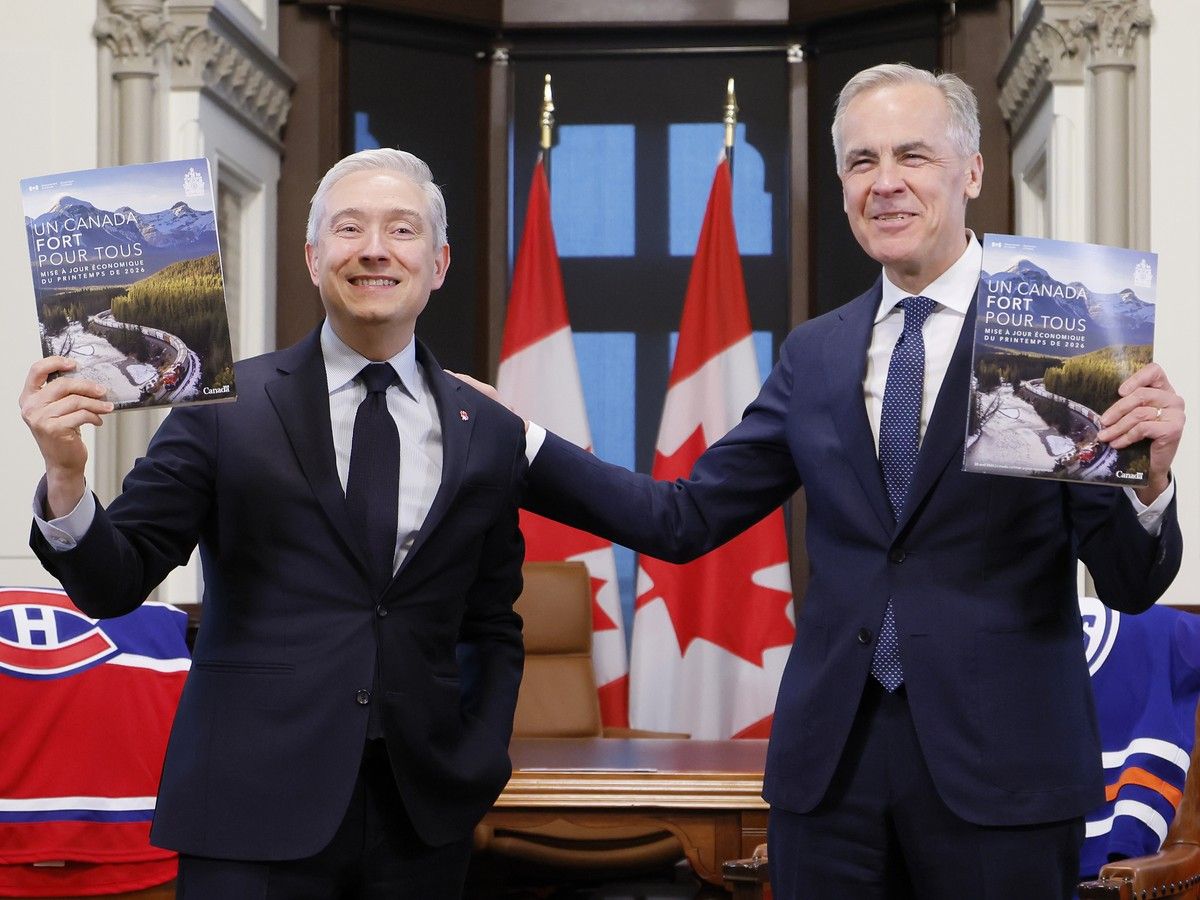
Photo via National Post

Carney will miss target for balancing operating budget, PBO says

Read the original at National Post ↗
Cite

Tuck, S. (2026, September 24). Carney will miss target for balancing operating budget, PBO says. National Post. https://nationalpost.com/news/politics/carney-will-miss-target-balancing-operating-budget-pbo-says

Dated when The Aporia collected the article, usually within hours of publication. Check the original for its exact date and byline.

National Post · collected 2026-09-24 · by Simon Tuck

Quick Summary

The Parliamentary Budget Office (PBO) reports that Canada's federal government will miss its target of balancing the operating budget by 2028-29 and won't achieve this goal until 2030. The PBO criticizes the Carney government for inconsistencies in classifying spending as either capital or operational, suggesting these discrepancies may obscure true financial status. Ottawa spent approximately $546.6 billion on operating expenses and $34.5 billion on capital costs in 2025-26, according to the report.
Written by AI on 2026-09-24, from this article's own text only (the story summary below draws on all the coverage).

AI analysis

Story summary

OTTAWA — The Parliamentary Budget Office (PBO) has released a report questioning when Prime Minister Mark Carney's government will achieve its goal of balancing the operating budget. Despite Carney’s statement last week that the government expects to meet this target a year earlier than initially planned, for 2027-28 rather than 2028-29, the PBO projects Ottawa will miss this mark by one additional year based on data from the 2025 budget and economic update. The PBO notes that Ottawa spent approximately $546.6 billion on operating expenses in 2025-26 and $34.5 billion on capital costs, raising concerns about inconsistent classification of spending programs like Agricultural Clean Technology as capital versus the operating side for other programs such as Agricultural Climate Solutions. This discrepancy undermines transparency and complicates efforts to accurately forecast future budget balances.

Written for “Canadian Budget Shortfall” on 2026-11-03, grounded in this article and the 0 other(s) covering the same event.

Story

📰 Canadian Budget Shortfall
Economy/Business · 1 article(s) covering the same event.

Compared with similar articles

This article reads unscored and hedges 4% of its claims. Each row says how that neighbour differs.
Toronto Star
Hedges 0 of 6 claims Outlet record 64/100
“The articles report on different time periods and financial outcomes related to federal government spending but do not describe the exact same incident.”
How this article was measured signals, leaning charts, publisher record, byline, topics and claims

Signals How these are calculated →

Claims extracted
24
sentences that state something as happening or true
Uncertain
4%
1 of 24 hedged ("reportedly", "may", "according to")
Leaning
withheld
no quote in the article backed the model's score
Publisher signals
60/100
National Post's corrections and hedging, across everything collected from it. Not a measure of accuracy.
Outlets on this story
1
Economy/Business
Same framing elsewhere
1
articles that frame the event the way this one does
Analyzed 2026-09-24 · how these are computed

How this is being covered How these are calculated →

Article leaning vs. publisher reliability
Source leaning vs. consistency

Publisher

National Post · 1242 article(s) · 2 correction(s) detected
Running correction rate · 2 correction(s)

Who wrote this

Simon Tuck
10 article(s) here · 1 carrying a prediction
🔮 OTTAWA — Tax reform designed to spur economic growth will be a key pillar in Prime Minister Mark Carney’s second budget, government sources say, signalling another policy shift in the governing Liberals from the Justin Trudeau era.
2026-10-29 · assertive framing · Carney budget to focus on taxes, shift from Trudeau era
🔮 The update also announced the new Council for 24 Sussex, a group of “distinguished” supporters of the project who will add their voices, expertise and access to networks, while helping raise awareness and encourage contributions.
🔮 That could include using sanctions to freeze and forfeit assets to compensate victims and their families.
🔮 The Carney government announced Tuesday that it will create a new Crown corporation for defence procurement, the latest new wing of the federal bureaucracy at a time of public service cuts.
🔮 A new report by Ottawa’s fiscal watchdog warns that the planned high-speed rail project from Toronto to Quebec city could cost as much as 25 per cent more than the Carney government’s highest estimates.
🔮 But as Meggs’ brief trek across the bridge suggests, the 15-acre park may now be overrun by swarms of government.
🔮 A new report by Ottawa’s fiscal watchdog raises questions about when the government will eliminate its operating deficit, despite Prime Minister Mark Carney saying last week that the government now expects to balance its operating budget a year earlier than the original goal.
🔮 — The Carney government’s latest round of counter-tariffs may weaken the legal case against the Trump tariffs, because they directly discriminate against American imports, a new think tank report says.
🔮 — Repeating his recent emphasis on saving Canadians’ money, Poilievre said the cuts would come largely from reducing the federal bureaucracy, foreign aid, corporate welfare, fake asylum claims and “boondoggles” like the government’s high-speed rail plan.
🔮 The domestic golf cart business has only a handful or so players, but small businesses that import and sell mobility scooters, power wheelchairs and other electric or battery-powered gadgets may also fall under the same automotive classification.
Also by Simon Tuck
Nothing else under this byline is closely related to this article, so these are simply their most recent.
All 10 articles by Simon Tuck →

Topics

Canada OTTAWA PBO The Government’s Operating Budget Fiscal Anchor the Parliamentary Budget Office

Subjects

OTTAWA GPE · 9× PBO ORG · 9× Carney PERSON · 4× Terrazzano PERSON · 2× Canada GPE · 1× Mark Carney PERSON · 1× Norway GPE · 1× The Government’s Operating Budget Fiscal Anchor ORG · 1× The United Kingdom GPE · 1× the Parliamentary Budget Office ORG · 1×

Narrative

In a document called The Government’s Operating Budget Fiscal Anchor, the PBO says it seems contradictory to classify the government’s Agricultural Clean Technology program as a capital cost, for example, while its Agricultural Climate Solutions program is on the operating side.
framing: assertive · carried by 1 article(s) · first seen 2026-09-24
🔮 A new report by Ottawa’s fiscal watchdog raises questions about when the government will eliminate its operating deficit, despite Prime Minister Mark Carney saying last week that the government now expects to balance its operating budget a year earlier than the original goal.
2026-09-24 · National Post
Carney will miss target for balancing operating budget, PBO says · assertive framing

Claims (24 extracted, 1 hedged)

A new report by Ottawa’s fiscal watchdog raises questions about when the government will eliminate its operating deficit, despite Prime Minister Mark Carney saying last week that the government now expects to balance its operating budget a year earlier than the original goal. asserted
government → raise → goal
Based on the information that the government released in its 2025 budget and this spring’s economic update, the Parliamentary Budget Office (PBO) projects that Ottawa will miss its target of balancing the operating budget by 2028-29 by a year. asserted
Ottawa → base → year
The PBO says Ottawa spent about $546.6-billion on operating expenses in 2025-26 and $34.5-billion on capital costs. asserted
Ottawa → say → costs
The report also says the Carney government’s treatment of some of its budget items is contradictory, raising further questions about the government’s decision last year to split its spending into two distinct ledgers. asserted
treatment → say → ledgers
The PBO said Thursday the federal government needs to do more to sort out its definitions for capital versus operating items, wiggle room that many economists say will tempt governments to lump as much spending as possible into the rosier-sounding capital side. asserted
economists → say → side
That temptation will be particularly alluring for the Carney government because it’s facing massive deficits for the foreseeable future and established a key fiscal target last year of eliminating the operating deficit by 2028-29. asserted
it → face → 2028
In a document called The Government’s Operating Budget Fiscal Anchor, the PBO says it seems contradictory to classify the government’s Agricultural Clean Technology program as a capital cost, for example, while its Agricultural Climate Solutions program is on the operating side. asserted
program → call → side
Both programs, the PBO says, are designed to trigger farm investments. asserted
PBO → say → investments
“This makes it difficult to anticipate how future spending will be sorted,” the PBO report says. asserted
report → make → ?
The PBO points out that Canada is not the first country to split its operating and capital budgets. asserted
Canada → point → budgets
The United Kingdom, Norway and Singapore do similar things, but the PBO points out that the U.K. also paired the move with a rule that borrowing is only allowed to pay for capital costs. asserted
borrowing → do → costs
The UK also used a definition of capital spending that is internationally accepted. asserted
that → use → spending
Franco Terrazzano, federal director of the Canadian Taxpayers Federation, said the PBO report is further evidence that Ottawa has been expanding the definition of capital spending in a way that wouldn’t be allowed in the UK. asserted
that → say → UK
But the real problem, Terrazzano said, isn’t the government’s accounting methods but that Carney’s “credit card government” spends and borrows way too much. asserted
government → say → much
The federal government is borrowing about $65-billlion a year, Terrazzano said, more than Ottawa sends to the provinces and territories for health transfers or collects from the GST. asserted
Ottawa → borrow → GST
“We’re paying way too much paying interest on the debt.” asserted
We → pay → debt
John Fragos, spokesman for Finance Minister François-Philippe Champagne, said the government has already identified $60-billion in savings over the next five years, allowing Ottawa to eliminate the operating deficit a year ahead of schedule. asserted
Ottawa → say → schedule
Those savings, Fragos said, will allow the federal government to spend more on capital costs that will support economic growth. asserted
that → say → growth
The Carney government’s first budget last fall marked the first time that Ottawa had separated capital and operational or day-to-day spending. asserted
Ottawa → mark → day
The key distinction, according to the government, is between regular, day-to-day expenses such as wages for federal public servants and social service payments, and those capital costs on such things as ports, military equipment and other infrastructure that should provide long-term benefit. uncertain
that → accord → benefit
In its spring economic update, the government said it expected to post a deficit of $66.9 billion for the past year, slightly less than expected, due to improved fiscal outcomes. asserted
it → say → outcomes
But Ottawa’s broader fiscal outlook remains dire. asserted
outlook → remain → ?
The federal government has now accumulated $1.27-trillion in total debt, almost half of which has been added over the last five years. asserted
half → accumulate → years
National Post Our website is the place for the latest breaking news, exclusive scoops, longreads and provocative commentary. asserted
website → break → news

💬Give feedback
🕘History 🎫Support