Talking Shop is our series where we talk to interesting people about their most interesting buys.
asserted
we → talk → buys
Maybe you read “The Fault in Our Stars” when it debuted as a bestseller, relied on Crash Course videos to study for college finals or subscribed to the Vlogbrothers YouTube channel after stumbling upon a few videos.
asserted
it → read → videos
However you discover John Green, it’s easy to become a fan of his work (at least in my opinion) and wonder what he’s doing next.
asserted
he → discover → what
This week, he gave us the answer.
asserted
he → give → answer
For the first time in nearly a decade, Green published a new book, his highly-anticipated novel, “Hollywood, Ending,” and he’s trying his absolute best to let you read it without spoilers.
asserted
you → publish → spoilers
“I feel like people who read a book the week it comes out should be able to read it completely cold,” says Green, who’s been extremely careful about how he discusses “Hollywood, Ending” in interviews, on social media and on tour.
asserted
he → feel → tour
He’s happy to give you a bird’s eye view of the plot, explain how he developed the characters and share where he found inspiration.
asserted
he → ’ → inspiration
But you need to crack open your copy for anything beyond that, or press play on the audiobook, which he totally supports.
asserted
he → need → which
I recently talked to Green about writing “Hollywood, Ending,” what he needs within reach while working and his travel must-haves for book tours.
asserted
he → talk → tours
He also gave me a mini tutorial on how he organizes his library, and, I promise, you’ll want to redo yours after reading his method.
asserted
you → give → method
Per Green’s request, I won’t spoil “Hollywood, Ending” after reading it, so here’s my one sentence synopsis: It tells the story of two young actors navigating the complexities of fame while falling in love and working on a movie together, a biopic about artist Andy Warhol.
asserted
It → spoil → Warhol
Green addresses themes in the book that he’s been ruminating on for a while.
asserted
he → address → while
“From the time I first had books adapted to movies, I knew that Hollywood would be an interesting place to write about, and I was interested in the ways that it’s not just movie stars now who are commodifying their private experience for public consumption,” says Green.
asserted
Green → have → consumption
“I’ve long felt like that would be fertile ground for a novel, but it took the last eight years to really find my way through it.”
asserted
it → feel → it
“Hollywood, Ending” is technically Green’s first fiction book for an adult audience: “The Fault in Our Stars,” “Looking for Alaska,” “Turtles All the Way Down,” “Paper Towns,” “An Abundance of Katherines” and “Will Grayson, Will Grayson” all centered around teens and naturally fell into the Young Adult (YA) genre.
asserted
Fault → look → genre
But he told me that he approached writing for adults very similarly to how he did for teens because both groups are “intellectually sophisticated and careful readers.”
asserted
groups → tell → teens
“The problems the characters in this book are facing are the problems of early adulthood.
asserted
characters → face → adulthood
When you’re in your 20s, you’re trying to figure out not just what you’re going to do with your life, but who you’re going to do life with,” says Green.
asserted
Green → ’re → life
“You have this huge array of possibilities for how your life can go, which is equal parts intoxicating and terrifying.
asserted
which → have → possibilities
I wanted to explore those problems and that time of life.”
asserted
I → want → life
Green’s favorite place to write is in his office, which is a shed on his property in Indianapolis.
asserted
which → write → Indianapolis
“It’s quiet, it’s solitary and it suits my introverted nature,” he says.
asserted
he → ’ → nature
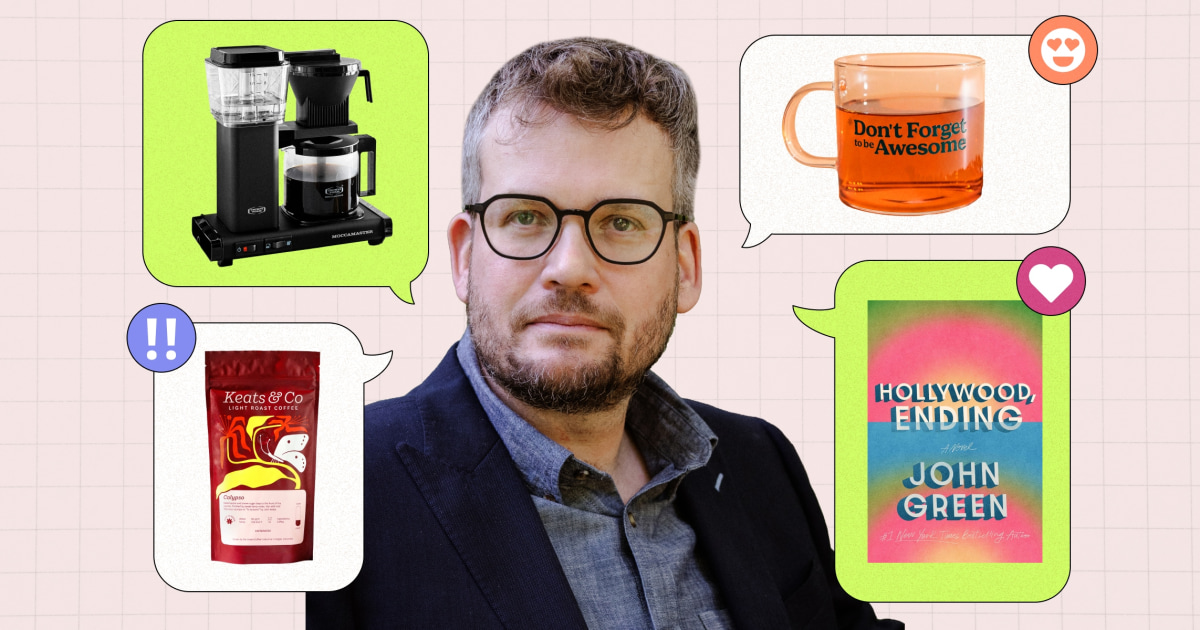
While putting pen to paper (well, fingers to keyboard), he often listens to his favorite band, The Mountain Goats, and he always has a hot cup of coffee within reach — he admittedly drinks a lot of it throughout the day, usually in his Don’t Forget to be Awesome glass mug.
asserted
he → put → mug
Green’s go-to brewer is the Moccamaster since he prefers drip coffee.
asserted
he → go → coffee
And while he’s passionate about how the quality of the coffee itself matters more than the brewing method, the Moccamaster is a top notch machine that’s built to withstand constant use.
asserted
that → ’ → use
The specific type of coffee Green drinks is from Keats & Co., a company he and his brother, Hank Green, founded as part of Good Store, a marketplace they run that donates 100 percent of its profits to charity.
asserted
that → drink → charity
Keats & Co. came about after the Greens worked with a coffee roaster in Kansas City for a year to nail down flavor profiles for their products.
asserted
Greens → come → products
“We work with small communities of farmers to get the best beans in the world, and then we work with one of the best roasters in the world to make really extraordinary coffee,” he says.
asserted
he → work → coffee
“I don’t like to brag, but I do drink the coffee every day, and when I have to drink grocery store coffee, I’m kind of grossed out.”
asserted
I → like → coffee
Now that “Hollywood, Ending” is published, Green is going on a 20-city book tour.
asserted
Green → publish → tour
“I’m traveling for like a month with a carry-on suitcase, so nothing inessential goes into it — only clothing, toothbrushes and the absolute essentials allowed,” he says.
asserted
he → travel → it
“I always travel with a book because you’re never alone in the world as long as you have a book to read.”
asserted
you → travel → book
Green’s favorite book of the year is “Canon: A Novel” by Paige Lewis — he even got to write a blurb for it that appears on the jacket.
asserted
that → get → jacket
When he’s done reading his books, he finds a spot for them in his library, which is intricately organized.
asserted
which → do → library
“One of my most prized books is the New York Public Library’s “Guide to Organizing a Home Library’,” says Green.
asserted
Green → organize → Library
“They have a lot of recommendations that I took, but the main one is to separate by genre as it makes sense to you, rather than as it makes sense to someone from the outside.
asserted
it → have → outside
And then with my fiction, I separate my dead authors from my living authors, so that when an author dies, I can make the somber transition.”
asserted
I → separate → transition
Before Green left for his book tour, he spent time doing one of his favorite activities: making hot sauce.
asserted
he → leave → sauce
“I have a garden that I share with my mother, and we grow peppers and then make hot sauce from them,” he says.
asserted
he → have → them
“From February to October, my mom and I always know what we’re doing with our spare time.
asserted
we → know → time
…and 6 more, not listed.
 The Aporia