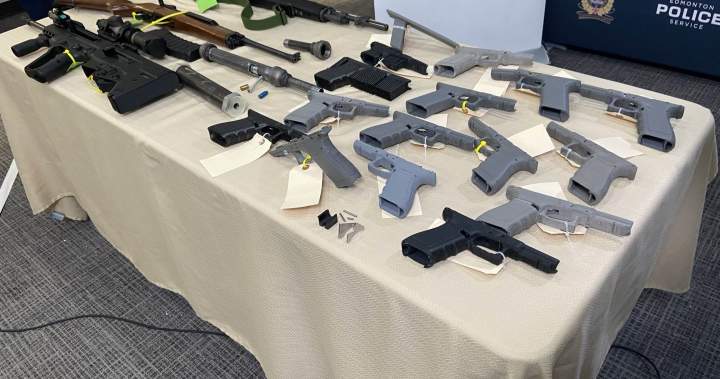
An Edmonton man will spend time behind bars after he used a 3D printer to manufacture guns.
asserted
he → spend → guns
The judge told the court these types of weapons create a unique danger to the public, police and potential victims.
asserted
types → tell → public
Roy Tucker, 31, originally faced more than 40 charges from the Edmonton Police Service, related to manufacturing 3D printed firearms and possession of prohibited firearms.
asserted
Tucker → face → firearms
Tucker’s charges stemmed from a national investigation called Project Reproduction, which began in Quebec in 2022.
asserted
which → stem → 2022
Police discovered in 2023 that the 31-year-old had purchased files that could be used to 3D print parts for firearms and in June of that year, officers searched Tucker’s northside home.
uncertain
officers → discover → home
Tucker was a registered firearms owner and according to an agreed statement of facts, officers found 38 lawfully owned guns in his home.
uncertain
officers → register → home
They also found numerous 3D-printed parts used to build firearms.
asserted
They → find → firearms
During his trial, the Crown told the court they found Tucker had printed or attempted to print 16 firearms.
asserted
Tucker → tell → firearms
Officers were able to build three operational guns from the 3D-printed parts and there were enough parts to assemble five more weapons.
asserted
Officers → build → weapons
The agreed statement of facts said Tucker also had more than 32,000 rounds of ammunition around his home.
asserted
Tucker → agree → home
He also owned 27 overcapacity magazines; some had more than the 30 rounds that are legally capable.
asserted
that → own → rounds
The Crown sought a four-and-a-half year jail sentence and numerous ancillary orders.
asserted
Crown → seek → sentence
Crown prosecutor Kerri Facchinutti said this was planned and deliberate and the opposite of an impulsive crime.
asserted
this → say → crime
Facchinutti noted 3D-printed weapons undermine Canada’s firearms program, and ghost guns are highly valuable on the black market.
asserted
guns → note → market
Get daily National news
The defense proposed a two-year conditional sentence order, with potentially 12 to 18 months of house arrest and a significant amount of community service.
asserted
defense → get → service
Defense lawyer Graham Rapson told the court that there was no suggestion or proof that the 3D-printed parts were going to be sold, and there is no evidence his client used the 3D printed firearms.
asserted
client → tell → firearms
The defense asked the judge to consider Tucker’s autism diagnosis in the sentence, saying it contributed to the 3D-printing activity and the number of items found in his home.
asserted
it → ask → home
Rapson suggested this was a hobby that has gone wrong and Tucker has a low risk of reoffending.
uncertain
Tucker → suggest → reoffending
Justice John Henderson questioned if a two-year sentence can satisfy general deterrence for this type of crime and that any message sent by the sentence has to dissuade people from getting into the 3D-weapons printing business.
asserted
message → question → business
Tucker spoke in court Wednesday.
asserted
Tucker → speak → court
In an emotional speech, he told the justice his intent was never for violence or profit and his actions stemmed from curiosity.
asserted
actions → tell → curiosity
“I know in my heart I will never do this again,” he said.
asserted
he → know → this
“I will never touch a firearm again.”
In his sentencing decision Thursday morning, Henderson told the court because of the severity of the crime, the 31-year-old could not serve his sentence in the community and a sentence of less than two years in custody would not satisfy the seriousness.
uncertain
sentence → touch → seriousness
The gravity of these offences is very high, the judge told the court in his decision.
asserted
judge → tell → decision
The agreed statement of facts said Tucker had a print out of Bill C-21, which proposed major changes to Canadian gun control laws.
“Several portions of the bill are highlighted, including prison time for the offences and search and seizure provisions,” the statement said.
asserted
statement → agree → offences
Henderson told the court that showed Tucker knew of the existence of regulations and still proceeded with manufacturing.
asserted
Tucker → tell → manufacturing
Henderson said this was a well-planned, sophisticated scheme that took place over many months.
asserted
that → say → months
Noting while there was no evidence to suggest Tucker attempted to sell or sold the weapon parts, making them in the first place created an inherent danger.
asserted
making → note → danger
“There is no single victim in this case, thus the gravity of the harm must be based not on the harm to a single victim, but to society and its values,” Henderson said.
asserted
Henderson → be → society
He noted the intention of Parliament to keep the public safe from firearms could not be clearer.
uncertain
intention → note → firearms
Tucker held his head in his hands as he was sentenced to three years in prison and received a lifetime weapons ban.
asserted
he → hold → ban
Tucker was released the day of his 2024 arrest, therefore will not receive any credit for time served awaiting trial.
asserted
Tucker → release → trial
 The Aporia