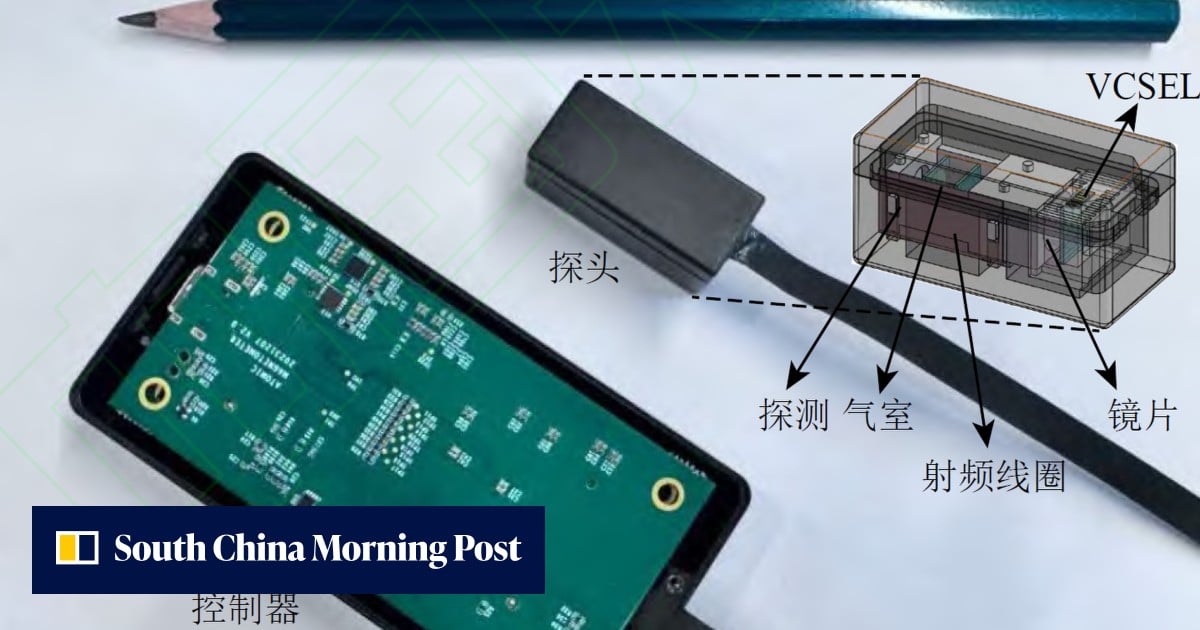
Photo via South China Morning Post

China tested a handheld submarine detector. It tracked a subway train underground

Read the original at South China Morning Post ↗
Cite

Tong, Z. (2026, September 25). China tested a handheld submarine detector. It tracked a subway train underground. South China Morning Post. https://www.scmp.com/news/china/science/article/3367965/china-tested-handheld-submarine-detector-it-tracked-subway-train-underground?utm_source=rss_feed

Dated when The Aporia collected the article, usually within hours of publication. Check the original for its exact date and byline.

South China Morning Post · collected 2026-09-25 · by Zhang Tong

Quick Summary

Chinese researchers have developed a small handheld device for detecting submarines that is capable of tracking a subway train underground. The device, created by Peng Xinhua and his team at the University of Science and Technology of China, is described in a study published on September 14. Despite being pencil-sized and using only 5 watts of power, it can detect magnetic disturbances caused by moving trains, including their braking, stopping, and departure.
Written by AI on 2026-09-25, from this article's own text only (the story summary below draws on all the coverage).

AI analysis

Story summary

China tested a handheld device designed to detect submarines but which also successfully tracked an underground subway train. Developed by Peng Xinhua and his team at the University of Science and Technology of China, this tiny apparatus is just the size of a pencil and uses only 5 watts of power. Published on September 14 in Acta Physica Sinica, the device can isolate the magnetic disturbances caused by moving objects like trains from Earth's background field, allowing it to record train movements such as braking, stopping, and departure accurately. This technology could potentially be adapted for various applications beyond submarine detection, including urban surveillance or infrastructure monitoring.

Written for “Chinese Submarine Detection Technology” on 2026-11-04, grounded in this article and the 0 other(s) covering the same event.

Story

📰 Chinese Submarine Detection Technology
Technology · 1 article(s) covering the same event.

Compared with similar articles

Nothing to compare against. No article is close enough to this one for the pipeline to have linked or judged the pair.
How this article was measured signals, leaning charts, publisher record, byline, topics and claims

Signals How these are calculated →

Claims extracted
4
sentences that state something as happening or true
Uncertain
0%
0 of 4 hedged ("reportedly", "may", "according to")
Leaning
not political
takes no side on a contested political question
Publisher signals
62/100
South China Morning Post's corrections and hedging, across everything collected from it. Not a measure of accuracy.
Outlets on this story
1
Technology
Same framing elsewhere
1
articles that frame the event the way this one does
Analyzed 2026-09-25 · how these are computed

How this is being covered How these are calculated →

Article leaning vs. publisher reliability
Source leaning vs. consistency

Publisher

South China Morning Post · 3720 article(s) · 8 correction(s) detected
Running correction rate · 8 correction(s)

Who wrote this

Zhang Tong
18 article(s) here · 0 carrying a prediction
🔮 The last state to close polls will be Alaska, at 1am Eastern Time (2pm Hong Kong time).
🔮 How the technology will affect a field known as most difficult discipline of all has sparked heated discussions in mathematical community Human teams are now interpreting the AI-generated results in mathematics, computer science and physics, OpenAI said.
🔮 “The programme noted in the letter will officially terminate after the current academic year,” she said.
🔮 A federal judge subsequently acquitted him on seven additional counts of economic espionage, finding insufficient evidence that he knew or intended at the time of the thefts that his conduct would benefit the Chinese government.
🔮 China lights up ‘super microscope’ hopes with world-leading electron gun beam By observing matter at the atomic scale, the Hefei Advanced Light Facility could drive breakthroughs in microchips
🔮 State broadcaster CCTV reported that the technology could fundamentally strengthen China’s ability to secure its own iron resources and reduce its heavy dependence on imports of the strategic commodity.
🔮 The Fengyun-4C’s storm-tracking abilities could provide vital early warnings about extreme weather events during the rescue operation China is using the world’s most powerful geostationary weather satellite to track severe thunderstorms over Nepal and deliver real-time intelligence as the two countries continue search and rescue operations following last month’s devastating glacier collapse.
🔮 By tracking the needle’s tiny deflections, the team can measure magnetic fields down to the femtotesla level – an advance that could widen the hunt for elusive dark matter particles or monitor brain signals.
Also by Zhang Tong
Nothing else under this byline is closely related to this article, so these are simply their most recent.
All 18 articles by Zhang Tong →

Topics

Acta Physica Sinica China the University of Science and Technology

Subjects

China GPE · 2× Acta Physica Sinica ORG · 1× Peng Xinhua PERSON · 1× the University of Science and Technology ORG · 1×

Narrative

The tiny device is the size of a pencil and uses just 5 watts of power but can record a train braking into a station under a city street The device, developed by Peng Xinhua and colleagues at the University of Science and Technology of China, is described in a study published on September 14 in Acta Physica Sinica.
framing: assertive · carried by 1 article(s) · first seen 2026-09-25
2026-09-25 · South China Morning Post
China tested a handheld submarine detector. It tracked a subway train underground · assertive framing

Claims (4 extracted, 0 hedged)

China tested a handheld submarine detector. asserted
China → test → detector
It tracked a subway train underground asserted
It → track → train
The tiny device is the size of a pencil and uses just 5 watts of power but can record a train braking into a station under a city street The device, developed by Peng Xinhua and colleagues at the University of Science and Technology of China, is described in a study published on September 14 in Acta Physica Sinica. asserted
device → use → Sinica
Though it is scarcely larger than a pencil and draws only 5 watts of power, it can isolate the magnetic disturbance caused by a moving train in the Earth’s vast background field, clearly recording the train braking into a station, its stop and its departure under traction. asserted
train → draw → traction
💬Give feedback · no sign-in needed

No sign-in needed for now. Your note is sent without a name, so it cannot be answered.

🕘History 🎫Support