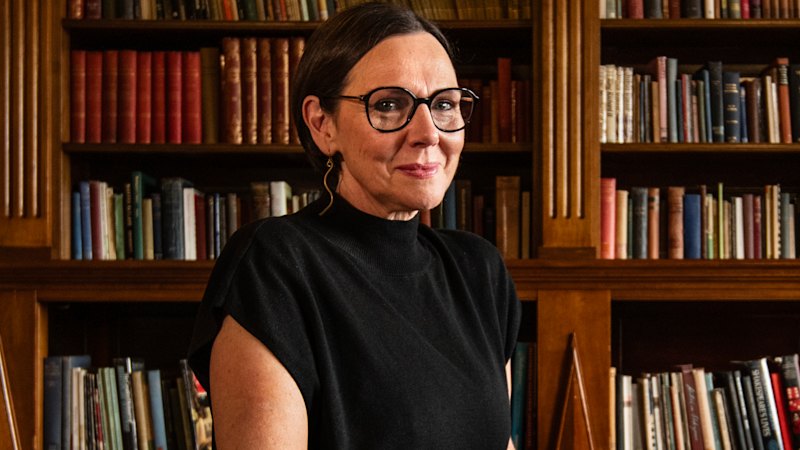
Because she spent six years writing Dictionary of Lost Words and Bookbinder of Jericho, Pip Williams was determined her next book would be a simple tale of love.
asserted
book → spend → love
The German Ward, released next week, is indeed a love story but, like New York Times bestseller Dictionary, it explores multiple themes from many perspectives.
asserted
it → release → perspectives
“In the end, it seems I’m incapable of writing just a simple, single storyline; it’s again a layered story.
asserted
it → seem → storyline
But at its heart, it is all about desire, the desire for something – and every character desires something,” the Adelaide-based author says.
asserted
author → desire → something
Set in Etaples in France during World War I, the book’s central character is the actor and suffragette Tilda Taylorfrom Bookbinder of Jericho.
asserted
character → Set → Jericho
During research for that novel, Williams was looking at work by Australian artist Iso Rae, deep in the archives of the Australian War Memorial (AWM).
asserted
Williams → look → Memorial
Rae and her family lived in the northern riverside town, which swelled to house 100,000 troops by 1917.
asserted
which → live → 1917
As well as helping in army base hospitals - 20 general hospitals served the wounded from the Somme battlefields - she documented what she saw.
asserted
she → help → what
While never an official war artist, that work has become her best known; about 19 pieces are held at the AWM.
asserted
pieces → become → AWM
Those drawings provided Williams with information she couldn’t find in the written records.
asserted
she → provide → records
“It’s happened in all of my novels.
asserted
It → happen → novels
A lot of the information that helps me furnish that history, that time and place, actually comes from women’s art, whether it’s poetry or memoir or visual art,” she says.
asserted
she → help → art
“I get so much from that kind of archival material compared to official records, and that’s often because the official records don’t pay much attention to women’s lives, whereas women pay attention to their lives, their surroundings, what affects them.”
asserted
what → get → them
The drawings gave her a sense of the place in which Rae lived and worked - crucial, because it was where she had sent Tilda in Bookbinder.
asserted
she → give → Bookbinder
“I wanted to be able to understand where the letters were coming from that Tilda was writing to the main characters in that previous novel.
asserted
Tilda → want → novel
The latest book’s title refers to the ward that housed injured Germans soldiers.
asserted
that → refer → soldiers
Like many elements of the story, the ward existed.
asserted
ward → exist → story
As did the Voluntary Aid Detachments, known as VADs, who worked alongside medical staff in such camps, tending to patients and often doing the work of nurses
asserted
who → do → nurses
While Rae worked as a VAD and was a prolific artist, she is fictionalised in the book.
asserted
she → work → book
Born in Collingwood, she studied at the National Art School, and, in 1887, her family moved to Paris.
asserted
family → bear → Paris
They moved to the French village in 1890, then home to an artist’s colony, and remained there even when war broke out because her mother was too frail to move.
asserted
mother → move → colony
As a social scientist turned novelist, Williams’ first career informs her writing: where possible, truth informs events, places and people.
asserted
truth → turn → events
In Dictionary of Lost Words, for example, every word featured is an actual word.
asserted
word → feature → example
“My adherence to the known facts is ingrained, which is why my author notes are so extensive.
asserted
notes → know → facts
Because I’ve spent 25 years having to acknowledge my sources,” she says.
asserted
she → spend → sources
Williams has no problem writing about and imagining real people but she has a particular approach to doing so.
asserted
she → have → approach
“Anything I know of them, I try very hard to be true to that understanding of them, whether it’s their nature, their humour, their particular moral code.”
asserted
it → know → them
“If there isn’t enough information, then I will respectfully imagine more, based on what I’ve got.”
She argues there is much we don’t know even about our closest friends and relatives.
asserted
we → be → friends
“I don’t think there is an official record of anyone who’s ever lived.
asserted
who → think → anyone
So much will be imagined.
asserted
much → imagine → ?
Even if you’re a biographer or historian, you will be imagining a lot, even if you say you’re not.”
asserted
you → ’re → lot
Where the formal documentation differs from a first-hand account, Williams gives priority to the first-hand.
asserted
Williams → differ → hand
For this book, her extensive research included journals, oral histories, memoir, poetry and art.
asserted
research → include → journals
She cites Vera Brittain’s poetry and her memoir Testament of Youth (1933), which details her experience as a VAD during the war, as critical.
asserted
which → cite → war
She also consulted with “all the usual sources”, museums, archives and galleries, and made two trips to Etaples.
asserted
She → consult → Etaples
When she visited and went for a swim, she realised she had to change one scene - having imagined it was sandy underfoot – when she realised it was silty.
asserted
it → visit → scene
Once she has all the background information, Williams begins to write, heading anywhere but the gorgeous, purpose-built room lined with bookcases attached to her home in the Adelaide Hills, which her husband built a few years ago.
asserted
husband → have → which
“I cannot write in there.
asserted
I → write → ?
Instead, she spends hours tapping away at her keyboard in cafes: “It gives me a sense that I’m not working.”
asserted
I → spend → sense
Often asked why she writes historical fiction, Williams says it wasn’t the genre she was drawn to but an interest in the Oxford English Dictionary.
asserted
she → ask → Dictionary
…and 40 more, not listed.
 The Aporia