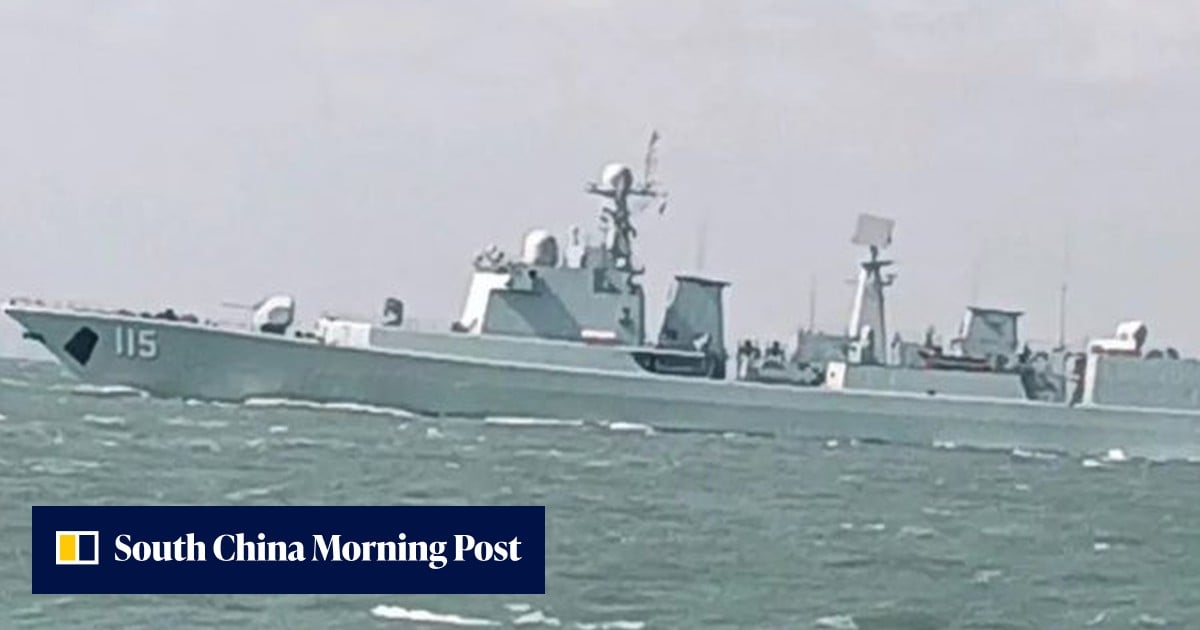
Photo via South China Morning Post

The Chinese roots of ‘gung-ho’ as Trump and Xi look to shared history

Read the original at South China Morning Post ↗
Cite

Zhen, L. (2026, September 25). The Chinese roots of ‘gung-ho’ as Trump and Xi look to shared history. South China Morning Post. https://www.scmp.com/news/china/military/article/3368832/chinese-roots-gung-ho-trump-and-xi-look-shared-history?utm_source=rss_feed

Dated when The Aporia collected the article, usually within hours of publication. Check the original for its exact date and byline.

South China Morning Post · collected 2026-09-25 · by Liu Zhen

Quick Summary

Donald Trump mentioned a Chinese phrase "gung-ho" during his welcome for Xi Jinping at the White House, which may have confused some viewers who do not know its origin. The term actually comes from the name of wartime cooperative groups called gongye hezuoshe (工业合作社) in China, established in 1938 to support the war effort against Japan by producing industrial supplies.
Written by AI on 2026-09-25, from this article's own text only (the story summary below draws on all the coverage).

AI analysis

Story summary

During a welcoming speech at the White House for Chinese President Xi Jinping on Thursday, US President Donald Trump mentioned a "Chinese phrase" called gung-ho, which puzzled some Chinese viewers. The term actually originates from 1938 in China when grassroots labor units known as industrial cooperatives (gongye hezuoshe) were established to produce small industrial supplies for the war effort against Japan. These cooperatives adopted the name gung-ho, which is a shortened version of "gong he" in pinyin, meaning "industrial cooperatives." The US Marine Corps later adapted this term into their lexicon during World War II.

Written for “Chinese Roots Of Gung Ho” on 2026-10-31, grounded in this article and the 0 other(s) covering the same event.

Story

📰 Chinese Roots Of Gung Ho
Politics · 1 article(s) covering the same event.

Compared with similar articles

Nothing to compare against. No article is close enough to this one for the pipeline to have linked or judged the pair.
How this article was measured signals, leaning charts, publisher record, byline, topics and claims

Signals How these are calculated →

Claims extracted
4
sentences that state something as happening or true
Uncertain
50%
2 of 4 hedged ("reportedly", "may", "according to")
Leaning
not political
takes no side on a contested political question
Publisher signals
64/100
South China Morning Post's corrections and hedging, across everything collected from it. Not a measure of accuracy.
Outlets on this story
1
Politics
Same framing elsewhere
1
articles that frame the event the way this one does
Analyzed 2026-09-25 · how these are computed

How this is being covered How these are calculated →

Article leaning vs. publisher reliability
Source leaning vs. consistency

Publisher

South China Morning Post · 3480 article(s) · 6 correction(s) detected
Running correction rate · 6 correction(s)

Who wrote this

Liu Zhen
18 article(s) here · 1 carrying a prediction
🔮 “The China Coast Guard conducted confirmation checks and maintained full supervision throughout the operation,” CCG spokesman Jiang Lue said, adding that China would continue to carry out rights-protection and law enforcement activities in the area.
🔮 Vehicle may have sparked Mongolia wildfire, putting China rescuers on high alert 3,400 emergency personnel deployed to the Chinese side of the border to combat the latest environmental threat from its neighbour The blaze, which erupted on October 8 in the inland country’s easternmost Dornod province bordering Russia and China, advanced rapidly towards China’s Inner Mongolia autonomous region, driven by strong autumn winds and drought conditions.
🔮 Chinese researchers make Arctic-to-Antarctic call using rival to Musk’s Starlink The Guowang network’s deployment is at an early stage, with around 180 satellites in orbit compared to Starlink’s 11,000 2-MIN READ2-MIN Listen Polar researchers have used a would-be Chinese rival to Elon Musk’s Starlink to make a satellite video call between the Arctic and Antarctic – the first publicly reported test of the Guowang constellation. The call highlights the growing capabilities of the country’s satellite constellations, according to state media.
🔮 It will be the first AI-driven geological map of the planet and aims to be the global standard, chief scientist on Tianwen-3 mission says China plans to complete a geological map of Mars by the end of 2028, as the red planet increasingly features in its space rivalry with the United States. State news agency Xinhua reported that the map would be the first AI-driven geological map of Mars and would be an important part of preparations for the Tianwen-3 mission.
🔮 The Chinese roots of ‘gung-ho’ as Trump and Xi look to shared history Trump’s mention of a ‘Chinese phrase’ may have puzzled some, but the US Marine Corps adopted gung-ho from the name of wartime cooperatives Chinese viewers watching Donald Trump welcome Xi Jinping to the White House on Thursday may have been puzzled by the US president’s reference to the “Chinese phrase” gung-ho.
🔮 So, as Chinese President Xi Jinping is about to arrive in Washington on Wednesday, local time, there is one object that may offer a small moment of entertaining comparison between the two American leaders: Xi’s car.
🔮 China names new Tibet party chief as Communist Party reshuffles regional leadership Hu Changsheng takes top Tibet post as regional transfers offer clues about broader political line-up ahead of national party congress Meanwhile, Luo Dongchuan, 60, Qinghai’s governor, will succeed Wu as party secretary of the province.
🔮 The Japanese Nikkei newspaper reported last week that the planned AI-equipped satellites would be capable of analysing surveillance intelligence in space.
🔮 Naval vessels homeported outside the United States are not strictly prohibited from receiving foreign MRO services and deployed US-homeported ships may also be serviced by foreign workers under specific conditions.
Also by Liu Zhen
Nothing else under this byline is closely related to this article, so these are simply their most recent.
All 18 articles by Liu Zhen →

Topics

Baidu Chinese Marine Corps cooperatives the US

Subjects

Chinese NORP · 6× Trump PERSON · 2× Baidu ORG · 1× China GPE · 1× Donald Trump PERSON · 1× Japanese NORP · 1× Marine Corps ORG · 1× Xi Jinping PERSON · 1× cooperatives ORG · 1× the US ORG · 1×

Narrative

These were grass-roots labour units set up in China in 1938 to produce small industrial supplies to support the war effort against the Japanese.
framing: mixed · carried by 1 article(s) · first seen 2026-09-25
🔮 The Chinese roots of ‘gung-ho’ as Trump and Xi look to shared history Trump’s mention of a ‘Chinese phrase’ may have puzzled some, but the US Marine Corps adopted gung-ho from the name of wartime cooperatives Chinese viewers watching Donald Trump welcome Xi Jinping to the White House on Thursday may have been puzzled by the US president’s reference to the “Chinese phrase” gung-ho.
2026-09-25 · South China Morning Post
The Chinese roots of ‘gung-ho’ as Trump and Xi look to shared history · mixed framing

Claims (4 extracted, 2 hedged)

The Chinese roots of ‘gung-ho’ as Trump and Xi look to shared history Trump’s mention of a ‘Chinese phrase’ may have puzzled some, but the US Marine Corps adopted gung-ho from the name of wartime cooperatives Chinese viewers watching Donald Trump welcome Xi Jinping to the White House on Thursday may have been puzzled by the US president’s reference to the “Chinese phrase” gung-ho. uncertain
Trump → look → phrase
Turning to Baidu – or increasingly, Doubao, the country’s most popular AI chatbot – they may well have asked: what Chinese expression is he referring to? uncertain
he → turn → expression
The word does have a genuine Chinese origin though. asserted
word → have → origin
These were grass-roots labour units set up in China in 1938 to produce small industrial supplies to support the war effort against the Japanese. asserted
These → set → Japanese
💬Give feedback
🕘History 🎫Support