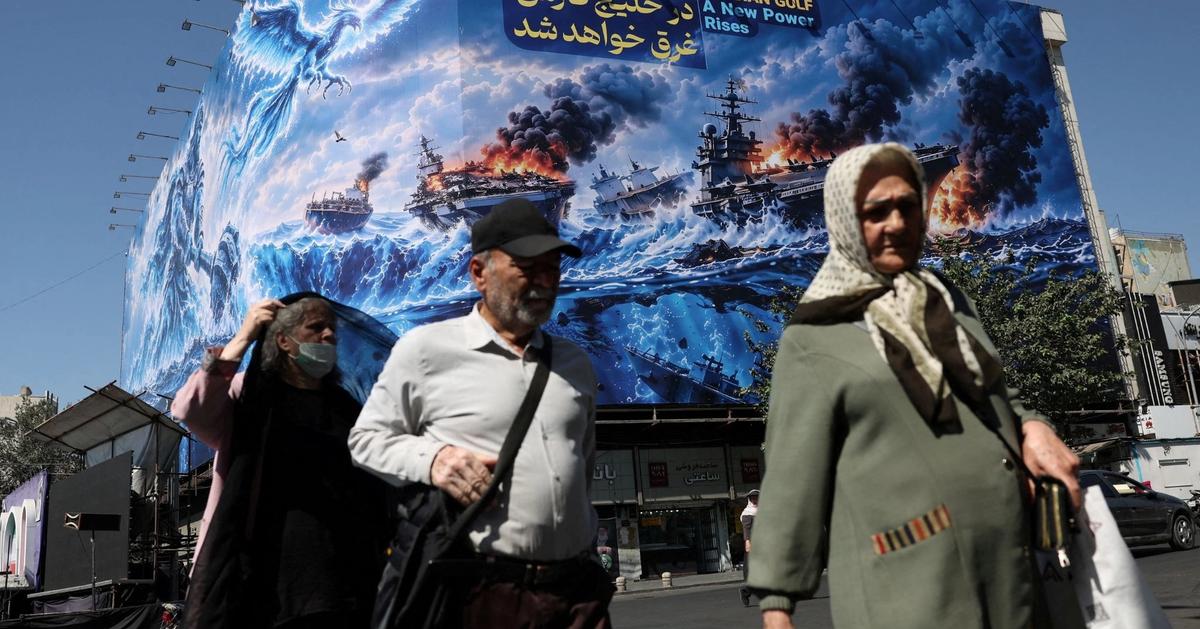
Photo via New York Post

Why JPMorgan has given up predicting what the oil markets will do next

Read the original at New York Post ↗
Cite

Gasparino, C. (2026, September 25). Why JPMorgan has given up predicting what the oil markets will do next. New York Post. https://nypost.com/2026/09/25/business/why-jpmorgan-has-given-up-predicting-what-the-oil-markets-will-do-next/

Dated when The Aporia collected the article, usually within hours of publication. Check the original for its exact date and byline.

New York Post · collected 2026-09-25 · by Charles Gasparino

Quick Summary

JPMorgan's commodities team has ceased providing baseline views on oil prices due to the unpredictable nature of the ongoing conflict in Iran. The lack of a clear resolution path from the White House, combined with recent military actions affecting key shipping routes and oil production cuts by Saudi Arabia, has rendered traditional modeling unreliable. This situation complicates forecasting for investors, businesses, and consumers facing higher gas prices. JPMorgan continues to publish estimates but acknowledges the challenges in predicting future oil market movements given current uncertainties.
Written by AI on 2026-09-25, from this article's own text only (the story summary below draws on all the coverage).

AI analysis

Story summary

JPMorgan's commodities team has given up predicting future crude costs due to ongoing uncertainty surrounding Iran negotiations. These talks have been stalled for seven months, complicating the ability to model oil price movements accurately. The team told clients they no longer have a "baseline view" on oil prices, indicating that the current conflict makes forecasting nearly impossible. This situation has made it difficult not only for investors but also for businesses and consumers dealing with fluctuating gas prices. The unpredictability stems from the unpredictable nature of Iran negotiations under the current administration's policies.

Written for “Oil Market Predictions Frustration” on 2026-11-02, grounded in this article and the 0 other(s) covering the same event.

Story

📰 Oil Market Predictions Frustration
Economy/Business · 1 article(s) covering the same event.

Compared with similar articles

This article reads unscored and hedges 15% of its claims. Each row says how that neighbour differs.
Global News
Hedges 1 of 29 claims Outlet record 63/100
“Article A discusses JPMorgan's struggle to predict future oil prices due to Iran conflict, while Article B reports on actual stock market performance affected by rising oil prices.”
Semafor
Hedges 1 of 5 claims Outlet record 59/100
“While both articles discuss the impact of Iran's situation on oil prices, Article A focuses on JPMorgan's inability to predict future crude costs due to ongoing conflicts and negotiations with Iran. Article B discusses a specific development in US-Iran relations where President Trump rejects a peace proposal from Iran.”
New York Post
Hedges 0 of 14 claims Outlet record 66/100
“The articles discuss different aspects of the Iran situation and its impact on oil markets, with no indication they are describing the same specific incident.”
New York Post
Hedges 5 of 22 claims Outlet record 66/100
“The articles discuss related issues concerning oil prices and geopolitical tensions but describe different events: one focuses on JPMorgan's struggle to predict oil markets due to Iran conflict, while the other reports on a specific price surge in oil futures following Trump's rejection of an Iran peace deal.”
How this article was measured signals, leaning charts, publisher record, byline, topics and claims

Signals How these are calculated →

Claims extracted
20
sentences that state something as happening or true
Uncertain
15%
3 of 20 hedged ("reportedly", "may", "according to")
Leaning
withheld
no quote in the article backed the model's score
Publisher signals
66/100
New York Post's corrections and hedging, across everything collected from it. Not a measure of accuracy.
Outlets on this story
1
Economy/Business
Same framing elsewhere
1
articles that frame the event the way this one does
Analyzed 2026-09-25 · how these are computed

How this is being covered How these are calculated →

Article leaning vs. publisher reliability
Source leaning vs. consistency

Publisher

New York Post · 16017 article(s) · 35 correction(s) detected
Running correction rate · 35 correction(s)

Who wrote this

Charles Gasparino
24 article(s) here · 1 carrying a prediction
🔮 The Iran conflict’s impact on fuel prices doesn’t help but the last time I checked, gas prices on average are not that different than when Biden was throttling drilling; the weakened mullahs will ultimately provide a peace dividend that many Americans favor.
🔮 OpenAI is saying it has no plans to go public this year – but senior Wall Street executives say they fully expect it will happen in the first quarter of 2027, On The Money has learned.
🔮 But as I’ve recently discovered, there’s a notable exception to this unhappy trend, and that would be Pot Inc.
🔮 “It will be years of hearings, investigations and nonstop turmoil,” one major Wall Street deal lawyer said.
🔮 With investors likely to get more details of Anthropic’s pending initial public offering as soon as Friday, the question is whether the official disclosures for the AI giant will actually stoke demand – or cause investors to think twice before tapping into stock, On The Money has learned.
🔮 A new and life-changing business known as the internet, you will recall, was going to make us all rich, and not just the oligarchs behind the technology.
🔮 Those two questions have become maybe the biggest parlor game in media circles these days now that David “Zas” Zaslav is no longer the CEO of Warner Bros Discovery, so I thought I would snoop around.
🔮 With $80 billion in debt and a sprawling media empire to combine, David Ellison will have his hands full with the now court-approved combination of Paramount and Warner Bros Discovery, known as Skydance.
🔮 The worry is that the firm collects sensitive customer data on Americans that could be shared with Chinese spies–something the company has steadfastly denied.
🔮 That could mean more wagering on high-profile M&A deals (Skydance’s recent purchase of WBD was one of the recent biggies), or picking winners of “Dancing With The Stars” or the upcoming midterm races in hotly contested Senate seats in Texas and Michigan.
Also by Charles Gasparino
Nothing else under this byline is closely related to this article, so these are simply their most recent.
All 24 articles by Charles Gasparino →

Topics

Fox Business’s Iran JPMorgan On The Money the White House’s

Subjects

Iran GPE · 5× JPMorgan ORG · 5× Charlie Gasparino PERSON · 2× On The Money ORG · 2× Trump PERSON · 2× Fox Business’s ORG · 1× Iranian NORP · 1× JPM ORG · 1× Teuta Dedvukaj PERSON · 1× the White House’s ORG · 1×

Narrative

With the White House’s on-again, off-again Iran negotiations dragging into their seventh month, JPMorgan’s commodities team has abandoned its “baseline view” on oil prices, the benchmark targets that weigh various factors that influence oil markets. “For the first time since the start of the Iran conflict, we don’t have a baseline view.
framing: assertive · carried by 1 article(s) · first seen 2026-09-25
🔮 The conflict in Iran has not only driven up the price of oil – it has also made it next to impossible for Wall Street firms to forecast future crude costs, On The Money has learned.
2026-09-25 · New York Post
Why JPMorgan has given up predicting what the oil markets will do next · assertive framing

Claims (20 extracted, 3 hedged)

The conflict in Iran has not only driven up the price of oil – it has also made it next to impossible for Wall Street firms to forecast future crude costs, On The Money has learned. asserted
Money → drive → costs
The commodities team at JPMorgan, one of the biggest players in the global oil markets, is telling clients it can no longer reliably model where crude prices go from here, according to reporting by Fox Business’s Teuta Dedvukaj. uncertain
prices → tell → Dedvukaj
With the White House’s on-again, off-again Iran negotiations dragging into their seventh month, JPMorgan’s commodities team has abandoned its “baseline view” on oil prices, the benchmark targets that weigh various factors that influence oil markets. “For the first time since the start of the Iran conflict, we don’t have a baseline view. asserted
we → drag → view
We simply don’t know how to model the endgame,” JPMorgan commodities strategists told clients last Thursday in a conference call with a large institutional investor, according to a person at the confab. uncertain
strategists → know → confab
The comments underscore just how tricky the conflict has become for investors trying to play the oil price swings, businesses seeking to hedge oil expenses and, of course, consumers getting squeezed by higher gas prices. asserted
conflict → underscore → prices
President Trump recently indicated he would be open to meet the president of Iran to end the hostilities – good news for consumers even if it underscores the problems with gauging future movements since such seemingly positive developments have sputtered repeatedly in the past. asserted
developments → indicate → past
“We assumed there were economic red lines the US administration would be unwilling to cross,” JPMorgan strategists wrote in a note to clients. asserted
strategists → assume → clients
“Six months later, many of those lines have been crossed, yet the exit strategy is less clear, not more.” asserted
strategy → cross → lines
A JPM executive who is authorized to speak to the press tells On The Money: “We continue to publish estimates, but the research team wanted to acknowledge that the end game has become hard to model given the ongoing volatility and a wide range of potential outcomes.” asserted
game → authorize → outcomes
The continued conflict has throttled about a quarter of the world’s oil that is shipped through the Strait of Hormuz, a narrow channel that passes through Iranian territory. asserted
that → continue → territory
Saudi Arabia — the world’s second-largest oil producer (the US is No. 1, Russia No. 3) — has cut oil shipments to Europe after drone attacks damaged its key export pipeline to the Red Sea. asserted
attacks → cut → Sea
Messaging from the White House hasn’t helped. asserted
Messaging → help → House
Trump has repeatedly announced progress and near-deals to end the conflict – including the Islamic Republic giving up its nuclear program – only to reverse course. asserted
Republic → announce → course
Charlie Gasparino has his finger on the pulse of where business, politics and finance meet Sign up to receive On The Money by Charlie Gasparino in your inbox every Thursday. asserted
business → meet → inbox
Last Thursday, the president told Axios that he is weighing a major decision over the war, including whether to resume large-scale military operations against Iran or move toward eventually bringing the conflict to an end. asserted
he → tell → end
Without clear answers to such basic questions, oil prices, set in global commodities markets, are likely to get increasingly volatile. asserted
prices → set → markets
The pricing of Brent crude has been bouncing in a wide band. asserted
pricing → bounce → band
When war started back in February, it traded at around $72 then surged to roughly $126 in April. asserted
it → start → April
Prices fell toward $73 in June and have since climbed back to around $100 a barrel. asserted
Prices → fall → 100
According to Dedvukaj’s reporting, JPMorgan believes the price shock from the lack of supply was offset somewhat by consumers cutting back on the use of petroleum products like gasoline. uncertain
shock → accord → gasoline

💬Give feedback
🕘History 🎫Support