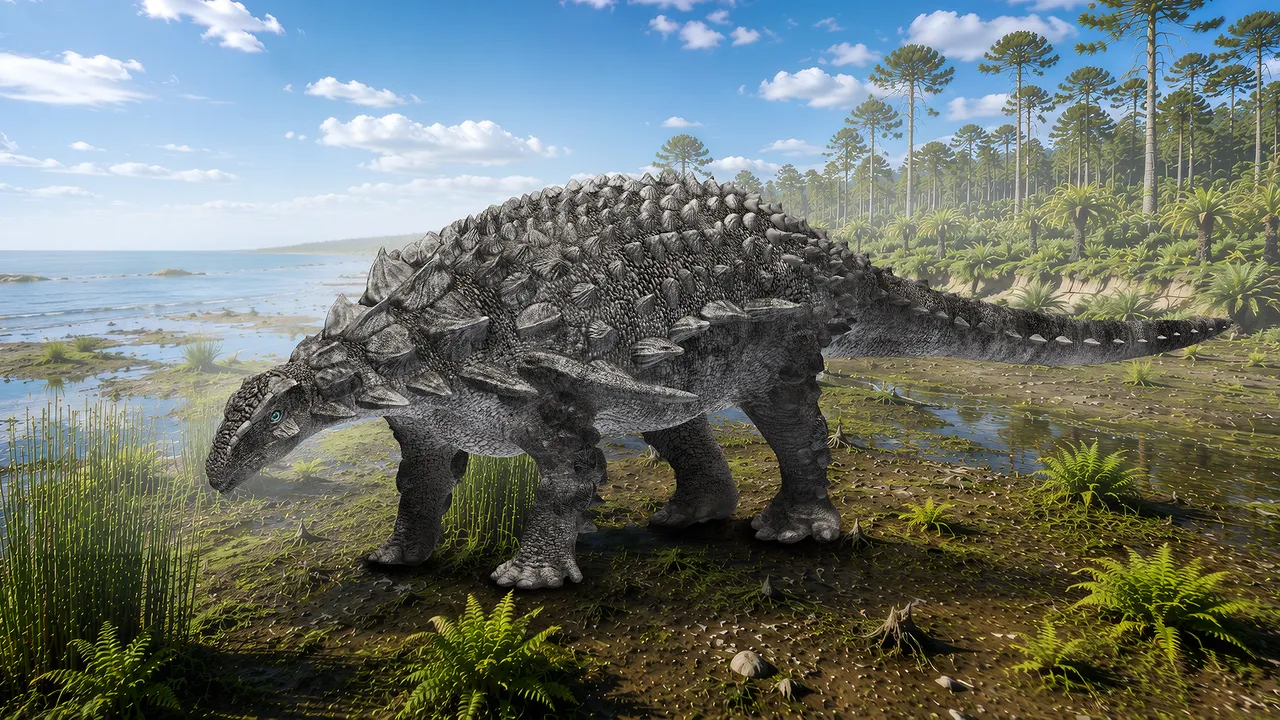
Photo via Times of India

Japan’s first named ankylosaur was linked to nodosaurids millions of years ago

Read the original at Times of India ↗
Cite

TOI World Desk. (2026, September 25). Japan’s first named ankylosaur was linked to nodosaurids millions of years ago. Times of India. https://timesofindia.indiatimes.com/world/rest-of-world/japans-first-named-ankylosaur-nipponopelta-yezoensis-was-more-closely-related-to-north-american-and-european-nodosaurids-96-94-million-years-ago/articleshow/134481521.cms

Dated when The Aporia collected the article, usually within hours of publication. Check the original for its exact date and byline.

Times of India · collected 2026-09-25 · by TOI World Desk

Quick Summary

Researchers have formally named a new ankylosaur species discovered in Japan over three decades ago, naming it Nipponopelta yezoensis. The study, published in Cretaceous Research, details how the partial skull was rediscovered and analyzed using CT scanning to reveal unique features that justify its classification as a distinct taxon. Surprisingly, phylogenetic analysis showed that this Asian ankylosaur is more closely related to nodosaurids from North America and Europe than to other Asian species, suggesting significant dinosaur dispersal patterns across ancient continents.
Written by AI on 2026-09-25, from this article's own text only (the story summary below draws on all the coverage).

AI analysis

Story summary

Researchers have formally named a partial ankylosaur skull, first found over three decades ago on a riverbank in Hokkaido, Japan, as Nipponopelta yezoensis. This makes it the first officially named ankylosaur from Japan and the only Asian nodosaurid known with skull elements. The study, published in *Cretaceous Research*, reveals that this specimen is more closely related to North American and European nodosaurids than to other Asian species. Specifically, Nipponopelta yezoensis shares closer ties with taxa such as Pawpawsaurus, Panoplosaurus, Nodosaurus, Edmontonia, Denversaurus, and Dracopelta, challenging previous assumptions about the geographic distribution of nodosaurid lineages over millions of years. This discovery highlights the importance of reassessing dinosaur dispersal patterns across ancient continents.

Written for “Japanese Ankylosaur Discovery” on 2026-11-01, grounded in this article and the 0 other(s) covering the same event.

Story

📰 Japanese Ankylosaur Discovery
Science · 1 article(s) covering the same event.

Compared with similar articles

Nothing to compare against. No article is close enough to this one for the pipeline to have linked or judged the pair.
How this article was measured signals, leaning charts, publisher record, byline, topics and claims

Signals How these are calculated →

Claims extracted
16
sentences that state something as happening or true
Uncertain
19%
3 of 16 hedged ("reportedly", "may", "according to")
Leaning
not political
takes no side on a contested political question
Publisher signals
59/100
Times of India's corrections and hedging, across everything collected from it. Not a measure of accuracy.
Outlets on this story
1
Science
Same framing elsewhere
1
articles that frame the event the way this one does
Analyzed 2026-09-25 · how these are computed

How this is being covered How these are calculated →

Article leaning vs. publisher reliability
Source leaning vs. consistency

Publisher

Times of India · 3882 article(s) · 2 correction(s) detected
Running correction rate · 2 correction(s)

Who wrote this

TOI World Desk
1304 article(s) here · 1 carrying a prediction
🔮 Mailyan, who operated the Healthy Way Medical Center clinic in Glendale, California, was convicted in May by a federal jury in the Central District of California on nine counts of wire fraud and three counts of obstruction of a criminal investigation into a healthcare offence.
🔮 Wild beavers are set to return to the Loch Ness catchment area for the first time in 500 years after officials approved a major rewilding project in the Scottish Highlands.
🔮 The coin could buy a few candy bars back then, and the boys wanted to know why they had given it away.
2026-11-01 · assertive framing · He was homeless twice, now he is a billionaire
🔮 However, the talks broke down because they could not agree on the financial terms.
🔮 "We are a self-serve frozen yogurt place, so I thought a self-serve squishy place would be a win-win," Harper told WNDU.
🔮 A Planning Inspectorate inquiry into the dispute began at the village hall in May.
🔮 Maya Jama has donated £83,500 of her own money to her chosen charity, Action for Children.
🔮 The appeal judges said the restrictions were too broad and unfairly limited how the neighbouring owners could use their own land without enough legal reason.
🔮 She took it home, made it a bed of flowers and expected it wouldn’t last the day.
2026-11-01 · assertive framing · Injured queen bumblebee becomes an online sensation
🔮 He also moved animals between pens and took flammable materials out of the way so the flames would not spread.
Wire or desk byline, not an individual reporter.
Also by TOI World Desk
Nothing else under this byline is closely related to this article, so these are simply their most recent.
All 1304 articles by TOI World Desk →

Topics

Asian European Hokkaido Japan North American

Subjects

Asian NORP · 4× Hokkaido GPE · 4× European NORP · 3× Japan GPE · 3× North American NORP · 2× Canada GPE · 1× Cretaceous Research ORG · 1× Hokkaido University ORG · 1× Shumpei Oyabu PERSON · 1× the United States GPE · 1×

Narrative

The specimen is particularly important because it is the only Asian nodosaurid currently known from skull elements; other Asian nodosaurids are known only from postcranial material, making it an important reference point for understanding the group's anatomy. A surprising family tree, closer to North America than Asia (Image: AI Generated) A surprising family tree, closer to North America than Asia Rather than grouping with the handful of other nodosaurids previously described from Asia, phylogenetic analysis placed Nipponopelta yezoensis deeply within derived North American and European nodosaurids, including Pawpawsaurus, Panoplosaurus, Nodosaurus, Edmontonia and Denversaurus, as well as the European taxon Dracopelta.
framing: assertive · carried by 1 article(s) · first seen 2026-09-25
🔮 This unexpected placement showed that Nipponopelta was more closely related to these North American and European forms than to other Asian nodosaurids, prompting the researchers to examine how different nodosaurid lineages may have become distributed across regions over millions of years.

Claims (16 extracted, 3 hedged)

More than three decades after a partial ankylosaur skull was first discovered in a Hokkaido riverbank deposit, researchers have formally named it as a new genus and species, Nipponopelta yezoensis, the first ankylosaur ever formally named from Japan. asserted
researchers → discover → Japan
The study, ‘ A new nodosaurid ankylosaur (Dinosauria: Ornithischia) from the Upper Cretaceous Hikagenosawa Formation in Japan reveals dispersal pattern of Asian nodosaurid ankylosaurs,’ published in Cretaceous Research, was led by Shumpei Oyabu of Hokkaido University alongside colleagues from Japan, Canada and the United States. asserted
ankylosaur → reveal → Japan
Using CT scanning and phylogenetic analysis, the researchers resolved the specimen's identity and uncovered an unexpected evolutionary relationship with nodosaurids from North America and Europe. asserted
researchers → use → America
Here's how the fossil was rediscovered, and what it reveals about how armoured dinosaurs were distributed across ancient continents. asserted
dinosaurs → rediscover → continents
A Hokkaido fossil in storage, how the specimen was finally identified A partial skull, the atlas, or first cervical vertebra, and several teeth, catalogued as MCM A522, were discovered in a concretion from the Hikagenosawa Formation along the Omakizawa River, a tributary of the Shuparo River in Yubari, Hokkaido, and donated to the Mikasa City Museum by Eijiro Goto. asserted
skull → identify → Goto
The specimen was first described in 2005 by Hayakawa and colleagues, who identified it as a nodosaurid ankylosaur based on its teeth and occipital bone morphology, but its precise taxonomic position remained unresolved for years. asserted
position → describe → years
Acid preparation and the limited exposure of teeth preserved within the skull made detailed morphological study difficult. asserted
study → limit → skull
What CT scanning revealed about the new species To finally resolve the specimen's identity, Oyabu and colleagues applied three-dimensional CT reconstruction, digitally revealing parts of the skull that had previously remained hidden, including a section of the lower jaw, two intact teeth and the dinosaur's left inner ear. asserted
that → reveal → jaw
The scans exposed a distinctive combination of features in the back of the skull, unique enough to justify naming a new taxon, Nipponopelta yezoensis. asserted
scans → expose → taxon
The specimen is particularly important because it is the only Asian nodosaurid currently known from skull elements; other Asian nodosaurids are known only from postcranial material, making it an important reference point for understanding the group's anatomy. A surprising family tree, closer to North America than Asia (Image: AI Generated) A surprising family tree, closer to North America than Asia Rather than grouping with the handful of other nodosaurids previously described from Asia, phylogenetic analysis placed Nipponopelta yezoensis deeply within derived North American and European nodosaurids, including Pawpawsaurus, Panoplosaurus, Nodosaurus, Edmontonia and Denversaurus, as well as the European taxon Dracopelta. asserted
analysis → know → Pawpawsaurus
This unexpected placement showed that Nipponopelta was more closely related to these North American and European forms than to other Asian nodosaurids, prompting the researchers to examine how different nodosaurid lineages may have become distributed across regions over millions of years. uncertain
lineages → show → years
How Nipponopelta's ancestors spread across continents Ancestral geographic analysis suggested that the lineage containing Nipponopelta yezoensis and its close relatives had a broad ancestral distribution spanning Laramidia, Appalachia and Asia. uncertain
lineage → spread → Laramidia
Habitat reconstruction further showed that Nipponopelta yezoensis preferred marine-influenced environments, likely inhabiting coastal or estuarine areas. asserted
yezoensis → show → areas
The researchers suggested that this coastal preference may have played an important role in shaping its dispersal patterns across different regions. uncertain
preference → suggest → regions
The Hikagenosawa Formation itself, part of the mostly marine Yezo Group, has also previously yielded other significant dinosaur finds, including the hadrosaurid Kamuysaurus japonicus and the therizinosaurid Paralitherizinosaurus japonicus. asserted
Formation → yield → japonicus
Together, these discoveries add to the importance of Hokkaido's Cretaceous rocks for understanding dinosaur diversity in ancient marine-influenced environments million years ago. asserted
discoveries → add → environments

💬Give feedback
🕘History 🎫Support