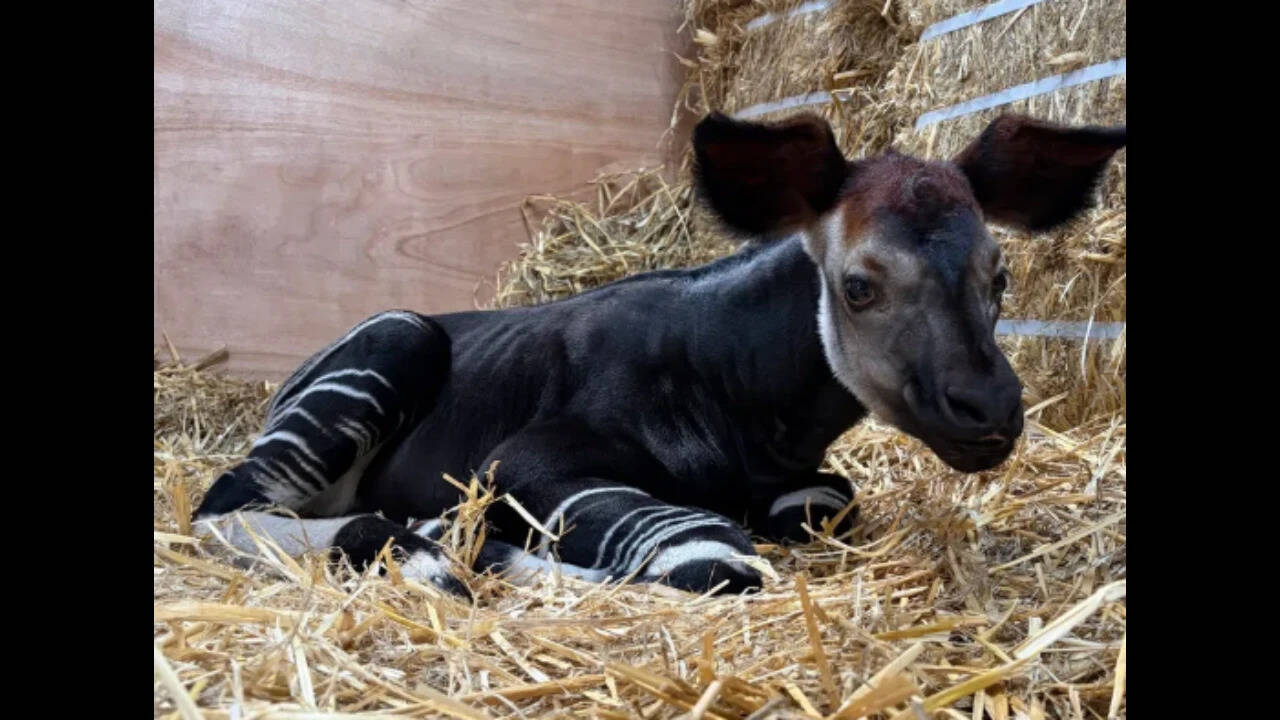
Photo via Times of India

Singapore welcomes Southeast Asia’s first okapi calf: Why this rare ‘forest giraffe’ is so unusual

Read the original at Times of India ↗
Cite

TOI World Desk. (2026, September 25). Singapore welcomes Southeast Asia’s first okapi calf: Why this rare ‘forest giraffe’ is so unusual. Times of India. https://timesofindia.indiatimes.com/world/rest-of-world/singapore-welcomes-southeast-asias-first-okapi-calf-why-this-rare-forest-giraffe-is-so-unusual/articleshow/134489107.cms

Dated when The Aporia collected the article, usually within hours of publication. Check the original for its exact date and byline.

Times of India · collected 2026-09-25 · by TOI World Desk

Quick Summary

Rainforest Wild Adventure in Singapore welcomed a male okapi calf on July 27, marking Southeast Asia’s first recorded birth of this endangered species. Weighing about 20kg at birth, the calf now weighs 48kg two months later and is cared for with its mother Kisala in the Hidden Forest area. Okapis are closely related to giraffes but live in dense tropical forests where they remain elusive due to their natural camouflage and secretive behavior; calves hide from predators while mothers forage nearby.
Written by AI on 2026-10-02, from this article's own text only (the story summary below draws on all the coverage).

AI analysis

Story summary

A rare okapi calf was born at Rainforest Wild Adventure in Singapore on July 27, marking the first recorded birth of an okapi in Southeast Asia. The male calf weighs nearly 48kg, having doubled from its initial weight of about 20kg after being born to parents Kisala and Xandor. Native only to the dense rainforests of the Democratic Republic of Congo, okapis are listed as Endangered on the International Union for Conservation of Nature (IUCN) Red List due to habitat loss and poaching, which have caused their wild population to sharply decline. The calf's birth is part of a breeding programme by Mandai Wildlife Group aimed at maintaining healthy populations of endangered species under human care.

Written for “Okapi Birth In Singapore” on 2026-10-30, grounded in this article and the 0 other(s) covering the same event.

Story

📰 Okapi Birth In Singapore
Science · 1 article(s) covering the same event.

Compared with similar articles

Nothing to compare against. No article is close enough to this one for the pipeline to have linked or judged the pair.
How this article was measured signals, leaning charts, publisher record, byline, topics and claims

Signals How these are calculated →

Claims extracted
28
sentences that state something as happening or true
Uncertain
7%
2 of 28 hedged ("reportedly", "may", "according to")
Leaning
not political
takes no side on a contested political question
Publisher signals
59/100
Times of India's corrections and hedging, across everything collected from it. Not a measure of accuracy.
Outlets on this story
1
Science
Same framing elsewhere
1
articles that frame the event the way this one does
Analyzed 2026-09-25 · how these are computed

How this is being covered How these are calculated →

Article leaning vs. publisher reliability
Source leaning vs. consistency

Publisher

Times of India · 3707 article(s) · 2 correction(s) detected
Running correction rate · 2 correction(s)

Who wrote this

TOI World Desk
1240 article(s) here · 1 carrying a prediction
🔮 People from outside Indiana University had also contacted Brian Williams, a professor at the Kelley School of Business who helped develop the programme, expressing interest in taking the course.
🔮 Thus, a decade ago, he began collecting Halloween costumes for kids who couldn't afford them.
🔮 He expressed concern that the confrontation could cost him his job.
🔮 They said the celebrity's "suicide risk" could be lowered through treatment.
🔮 In one recording, Higby explained that they wanted to find out whether people could vote without showing identification.
🔮 According to Farm Journal, Pottinger discovered Sabanto, a company developing technology to convert conventional tractors into autonomous machines, after his lender suggested further equipment savings could improve the farm’s cash flow.
🔮 Under the West Virginia law that was struck down, a person could be sued and face set damages for showing or publishing covered personal information online.
🔮 An Australian man searching desperately for his missing dog offered a A$10,000 reward for its safe return, hoping someone would help bring his beloved pet home.
🔮 For weeks, it may have been hiding in plain sight, tucked beneath rows of corn in an otherwise unremarkable Minnesota field.
🔮 Over the next few years, the owners put the land up for sale but could not find a buyer.
Wire or desk byline, not an individual reporter.
Also by TOI World Desk
Nothing else under this byline is closely related to this article, so these are simply their most recent.
All 1240 articles by TOI World Desk →

Topics

IUCN Mandai Wildlife Group’s Singapore the Democratic Republic of Congo the International Union for Conservation of Nature

Subjects

Kisala PERSON · 4× Singapore GPE · 3× Mandai ORG · 2× Xandor PERSON · 2× Democratic Republic of Congo GPE · 1× IUCN ORG · 1× Mandai Wildlife Group’s ORG · 1× the Democratic Republic of Congo GPE · 1× the EAZA Ex situ Programme ORG · 1× the International Union for Conservation of Nature ORG · 1×

Narrative

The programme works to maintain healthy populations of endangered animals under human care, including through managed breeding and the movement of animals between participating institutions.
framing: assertive · carried by 1 article(s) · first seen 2026-09-25
🔮 Why okapi calves are unusual The Singapore calf has also been displaying a behaviour that may seem surprising to visitors.

Claims (28 extracted, 2 hedged)

A rare okapi calf has been born at Rainforest Wild Adventure in Singapore, marking the first recorded birth of an okapi in Southeast Asia. asserted
calf → bear → Asia
The male calf was born on July 27 to first-time parents Kisala, 7, and Xandor, 4, at Mandai Wildlife Group’s wildlife park. asserted
calf → bear → park
The calf weighed about 20kg when it was first weighed a day after birth. asserted
it → weigh → birth
Nearly two months later, it has more than doubled its weight to 48kg. asserted
it → double → kg
The young okapi is being cared for with its mother in the Hidden Forest at Rainforest Wild Adventure East. asserted
okapi → care → East
Okapis are an endangered species and are rarely seen even in zoos. asserted
Okapis → see → zoos
Native only to the dense rainforests of the Democratic Republic of Congo, the animals are listed as Endangered on the International Union for Conservation of Nature (IUCN) Red List. asserted
animals → list → List
Habitat loss and poaching have contributed to a sharp decline in their wild population. asserted
loss → contribute → population
Despite its zebra-like striped legs and brown body, the okapi is actually the closest living relative of the giraffe. asserted
okapi → strip → giraffe
It shares several characteristics with giraffes, including a long, flexible tongue and bony, horn-like structures called ossicones on the head of males. asserted
It → share → males
The animal is sometimes described as a “forest giraffe” because it lives in dense tropical forests rather than the open grasslands associated with giraffes. asserted
it → describe → giraffes
Its striped hindquarters and legs are thought to provide camouflage in the forest undergrowth. asserted
hindquarters → think → undergrowth
Okapis are elusive, largely solitary animals that live in the forests of northeastern and central Democratic Republic of Congo. asserted
that → live → Congo
Their habitat provides dense vegetation in which they can browse for leaves, shoots and other plant material. asserted
they → provide → leaves
Why okapi calves are unusual The Singapore calf has also been displaying a behaviour that may seem surprising to visitors. uncertain
that → display → visitors
Instead of constantly following its mother, the young okapi spends much of its time hidden in its den, reports said. asserted
reports → follow → den
Okapi calves naturally remain concealed for much of their first few months, while their mothers leave them periodically to forage and return to nurse them. asserted
mothers → remain → them
This behaviour is believed to help protect the young from predators. asserted
behaviour → believe → predators
Okapis also have an unusually long pregnancy. asserted
Okapis → have → pregnancy
Gestation lasts around 14 to 15 months — roughly 440 days — and females generally give birth to a single calf. asserted
females → last → calf
Mandai said it prepared a quiet, secluded calving box for Kisala and her calf to allow them to follow this natural behaviour. asserted
them → say → behaviour
The calf has recently been given access to its outdoor habitat, although keepers said it is still taking time to become comfortable in the new surroundings. asserted
it → give → surroundings
A first for Southeast Asia Kisala and Xandor arrived in Singapore under the EAZA Ex situ Programme, a coordinated breeding programme for threatened species. asserted
first → arrive → species
The programme works to maintain healthy populations of endangered animals under human care, including through managed breeding and the movement of animals between participating institutions. asserted
programme → work → institutions
Visitors to Rainforest Wild Adventure East can see Kisala and the calf in the Hidden Forest, although the youngster may retreat to its den. uncertain
youngster → see → den
A live “baby monitor” also allows visitors to catch glimpses of the calf when it is inside. asserted
it → allow → calf
Mandai has invited the public to help choose the calf's name. asserted
Mandai → invite → name
The three options are Imara, meaning “strong” in Swahili; Mayaka, meaning “pearl” in Lingala; and Kiah, meaning “dawn”, “new beginnings” or “start of the season” in Swahili. asserted
options → mean → Swahili

💬Give feedback
🕘History 🎫Support