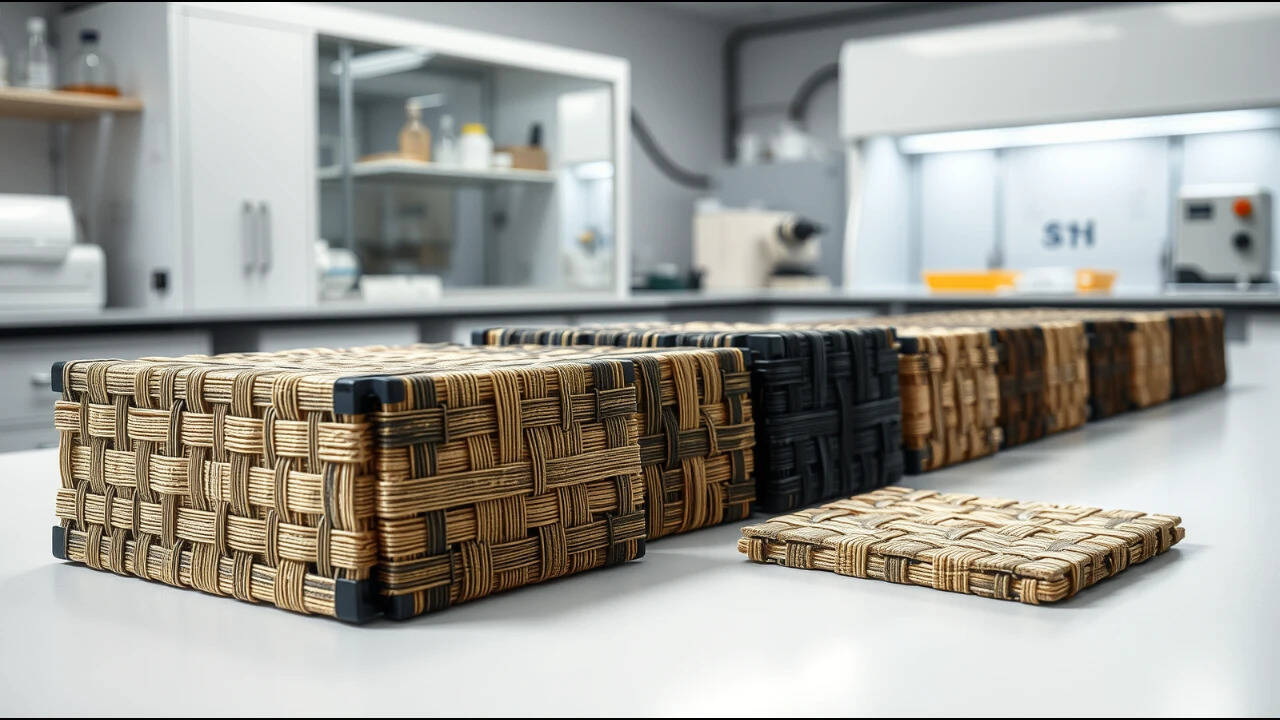
Plastic waste collected in Rwanda has been turned into experimental construction tiles that combine recycled thermoplastics with locally sourced sisal fibres.
asserted
that → collect → fibres
In a study published in Frontiers in Sustainability titled
Manufacturing of plastic tiles based on reinforced sisal and recycled plastic wastes: a case of Rwanda, researchers at Rwanda Polytechnic-Ngoma College tested tiles made from recycled high-density polyethene, polyethene terephthalate, polypropylene, polyvinyl chloride and polystyrene, combined with sand, marble chips, cement and sisal.
asserted
researchers → publish → sand
The strongest formulation, containing 5% sisal by volume, reached a mean compressive strength of 41.66 megapascals (MPa), while three tested tile samples recorded an average water absorption of just 0.225% after 24 hours of immersion.
asserted
samples → contain → immersion
Rwanda's plastic waste problem provided the starting point
The researchers developed the tiles against a persistent waste-management problem.
asserted
researchers → provide → problem
Rwanda introduced a plastic-bag ban in 2008 and prohibited single-use plastics in 2019, but the study says substantial quantities of rigid post-consumer plastic remain outside formal collection and recycling systems.
asserted
quantities → introduce → systems
Citing previous research, the authors report that informal recyclers lack sufficient capacity and that about 70% of rigid plastic is left uncollected.
asserted
% → cite → plastic
The paper also points to plastic bottles clogging drainage systems in Kigali, contributing to flash flooding during heavy rain, and reports that microplastics have been detected in the Nyabarongo River.
asserted
microplastics → point → River
The researchers argue that converting discarded plastics into construction products could provide another route for handling material that might otherwise accumulate at disposal sites such as Nduba landfill.
uncertain
that → argue → landfill
Five per cent sisal produced the strongest formulation
The team tested different levels of sisal reinforcement and found a clear increase in compressive strength as the fibre content rose.
asserted
content → produce → strength
The control formulation without sisal reached 30.12 MPa, while mixtures containing 2%, 3% and 5% sisal reached 31.825, 37.705 and 41.66 MPa, respectively.
asserted
mixtures → reach → sisal
The 5% formulation therefore represented a 38.3% increase over the 0% control, according to the researchers.
uncertain
formulation → represent → researchers
The tested mixture was not simply plastic and fibre: the optimal formulation contained, by volume, 50.5% recycled plastic waste, 26.5% marble chips, 13% cement, 5% sisal fibres and 5% fine sand.
asserted
formulation → test → waste
The plastics were heated to between 200°C and 300°C, then mixed with the aggregate and sisal before being placed in wooden moulds and compressed while cooling.
asserted
plastics → heat → moulds
The recycled-plastic tiles absorbed very little water
The tiles also performed strongly in the study's water-absorption test.
asserted
tiles → recycle → test
Researchers dried the samples, immersed them in water for 24 hours and then compared their wet and dry masses.
asserted
Researchers → dry → masses
Three samples recorded absorption rates of 0.223%, 0.216% and 0.238%, producing a mean of 0.225%.
asserted
samples → record → %
The test followed ASTM D570, a standard method for measuring water absorption in plastics.
asserted
test → follow → plastics
The researchers attribute the low absorption partly to the hydrophobic plastic matrix, while the cement was intended to help bind the hydrophilic sisal and aggregate to the plastic and reduce internal voids.
asserted
cement → attribute → voids
The result indicates strong resistance to water absorption under the specific laboratory conditions tested, although it does not by itself establish long-term performance in real buildings or outdoor environments.
asserted
it → indicate → buildings
The researchers compared the tiles with ceramic and granite
The paper also compares the experimental material with conventional ceramic and Nyagatare granite tiles used in Rwanda.
asserted
paper → compare → Rwanda
The researchers report compressive strengths of roughly 20 to 30 MPa for ceramic tiles and 60 to 80 MPa for Nyagatare granite, while the experimental plastic tile reached 41.66 MPa.
asserted
tile → report → MPa
They also report water absorption of 0.5% to 7% for the ceramic comparison and about 0.1% for granite.
asserted
They → report → granite
In the study's cost comparison, the experimental tiles were estimated at 26,500 to 32,150 Rwandan francs per square metre, compared with 13,500 to 17,000 francs for ceramic and 36,000 to 45,400 francs for Nyagatare granite.
asserted
tiles → estimate → granite
These figures are the researchers' estimates and comparisons, rather than evidence of established market prices or a commercial cost advantage.
asserted
figures → establish → prices
The next challenge is moving beyond the laboratory
For now, the material remains an experimental laboratory product rather than a demonstrated mass-produced building material.
asserted
material → move → material
The researchers produced the tiles using a manual compression press and wooden moulds, with specimens allowed to remain under ambient laboratory conditions for seven days before testing.
asserted
specimens → produce → testing
They suggest that industrial production would require more controlled equipment to improve mixing, fibre dispersion, moulding, and consistency.
asserted
production → suggest → mixing
The study concludes that the 5% sisal formulation demonstrated technical feasibility under its tested conditions and recommends further research, including the use of artificial intelligence to predict cracking and fracture behaviour over the tiles' working life.
asserted
formulation → conclude → life
That leaves durability, large-scale manufacturing and real-world performance as important questions for future testing.
asserted
That → leave → testing
 The Aporia