Photo via The Sydney Morning Herald

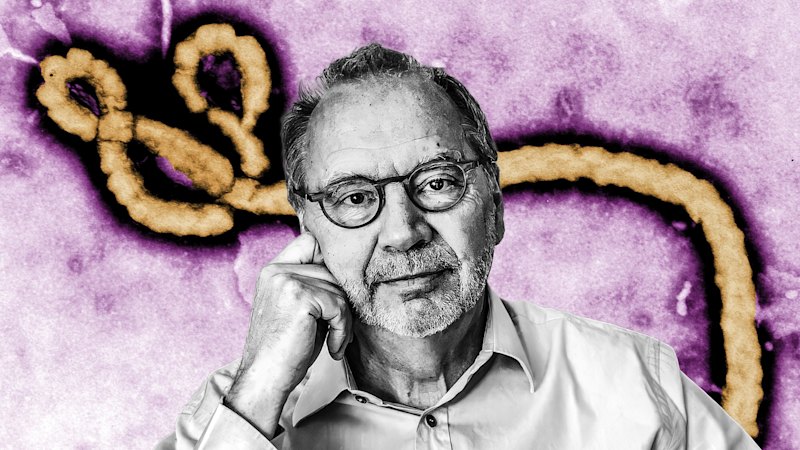
Peter Piot helped discover Ebola. Fifty years on, he’s advocating for a ‘holy grail’ vaccine

Read the original at The Sydney Morning Herald ↗
Cite

Dalton, A. (2026, September 25). Peter Piot helped discover Ebola. Fifty years on, he’s advocating for a ‘holy grail’ vaccine. The Sydney Morning Herald. https://www.smh.com.au/national/peter-piot-helped-discover-ebola-fifty-years-on-he-s-advocating-for-a-holy-grail-vaccine-20260926-p60y66.html?ref=rss&utm_medium=rss&utm_source=rss_feed

Dated when The Aporia collected the article, usually within hours of publication. Check the original for its exact date and byline.

The Sydney Morning Herald · collected 2026-09-25 · by Angus Dalton

Quick Summary

Sir Peter Piot, who helped discover Ebola fifty years ago when he received a mysterious package containing blood samples from a Belgian nun, is now advocating for a vaccine that can protect against entire families of viruses rather than individual strains. During the current outbreak in the Democratic Republic of Congo and Uganda, over 8000 people have contracted the virus, resulting in 3761 confirmed deaths as of the time of reporting. Piot emphasizes the need for broader protection against viral outbreaks, noting that despite significant funding—about $US3 billion—the situation remains dire due to issues like unpaid healthcare workers and the potential spread into urban areas.
Written by AI on 2026-10-02, from this article's own text only (the story summary below draws on all the coverage).

AI analysis

Story summary

In 1976, Peter Piot helped discover the Ebola virus from a mysterious sample sent to his lab in Belgium. The virus came from blood taken by a physician treating a Belgian nun suffering an unknown illness at a clinic in Kinshasa, then part of Zaire (now the Democratic Republic of Congo or DRC). Half a century later, Piot regrets not investing earlier in a vaccine that could protect against all strains of Ebola, such as the current Bundibugyo strain causing devastation in the DRC. He advocates for developing treatments that provide broader protection across entire virus families rather than just individual strains.

Written for “Ebola Discovery And Vaccine Advocacy” on 2026-10-31, grounded in this article and the 0 other(s) covering the same event.

Story

📰 Ebola Discovery And Vaccine Advocacy
Health · 1 article(s) covering the same event.

Compared with similar articles

This article reads unscored and hedges 9% of its claims. Each row says how that neighbour differs.
ABC News (AU)
Hedges 5 of 55 claims Outlet record 68/100
“Article A describes the discovery of Ebola in 1976 by Peter Piot, while Article B covers a large-scale Ebola outbreak in the Democratic Republic of Congo in 2026.”
How this article was measured signals, leaning charts, publisher record, byline, topics and claims

Signals How these are calculated →

Claims extracted
54
sentences that state something as happening or true
Uncertain
9%
5 of 54 hedged ("reportedly", "may", "according to")
Leaning
not political
takes no side on a contested political question
Publisher signals
61/100
The Sydney Morning Herald's corrections and hedging, across everything collected from it. Not a measure of accuracy.
Outlets on this story
1
Health
Same framing elsewhere
1
articles that frame the event the way this one does
Analyzed 2026-09-25 · how these are computed

How this is being covered How these are calculated →

Article leaning vs. publisher reliability
Source leaning vs. consistency

Publisher

The Sydney Morning Herald · 5607 article(s) · 15 correction(s) detected
Running correction rate · 15 correction(s)

Who wrote this

Angus Dalton
8 article(s) here · 1 carrying a prediction
🔮 The 2028 mission to the International Space Station would mark the first time an astronaut flies to space under the Australian flag.
🔮 More supply of the live-attenuated virus is expected to bring down the cost following ATAGI’s updated advice.
🔮 That was the opening salvo in what would become an evolutionary battle between medical researchers and their pathogenic microbial enemies that have rapidly evolved to outfox antibiotics and kill more than 1.2 million people each year through drug-resistant infections.
🔮 The letters could still be deciphered: the blood, a physician had written from a clinic in Kinshasa, now the capital of the Democratic Republic of the Congo, was from a Belgian nun struck down by an ugly affliction he could not diagnose.
🔮 “There were what appears to be attempts at eye contact, just observing it to see whether, maybe, there was any sign of life,” said Griffith University whale scientist Dr Olaf Meynecke.
🔮 “And I was like, well, if that’s the protocol, then I would appreciate if someone had told me that, you know?”
🔮 “We’re a small but mighty country.
🔮 If you ever find yourself buried beneath the rubble of an earthquake’s aftermath or expiring in a remote cave, salvation may not arrive in the form of a dashing rescuer or detection dog, but of a hulking, hissing, spiky-legged cockroach.
Also by Angus Dalton
Nothing else under this byline is closely related to this article, so these are simply their most recent.
All 8 articles by Angus Dalton →

Topics

Belgian Congo DRC Kinshasa the Democratic Republic of the Congo

Subjects

Piot PERSON · 5× Belgian NORP · 2× Congo GPE · 2× DRC GPE · 2× the Democratic Republic of the Congo GPE · 2× Bundibugyo GPE · 1× Kinshasa PERSON · 1× Peter Piot PERSON · 1× South Ubangi GPE · 1× Uganda GPE · 1×

Narrative

Watching the most aggressive-ever outbreak of the haemorrhagic fever devastate the DRC half a century later, unleashed by the rare Bundibugyo strain, the now-renowned virologist has turned his mind to the “holy grail” of prevention: treatments that work against whole families of a virus. “I regret that we did not invest in a vaccine for the whole family – not just each virus strain,” he says.
framing: assertive · carried by 1 article(s) · first seen 2026-09-25
🔮 The letters could still be deciphered: the blood, a physician had written from a clinic in Kinshasa, now the capital of the Democratic Republic of the Congo, was from a Belgian nun struck down by an ugly affliction he could not diagnose.

Claims (54 extracted, 5 hedged)

Fifty years ago, Sir Peter Piot opened a mysterious package sent to his Belgian lab containing a thermos. asserted
Piot → open → thermos
With no protective gear besides latex gloves, the young microbiologist unscrewed it and found a slurry of half-melted ice, the shards of a broken test tube, clotted blood, and ink running from a handwritten note. asserted
microbiologist → unscrew → note
The letters could still be deciphered: the blood, a physician had written from a clinic in Kinshasa, now the capital of the Democratic Republic of the Congo, was from a Belgian nun struck down by an ugly affliction he could not diagnose. uncertain
he → decipher → affliction
From that unsavoury soup, Piot and his colleagues would extract and discover one of the most dangerous viruses ever found: Ebola. asserted
Piot → extract → viruses
Watching the most aggressive-ever outbreak of the haemorrhagic fever devastate the DRC half a century later, unleashed by the rare Bundibugyo strain, the now-renowned virologist has turned his mind to the “holy grail” of prevention: treatments that work against whole families of a virus. “I regret that we did not invest in a vaccine for the whole family – not just each virus strain,” he says. asserted
he → watch → family
“We need to go to something that is broadly protective.” asserted
that → need → something
Soon after co-discovering the strange, wormlike virus in 1976, Piot found himself in the Congo, examining the blood of a nurse racked with uncontrollable vomiting, diarrhoea and sticky black bruises around her nose, ears and mouth. asserted
Piot → - → nose
His hands shook as he handled her sample, saw the cratered platelet count and came to understand the terror the virus brought: her blood work, at a cellular level, was a “catastrophe”. asserted
work → shake → level
Close to 8000 people have contracted the virus during the latest outbreak. asserted
people → contract → outbreak
There have been 3761 confirmed deaths across the Democratic Republic of the Congo and Uganda and the disease has now reached the South Ubangi province, 1000 kilometres from the outbreak’s epicentre. asserted
disease → confirm → epicentre
With no treatments for Bundibugyo, responders have had little choice but to roll out a vaccine targeting a different type of the virus, Zaire, which Piot believes will offer at least some protection. asserted
Piot → have → protection
“It will get worse before it gets better. asserted
it → get → ?
It’s still expanding. asserted
It → expand → ?
And the big unknown is whether it will get into a city in Congo like Kisangani. asserted
it → get → Kisangani
Will it go to Goma? asserted
it → go → Goma
Will it get into South Sudan? asserted
it → get → Sudan
Before the end of the year there’s definitely no way it’ll be over. asserted
it → ’ → year
Part of the frustration is watching the global community funnel funds into the region – about $US3 billion has gushed into the DRC – and deaths still mount. asserted
deaths → watch → DRC
Despite the influx of funds, some frontline nurses and doctors at most risk of illness are not getting paid. asserted
nurses → pay → illness
“Healthcare workers have not been paid for three months. asserted
workers → pay → months
They risk their lives every single day. asserted
They → risk → lives
They’re not paid so they go and strike. asserted
they → pay → ?
I mean, I would do the same. asserted
I → mean → same
It’s a tragedy. asserted
It → ’ → ?
It’s a cycle Piot wants broken: new zoonotic outbreak, global panic, torched resources, eventual loss of interest, and a lapse back into complacency. asserted
Piot → ’ → complacency
Piot visited the Doherty Institute in Melbourne this month, in part to discuss efforts to make new antivirals and multi-variant vaccines, which would be key to breaking this deadly loop. asserted
which → visit → loop
It’s a scientific quest easier said than done. asserted
It → ’ → ?
The institute’s namesake, Nobel Prize winner Peter Doherty, has said making a multi-strain vaccine is harder than putting man on the moon. asserted
making → say → moon
But the rockets, so to speak, are warming up. asserted
rockets → speak → ?
In June, scientists from the University of Cambridge announced they’d trialled a new vaccine in 39 people that could protect against a range of Sarbeco coronaviruses including COVID-19, SARS and other related viruses in bats. uncertain
that → announce → bats
Instead of crafting a vaccine tailored to one strain’s spike protein, the researchers used AI to analyse the genetics of thousands of related viruses to create a “super-antigen”: something that generates an immune response targeting common features across the whole viral family. asserted
that → craft → family
The impact on the immune system was “modest”, the researchers wrote in the Journal of Infection, but promising enough that the team are planning to use the same approach to tackle multiple Ebola strains. asserted
team → write → strains
The study marked the first use of an AI-designed vaccine in people. asserted
study → mark → people
“I was in intensive care and I got long COVID. asserted
I → get → COVID
I know it’s no joke,” he says. asserted
he → know → ?
As he struggled for breath in a ward he shared with three other gasping patients, his only gratitude was that he didn’t have Ebola. asserted
he → struggle → Ebola
For weeks afterwards he could only whisper. uncertain
he → whisper → weeks
The experience convinced him we need faster-acting antivirals to handle outbreaks alongside vaccines, which can take days to kick in with an immune response. asserted
which → convince → response
“I’m promoting the fact that we should develop small molecule therapeutics that can treat or prevent infections on a whole family of viruses,” he says. asserted
he → promote → viruses
One of the Doherty Institute’s researchers Piot met last week, Dr Rubaiyea Farrukee, is pursuing just that. asserted
Piot → meet → that
…and 14 more, not listed.

💬Give feedback
🕘History 🎫Support