Grief does funny things to people; sometimes it even makes them a little crazy.
asserted
them → do → people
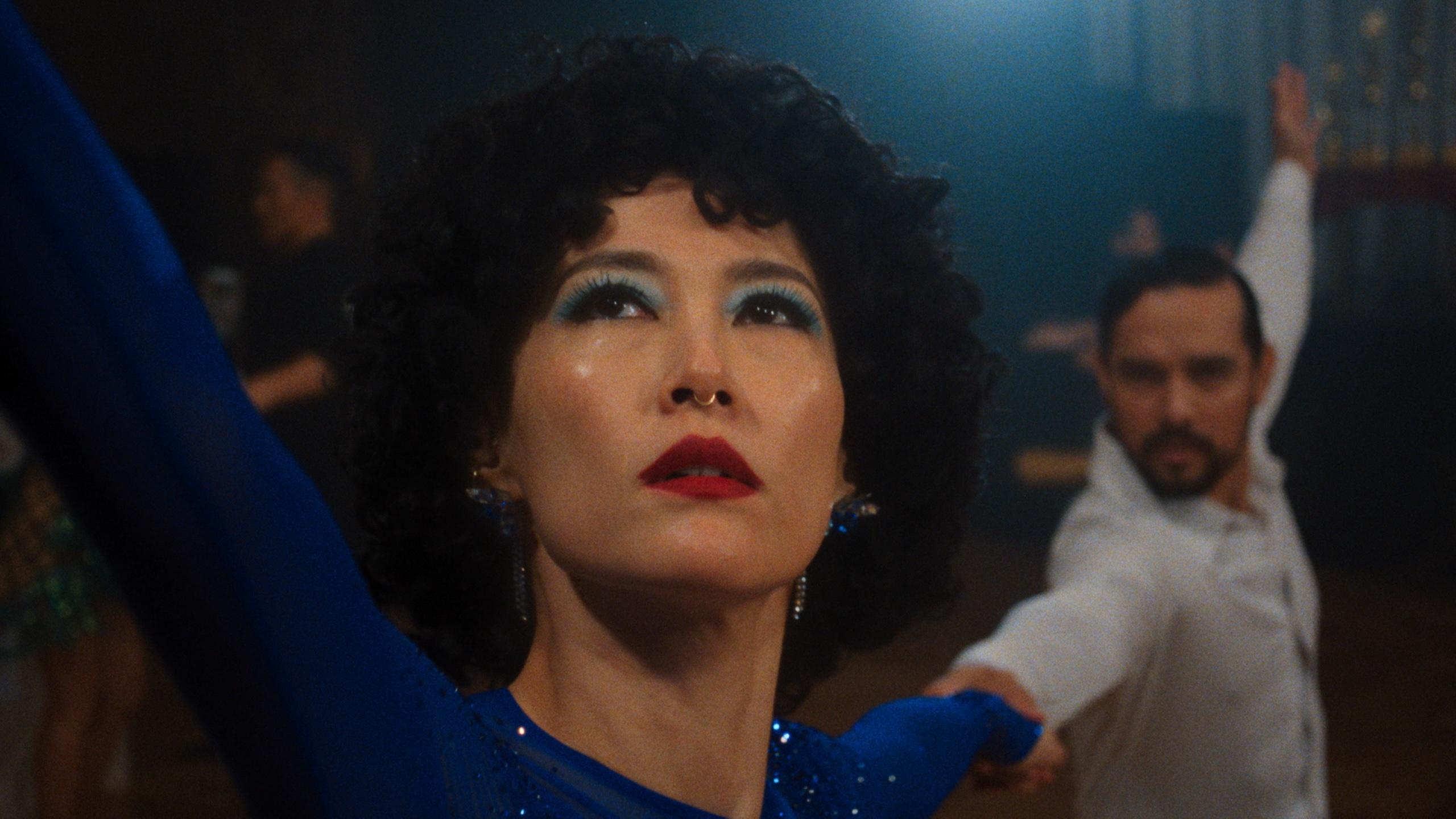
That’s what happens to bereaved widow Haru, played by Rinko Kikuchi, in Josef Kubota Wladyka’s bittersweet comedy Ha-Chan, Shake Your Booty!
asserted
what → ’ → Booty
Haru lives happily in Tokyo with her husband, Luis (Alejandro Edda), who’s also her dance partner—the two enjoy competitive ballroom dancing, a joyous physical representation of the relaxed, real-life romance that plays out at home.
asserted
that → live → home
Then Luis is taken from Haru.
asserted
Luis → take → Haru
She stops seeing friends and family and, worse yet, stops dancing.
asserted
She → stop → friends
Nine months later, when she’s finally persuaded to return to the studio for a class, a new instructor, Alberto Guerra’s Fedir, stops her cold: He’s a fantastic dancer, and handsome as a stallion.
asserted
He → persuade → stallion
A fling might be just what she needs.
uncertain
she → need → what
That’s just the barest outline of Haru’s plight.
asserted
That → ’ → plight
The movie Wladyka, along with his cowriter Nicholas Huynh, has built around her is a swirl of unchained desire, of fantasy dance sequences that unfold on ordinary Tokyo streets, and totally messy feelings.
asserted
that → build → streets
There’s no easy, one-size-fits-all way to navigate the loss of a loved one, just one of the truths that Ha-Chan, Shake Your Booty! navigates with warmth and humor.
asserted
Chan → ’ → warmth
The movie is pleasing, if slight, though Kikuchi’s performance is nuanced enough to keep you watching, and to keep you rooting for her.
asserted
performance → keep → her
The intimacy between Haru and Luis is reflected in the warmth of the home they’ve built together—most notably a wall of LPs, fronted by a turntable, that serves as a kind of hearth, which makes sense for two people who love to dance.
asserted
who → reflect → people
It looks like heaven, but for Haru it becomes a kind of limbo, a place where the dead and the living rub shoulders, sometimes uneasily.
asserted
dead → look → shoulders
After Luis’ death, Haru can barely bring herself to face the music, either literally or figuratively.
asserted
Haru → bring → music
She still feels his presence everywhere, and she sees it, too: he rather whimsically appears to her in the form a big black Tweety Bird with dark, shiny eyes.
asserted
he → feel → eyes
His human arms reach for her beneath his bird wings, and she allows herself to be enfolded in his embrace.
asserted
herself → reach → embrace
It’s both a comforting place to be and one that’s a little dangerous.
asserted
that → ’ → ?
When Haru meets Fedir—whose wife is a Paris-based dance champion, though the marriage is an open one—she glimpses fresh possibilities, or at least just an adventure.
asserted
she → meet → possibilities
In an early scene, after she and Fedir have had a pleasant, platonic dinner together, they’re ready to part ways in the street.
asserted
they → have → street
A crew of drunken businessmen jostle Haru, and Fedir stands up for her.
asserted
Fedir → jostle → her
What follows is a cleverly choreographed dream ballet—though the genre is actually the bachata, one of the dance forms Fedir teaches, its movements an expression of longing and heartache—in which Fedir defends Haru’s honor against this gang of boorish men.
asserted
Fedir → follow → men
Other passersby join in, and the scene becomes a metaphor for the act of rejoining life.
asserted
scene → join → life
By the end of the evening, Haru and Fedir have tumbled into bed.
asserted
Haru → tumble → bed
Their two hookups are enjoyable and tender—until the wife shows up, and Haru realizes she has feelings she can’t control.
asserted
she → show → feelings
Kikuchi shifts gears smoothly: One minute, she shows how Haru is nearly deadened by sorrow.
asserted
Haru → shift → sorrow
The next, her exhilaration becomes a kind of artificial sunshine.
asserted
exhilaration → become → sunshine
But a flash of anger and jealousy causes her to act out, in a scene that makes you recoil a bit even as you laugh.
asserted
you → cause → scene
Kikuchi is perhaps best known for her roles in movies like Babel and Pacific Rim, as well as HBO’s Tokyo Vice, several episodes of which Wladyka directed.
asserted
Wladyka → know → which
Here, she captures the spirit of a woman who longs to get back to being herself, if only she could remember who that self was.
uncertain
self → capture → woman
By the movie's end, she has found her way forward, because she realizes there’s no going back.
asserted
she → find → way
She’ll have to be a new person, encompassing the experiences and memories of the old one.
asserted
She → have → one
Kikuchi captures that difficult butterfly transition as it unfolds; it’s both painful and funny to watch.
asserted
it → capture → transition
But in the end, she shows us how Haru finds her way back to the music, which is the only way she can move into the future, one note, and one dance step, at a time.
asserted
she → show → time
 The Aporia