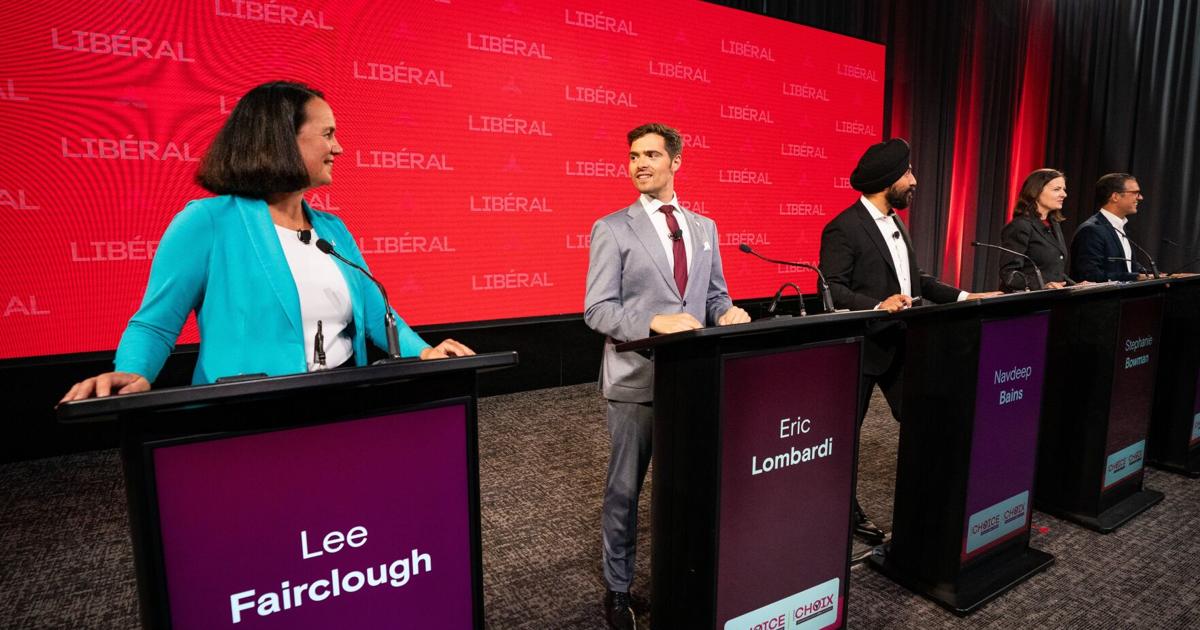
Photo via Toronto Star

How did you come up with the questions in the list?

Read the original at Toronto Star ↗
Cite

How did you come up with the questions in the list? (2026, September 25). Toronto Star. https://www.thestar.com/how-did-you-come-up-with-the-questions-in-the-list/article_1a55d193-174a-4f69-b072-10416945cd28.html

Dated when The Aporia collected the article, usually within hours of publication. Check the original for its exact date and byline.

Toronto Star · collected 2026-09-25 · by Unknown

Quick Summary

The article explains how questions for a list were developed by analysts reviewing policy statements from political parties since the last election to highlight where their views differ. This process is described as part of an effort to make The Star a preferred source on Google.
Written by AI on 2026-09-25, from this article's own text only (the story summary below draws on all the coverage).

AI analysis

Story summary

The Toronto Star explains how they formulated questions for a recent list by reviewing policy statements from various political parties since the last election. Their analysts identify issues where the parties have differing views and use this information to create relevant questions. The article emphasizes that their approach makes them a reliable source on Google, highlighting the importance of thorough research in shaping public discourse.

Written for “Question Creation Process” on 2026-11-03, grounded in this article and the 0 other(s) covering the same event.

Story

📰 Question Creation Process
Politics · 1 article(s) covering the same event.

Compared with similar articles

This article reads unscored and hedges 0% of its claims. Each row says how that neighbour differs.
Toronto Star
Outlet record 64/100
“Article A discusses a referendum in Alberta, while Article B asks about the process of creating questions for policy statements from political parties.”
CBC News
Hedges 5 of 46 claims Outlet record 74/100
“Article A discusses the methodology for creating questions based on party policy statements, while Article B reports on a poll about Albertans' opinions on immigration and non-separation questions.”
Toronto Star
⚖️ Leans left Hedges 1 of 30 claims Outlet record 64/100
“The articles discuss different aspects of political questions and party dynamics without describing the same specific incident.”
Toronto Star
Hedges 0 of 25 claims Outlet record 64/100
“Article A discusses the process of creating questions for policy analysis, while Article B reports on a debate among Ontario Liberal leadership candidates.”
Toronto Star
⚖️ Leans left Hedges 5 of 40 claims Outlet record 64/100
“The articles discuss entirely different topics and are not describing the same specific incident.”
CBC News
Hedges 4 of 29 claims Outlet record 74/100
“The articles discuss different topics: one about Alberta's premier stance on referendum ads, and another asking about question formulation in a list.”
Toronto Star
Hedges 0 of 26 claims Outlet record 64/100
“Article A discusses political upheaval in British Columbia leading up to an election call, while Article B appears to be about how questions were formulated for some kind of policy review and does not describe the same specific event.”
Toronto Star
⚖️ Leans left Hedges 0 of 48 claims Outlet record 64/100
“The articles are completely unrelated; one discusses a Montreal street encampment and its impact on politics, while the other is about question generation for political analysis.”
How this article was measured signals, leaning charts, publisher record, byline, topics and claims

Signals How these are calculated →

Claims extracted
2
sentences that state something as happening or true
Uncertain
0%
0 of 2 hedged ("reportedly", "may", "according to")
Leaning
not political
takes no side on a contested political question
Publisher signals
64/100
Toronto Star's corrections and hedging, across everything collected from it. Not a measure of accuracy.
Outlets on this story
1
Politics
Same framing elsewhere
1
articles that frame the event the way this one does
Analyzed 2026-09-25 · how these are computed

How this is being covered How these are calculated →

Article leaning vs. publisher reliability
Source leaning vs. consistency

Publisher

Toronto Star · 11297 article(s) · 28 correction(s) detected
Running correction rate · 28 correction(s)
2026-10-26
Correction
2026-10-24
Correction
2026-10-07
Correction
2026-09-24
Correction

Who wrote this

No reporter is named on this article, beyond the feed's “Unknown”.

Topics

Canadian Google The Toronto Star Toronto Toronto Star Newspapers Limited

Subjects

Toronto Star Newspapers Limited ORG · 4× The Toronto Star ORG · 2× Toronto ORG · 2× Canadian NORP · 1× Google ORG · 1×

Narrative

Our analysts review all the policy statements that the various parties have made since the last election and we use this information to identify issues where the parties diverge in their views.
framing: assertive · carried by 1 article(s) · first seen 2026-09-25
2026-09-25 · Toronto Star
How did you come up with the questions in the list? · assertive framing

Claims (2 extracted, 0 hedged)

Our analysts review all the policy statements that the various parties have made since the last election and we use this information to identify issues where the parties diverge in their views. asserted
parties → review → views
Make us a preferred source on Google flag wire: asserted
us → make → Google
💬Give feedback
🕘History 🎫Support