Photo via New York Post

Trump ‘wasn’t trying to dominate’ at state dinner with Xi, as body language expert notes ‘sign of respect’

Read the original at New York Post ↗
Cite

Nava, V. (2026, September 25). Trump ‘wasn’t trying to dominate’ at state dinner with Xi, as body language expert notes ‘sign of respect’. New York Post. https://nypost.com/2026/09/25/us-news/trump-wasnt-trying-to-dominate-at-state-dinner-with-xi-body-language-expert/

Dated when The Aporia collected the article, usually within hours of publication. Check the original for its exact date and byline.

New York Post · collected 2026-09-25 · by Victor Nava

Quick Summary

A body language expert analyzed President Trump's interactions with Chinese leader Xi Jinping during a White House state dinner, suggesting that Trump was attempting to show respect rather than dominate. Sean Johns noted unusual behavior from Trump, such as not engaging in his typical aggressive handshakes and maintaining a neutral demeanor during the toast despite positive words. However, when Trump spoke about the new White House ballroom under construction, he displayed genuine excitement and more expressive body language, including pointing directly at the camera which is seen as an assertive gesture.
Written by AI on 2026-09-26, from this article's own text only (the story summary below draws on all the coverage).

AI analysis

Story summary

The summit between US President Donald Trump and Chinese President Xi Jinping on September 24 focused largely on AI regulation amid escalating tensions over advancements in artificial intelligence technology. The meeting aimed to address mutual concerns about the risks associated with rapid AI development but ended with both sides maintaining their positions, despite attempts by China's Foreign Minister Wang Yi to emphasize "equality" and "reciprocity." Chinese state media highlighted the high-level reception Xi received at the White House as a sign of equality between the two nations, while US officials viewed reciprocity more transactionally. This divergence in interpretation has led to skepticism about whether genuine progress was made regarding AI guardrails or broader diplomatic cooperation.

Written for “Xi-Trump Summit Out comes” on 2026-11-05, grounded in this article and the 282 other(s) covering the same event.

Story

📰 Xi-Trump Summit Out comes
Politics · 283 article(s) covering the same event. See how they differ ↓

Compared with similar articles

This article reads unscored and hedges 5% of its claims. Each row says how that neighbour differs.
Washington Examiner
Hedges 2 of 24 claims Outlet record 69/100
South China Morning Post
Hedges 0 of 4 claims Outlet record 62/100
The Hindu
⚖️ Leans left Hedges 3 of 23 claims Outlet record 60/100
Al Jazeera
⚖️ Leans right Hedges 0 of 13 claims Outlet record 60/100
BBC News
⚖️ Leans left Hedges 7 of 33 claims Outlet record 66/100
Euronews
Hedges 0 of 4 claims Outlet record 60/100
ABC News (AU)
Hedges 3 of 26 claims Outlet record 67/100
NPR
Hedges 5 of 34 claims Outlet record 60/100
How this article was measured signals, leaning charts, publisher record, byline, topics and claims

Signals How these are calculated →

Claims extracted
38
sentences that state something as happening or true
Uncertain
5%
2 of 38 hedged ("reportedly", "may", "according to")
Leaning
not political
takes no side on a contested political question
Publisher signals
66/100
New York Post's corrections and hedging, across everything collected from it. Not a measure of accuracy.
Outlets on this story
283
Politics
Same framing elsewhere
1
articles that frame the event the way this one does
Analyzed 2026-09-26 · how these are computed

How this is being covered How these are calculated →

Article leaning vs. publisher reliability
Source leaning vs. consistency

Publisher

New York Post · 17225 article(s) · 36 correction(s) detected
Running correction rate · 36 correction(s)

Who wrote this

Victor Nava
77 article(s) here · 1 carrying a prediction
🔮 Cruz warned that with their new political power “Democrats in Austin and in Washington will overshoot” and may attempt to push a “radical transgender agenda,” new tax and energy policies and “persecute those they perceive to be enemies, especially Elon Musk.”
🔮 Collins, 73, will leave Congress as the longest-serving female Republican senator in history.
🔮 “Bret, Bret … no, no, no … let me just stop there,” El-Sayed interjected, cutting off Baier before he could finish the question.
🔮 Far-left candidates backed by the Democratic Socialists of America (DSA) appear poised to notch victories in Tuesday’s midterm election, which would allow the radical flank of the Democratic Party to shore up its foothold in Congress and take control of major American cities from coast to coast.
🔮 Stevens explained that once she concluded El-Sayed was “not fit to serve,” she decided to back Rogers “with the hope that he can serve in the tradition of John McCain: a senator willing to put country before party and stand up to his own side when conscience requires it.”
🔮 President Trump on Monday argued Republicans should be able to “win in a landslide” while warning that his administration’s achievements will be “wiped out” if Democrats emerge victorious in the midterm elections.
🔮 The effects of Trump’s declining support among Hispanic voters could be most apparent on Election Night in districts that went for Trump in the 2024 elections, have large Latino populations and GOP incumbents on the ballot in House races.
🔮 “As we speak, law enforcement around the country are taking investigative steps with respect to the criminal investigation,” he added, noting that he could not discuss the specifics of what those steps were due to the ongoing probe.
🔮 Watters joked that the network’s next town hall will be held inside a Cheesecake Factory.
🔮 Trump is in the final stretch of a whirlwind tour of predominantly red states with tight midterm races, hoping his rallies will help Republicans maintain control of the House and Senate.
Also by Victor Nava
Nothing else under this byline is closely related to this article, so these are simply their most recent.
All 77 articles by Victor Nava →

Topics

BodyLytics Chinese The Post White House

Subjects

Johns PERSON · 11× Trump PERSON · 11× Chinese NORP · 2× Donald Trump PERSON · 2× White House ORG · 2× BodyLytics ORG · 1× Sean Johns PERSON · 1× The Post ORG · 1× Xi Jinping PERSON · 1×

Narrative

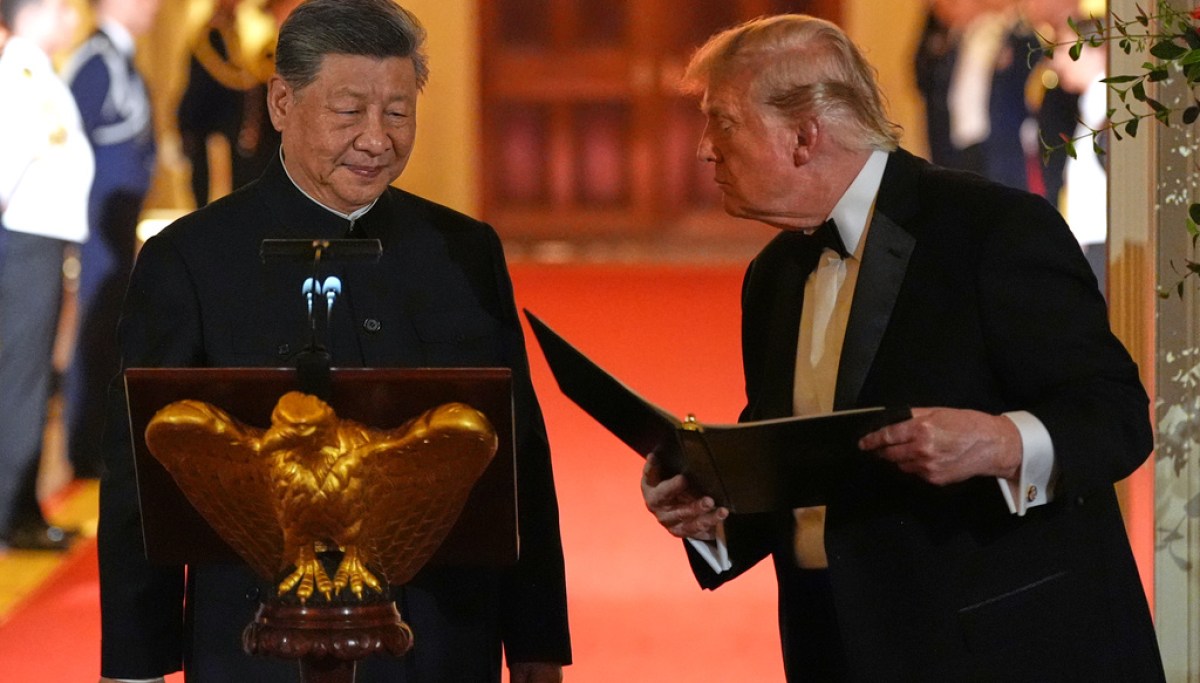
Sean Johns, who has 20 years of experience analyzing nonverbal communication and is the founder of the body language training company BodyLytics, told The Post that from Trump’s initial handshake with Xi and through the toast, the president appeared to be trying his best to make his Chinese counterpart feel welcomed and respected during the high-stakes visit.
framing: assertive · carried by 1 article(s) · first seen 2026-09-26
🔮 Johns pointed out that at the end of the handshake Trump forced “a little false smile,” which he would later deploy again during his toast for Xi.

Claims (38 extracted, 2 hedged)

President Trump was trying to “connect” with Xi Jinping, rather than “dominate” him, at the White House state dinner for the Chinese leader, according to a body language expert. uncertain
Trump → try → expert
Sean Johns, who has 20 years of experience analyzing nonverbal communication and is the founder of the body language training company BodyLytics, told The Post that from Trump’s initial handshake with Xi and through the toast, the president appeared to be trying his best to make his Chinese counterpart feel welcomed and respected during the high-stakes visit. asserted
counterpart → have → visit
Johns noticed the president “closed the distance” and “came towards” Xi during the arrival ceremony on the North Portico, which he found “not typical for Donald Trump.” asserted
he → notice → Trump
“Closing the distance between people is trying to kind of like connect. asserted
Closing → close → people
In a strange way, you’re connecting. asserted
you → connect → way
So you’re closing that gap,” he explained. asserted
he → close → gap
“What we’re looking at with this handshake is what was not there,” Johns said. asserted
Johns → look → handshake
“Because Donald Trump is known for the aggressive handshake. asserted
Trump → know → handshake
He shakes for too long. asserted
He → shake → long
He kind of grabs you by the arm often. asserted
He → grab → arm
“And with President Xi, he didn’t do that.” asserted
he → do → that
Trump’s approach to the handshake was “more of a sign of respect,” according to the body language expert. uncertain
approach → accord → expert
“I think that he wasn’t trying to dominate, which he usually does,” Johns said, noting that Trump typically overdoes it with handshakes and aggressive pats on the back “depending on who he’s dealing with.” asserted
he → think → who
“This showed that there was a lot of respect for [Xi]. asserted
This → show → Xi
And it was a very two-sided thing,” he continued, adding that both leaders “looked quite comfortable around each other … and there was no dominance play from either side.” asserted
leaders → continue → side
Johns pointed out that at the end of the handshake Trump forced “a little false smile,” which he would later deploy again during his toast for Xi. asserted
he → point → Xi
At several points in his toast, Trump displayed what Johns described as “incongruence” between his remarks and body language. asserted
Johns → display → remarks
“He emphasized that ‘We’re delighted to have you here,’ but there was no body language delight … asserted
We → emphasize → you
the words were positive, but the body language was neutral,” the expert noted. asserted
expert → note → ?
“And he did this twice.” asserted
he → do → this
“When he said, ‘We’re happily celebrating,’ It didn’t look like he was happy celebrating, it just looked like protocol.” asserted
it → say → protocol
Another moment that stood out to Johns during Trump’s speech was when the president went off-script to invite guests to tour the new White House ballroom, which is still under construction. asserted
which → stand → construction
“That’s the first time where you see a genuine smile,” Johns said, “and he almost came across like a naughty schoolboy. asserted
he → ’ → schoolboy
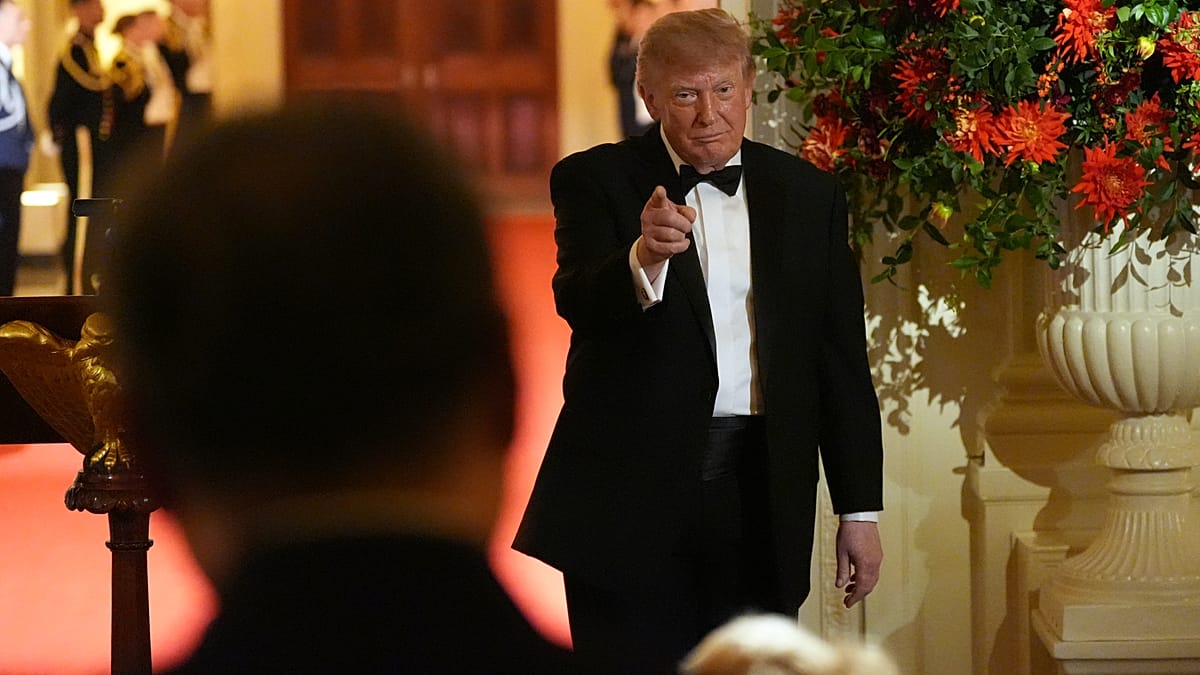
When discussing the ballroom, Trump became more expressive and aggressive than at any other point in his remarks or interactions with Xi. asserted
Trump → discuss → Xi
“He makes his first hand gesture, bearing in mind that his hands have been down the whole time,” Johns observed. asserted
Johns → make → mind
“He points directly at the camera. asserted
He → point → camera
Pointing, in body language, with the index finger, is considered aggressive,” he continued, noting that again, Trump’s words and body language were “not congruent.” asserted
words → point → finger
“You’re making a slightly aggressive gesture with a finger point, but you’re saying the ‘beautiful ballroom.’” asserted
you → make → ballroom
“There’s a disconnect there somewhere between the perception of perhaps the ballroom and all the drama that surrounded it,” Johns said. asserted
Johns → ’ → it
Based on his body language, the president was also genuinely pleased with the large, bald eagle statue he gifted Xi at the dinner. asserted
he → base → dinner
“When they reveal the bald eagle statue, Trump does, kind of, two awkward steps … asserted
Trump → reveal → steps
I think that was a closing distance gesture between him and the statue,” Johns said. asserted
Johns → think → him
“It’s showing approval towards it almost. asserted
It → show → it
You get close to things you like. asserted
you → get → things
So he’s closed the distance and then, interestingly, he’s kind of does an exaggerated look at it and then looks back at Xi …. asserted
he → close → Xi
he’s trying to signal to him, ‘Look at the wonderful statue that we gave you.’” asserted
we → try → you
Johns’ biggest takeaway was the “lack of physical, non-verbal aggression” throughout the dinner that Trump “usually shows certain people.” asserted
Trump → show → people
“I think that what it shows to me is the amount of respect and perhaps the importance of the meeting and the fact that it was an important guest that had importance to even the economy, I would say,” he explained. “So he took that very seriously, aside from the odd joke or two.” asserted
he → think → joke

💬Give feedback · no sign-in needed

No sign-in needed for now. Your note is sent without a name, so it cannot be answered.

🕘History 🎫Support