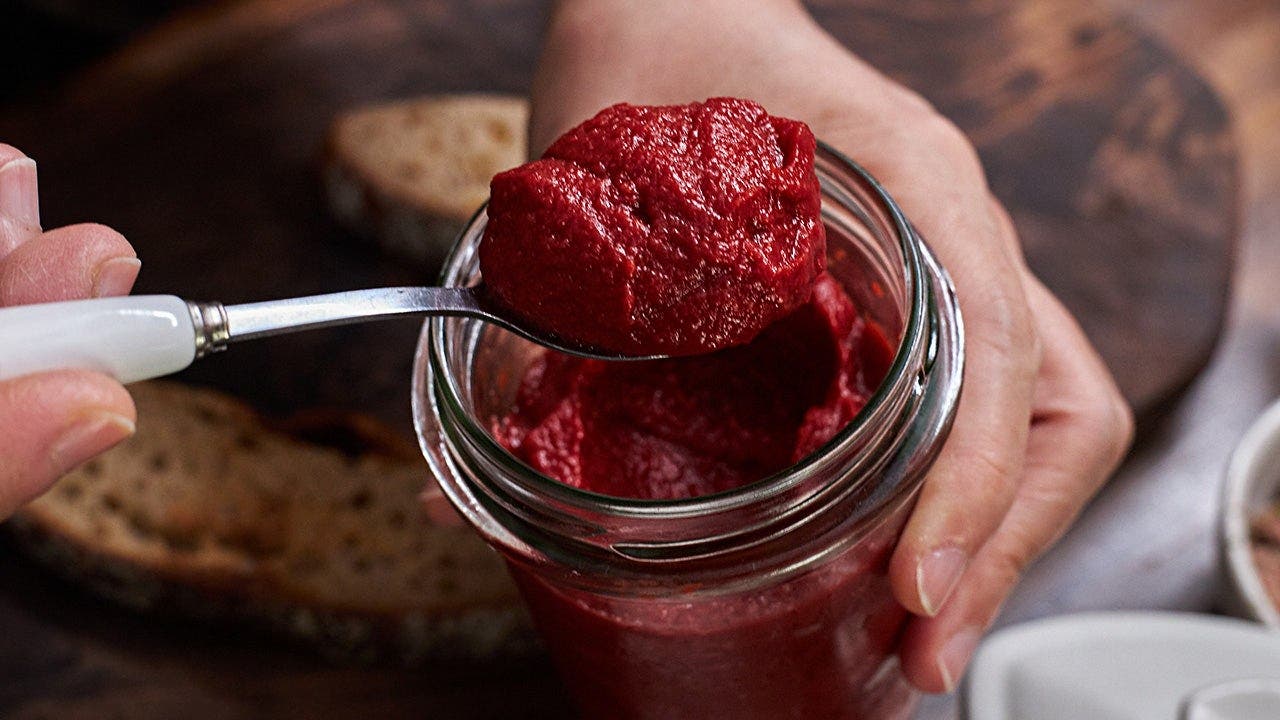
Photo via Fox News

Common kitchen staple may sharpen your brain — and it only takes 2 tablespoons

Read the original at Fox News ↗
Cite

Bardolf, D. (2026, September 26). Common kitchen staple may sharpen your brain — and it only takes 2 tablespoons. Fox News. https://www.foxnews.com/food-drink/common-kitchen-staple-may-sharpen-your-brain-only-takes-2-tablespoons

Dated when The Aporia collected the article, usually within hours of publication. Check the original for its exact date and byline.

Fox News · collected 2026-09-26 · by Deirdre Bardolf

Quick Summary

A new study from Spain suggests that consuming about two tablespoons of tomato paste daily for three months may improve attention and processing speed. The research involved forty-two healthy adults aged 40 to 55 who followed a diet low in lycopene before switching to a diet including tomato paste, with blood tests showing a borderline increase in BDNF, a protein linked to brain-cell growth. Participants scored higher on cognitive tests during the tomato paste phase compared to their baseline scores when not consuming it. The study, published in Antioxidants, indicates that while preliminary and requiring further research, lycopene-rich foods like tomatoes might have positive effects on brain function.
Written by AI on 2026-10-02, from this article's own text only (the story summary below draws on all the coverage).

AI analysis

Story summary

Researchers in Spain discovered that consuming about two tablespoons of tomato paste daily for three months may slightly enhance cognitive functions such as concentration and processing speed. The study involved 42 healthy adults aged 40 to 55, who followed a diet low in lycopene (the antioxidant found in tomatoes) before switching to the high-lycopene diet during the trial period. Participants ate approximately 35 grams of tomato paste daily, which led to an average improvement of 7.2 points for concentration and 8.3 points for processing speed on standardized tests. The study used a randomized crossover design where each participant served as their own control group before and after consuming the tomato paste. While these findings suggest potential benefits, the small sample size means they do not definitively prove significant brain improvements.

Written for “Brain Health Benefits Of Food” on 2026-11-04, grounded in this article and the 0 other(s) covering the same event.

Story

📰 Brain Health Benefits Of Food
Health · 1 article(s) covering the same event.

Compared with similar articles

Nothing to compare against. No article is close enough to this one for the pipeline to have linked or judged the pair.
How this article was measured signals, leaning charts, publisher record, byline, topics and claims

Signals How these are calculated →

Claims extracted
19
sentences that state something as happening or true
Uncertain
26%
5 of 19 hedged ("reportedly", "may", "according to")
Leaning
not political
takes no side on a contested political question
Publisher signals
68/100
Fox News's corrections and hedging, across everything collected from it. Not a measure of accuracy.
Outlets on this story
1
Health
Same framing elsewhere
1
articles that frame the event the way this one does
Analyzed 2026-09-26 · how these are computed

How this is being covered How these are calculated →

Article leaning vs. publisher reliability
Source leaning vs. consistency

Publisher

Fox News · 6507 article(s) · 12 correction(s) detected
Running correction rate · 12 correction(s)

Who wrote this

Deirdre Bardolf
39 article(s) here · 1 carrying a prediction
🔮 Paper straws have been marketed as a more environmentally friendly alternative to plastic, but a new South Korean assessment suggests they may carry a greater pollution-related health burden.
🔮 He explains that he was already an hour late getting home, his children had already gone to bed without him and he would have to get up at 5 a.m. the next day for work.
🔮 Your daily cup of coffee may be doing more than helping you wake up in the morning, a new study has found.
🔮 A separate deal for a 79-cent-per-pound Good & Gather frozen turkey — not the Butterball turkey included in the meal deal — will begin in November.
🔮 A recent survey out of Germany found that nearly one in three people cut mold off food before eating the rest, a habit that may not remove all toxins.
🔮 As a dentist, he said he evaluates candy by how it could damage teeth: "Can it harm the enamel?
🔮 Card told Fox News Digital that his experience working in hotel and restaurant kitchens preparing and cutting steaks made him confident he could tell the difference.
🔮 Alton Brown's unconventional approach calls for mayonnaise and extra egg yolks.
🔮 Hurts is receiving treatment with the medication and is expected to miss the remainder of the 2026 season, according to the NFL.
🔮 Sage's drying quality works well to balance rich, fatty dishes, and it was even traditionally rubbed between the hands as a home remedy for clamminess, Perr said. For dried herbs, Perr also recommends crushing them in your hand before adding them to a dish to help release their oils. "Crushing it before you add it to something will explode the flavor," she said.
Also by Deirdre Bardolf
Nothing else under this byline is closely related to this article, so these are simply their most recent.
All 39 articles by Deirdre Bardolf →

Topics

Fox News Digital Linus Health Pennsylvania Spain

Subjects

Fox News Digital ORG · 2× Showalter PERSON · 2× John Showalter PERSON · 1× Linus Health ORG · 1× Pennsylvania GPE · 1× Spain GPE · 1×

Narrative

Researchers in Spain found that participants who ate about two tablespoons of tomato paste every day for three months scored slightly higher on tests of concentration, processing speed and associative memory than when they followed a diet low in lycopene, the red antioxidant pigment found in tomatoes and other fruits.
framing: mixed · carried by 1 article(s) · first seen 2026-09-26
🔮 Researchers said the pattern could suggest more efficient brain communication, but the small sample means it does not prove a meaningful brain benefit.

Claims (19 extracted, 5 hedged)

A couple of daily tablespoons of a common pantry staple often used to make pasta sauce richer were linked to better attention and processing speed, a small new study found. asserted
study → use → attention
Researchers in Spain found that participants who ate about two tablespoons of tomato paste every day for three months scored slightly higher on tests of concentration, processing speed and associative memory than when they followed a diet low in lycopene, the red antioxidant pigment found in tomatoes and other fruits. asserted
they → find → tomatoes
Forty-two healthy adults ages 40 to 55 completed the study and spent three months on each diet with a one-month washout period in between. asserted
adults → complete → between
When they ate the low-lycopene diet, they stuck to their usual eating habits and avoided foods such as tomatoes. asserted
they → eat → tomatoes
During the tomato paste phase, they consumed 0.5 grams per kilogram of body weight each day, averaging about 35 grams daily. asserted
they → consume → grams
Afterwards, participants scored an average of 7.2 points higher for concentration, 8.3 points higher for processing speed and 0.8 points higher on a test matching faces with names. asserted
participants → score → names
The trial used a randomized crossover design, meaning participants served as their own comparisons before and after eating the tomato paste. asserted
participants → use → paste
Their blood tests also showed a borderline increase in BDNF, a protein involved in brain-cell growth and adaptability, according to the research. uncertain
tests → show → research
Brain scans in a small subset of participants also showed changes in resting connectivity, which is how different brain regions work when a person is not focused on a specific task. asserted
person → show → task
Researchers said the pattern could suggest more efficient brain communication, but the small sample means it does not prove a meaningful brain benefit. uncertain
it → say → benefit
The study, published in the journal Antioxidants earlier this year, did not show that tomato paste prevents cognitive decline or disease, but it offers an early look at how lycopene-rich tomato foods may affect the brain uncertain
foods → publish → brain
, the researchers said. asserted
researchers → say → ?
They called the findings preliminary and said larger studies are needed. asserted
studies → call → findings
Dr. John Showalter, a Pennsylvania-based internal medicine physician and chief operating officer of Linus Health, said that, while the trial was small, it fits into a larger body of research that says people need naturally red foods in their diets. asserted
people → base → diets
The low-lycopene phase may be the study's most telling comparison, Showalter told Fox News Digital. uncertain
Showalter → tell → Digital
Rather than showing tomato paste acts as a standalone cognitive enhancer, he said, the results suggest that restricting lycopene-rich foods may leave the brain functioning less well. uncertain
restricting → show → brain
"We know that people that have low lycopene levels have a higher mortality rate, they have more cardiovascular events, and there's been increasing literature that low lycopene is bad for your brain," he said. asserted
he → know → brain
Watermelon, papaya and red peppers also contain lycopene, though cooked and concentrated tomato foods, including ketchup and sun-dried tomatoes, can provide especially high amounts, Showalter added. asserted
Showalter → contain → amounts
Fox News Digital reached out to the researchers for comment. asserted
Digital → reach → comment

💬Give feedback · no sign-in needed

No sign-in needed for now. Your note is sent without a name, so it cannot be answered.

🕘History 🎫Support