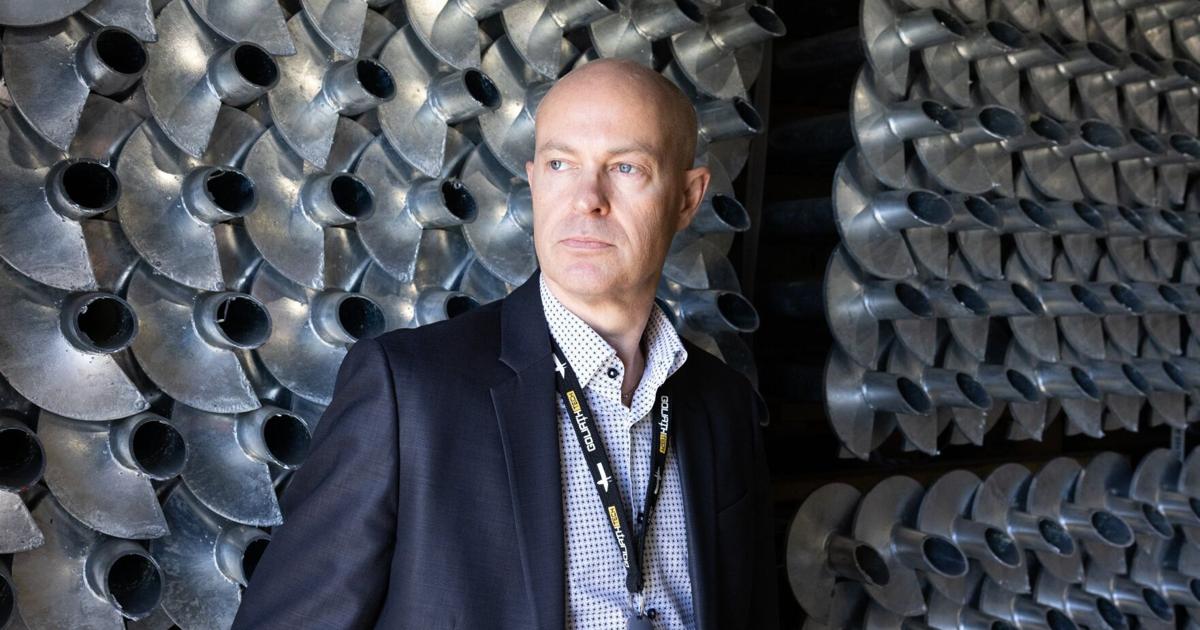
One day last December, Julian Reusing pulled his managers into a virtual meeting to lay bare an uncomfortable truth.
asserted
Reusing → pull → truth
His Quebec company, GoliathTech, a manufacturer of helical screw piles that operates on a franchise model, was getting battered by U.S. tariffs and running out of ways to keep its head above water.
asserted
that → operate → water
Since the steel tariffs came into effect last March, the company has paid about $3.7 million in tariffs that it has split with its U.S. franchisees.
asserted
it → come → franchisees
Reusing, 56, was eager to open a factory south of the border, but he was cash-strapped.
asserted
he → open → border
Just days earlier, RBC had turned down financing for the company’s European franchise expansion.
asserted
RBC → turn → expansion
Reusing appealed to his own employees for money.
asserted
Reusing → reuse → money
There have been few moments in Canadian history when small and mid-sized manufacturers have faced such pressure.
asserted
manufacturers → face → pressure
Insurmountable trade barriers with the U.S. have appeared overnight for some companies, suddenly cutting off their largest export market and forcing an urgent need to pivot.
The fight to survive can feel lonely, business owners told the Star.
asserted
owners → appear → Star
Several said the country’s support falls far short of what they need: the tariff relief programs don’t go far enough and structural threats to Canadian manufacturing competitiveness are making it difficult to replace lost U.S. business.
asserted
it → say → business
Luckily, GoliathTech did not go under that winter.
asserted
GoliathTech → go → ?
Instead, following that pivotal meeting in December, the company raised $900,000 through an equity sale to six of its employees, alongside $1.5 million from a private investor.
asserted
company → follow → investor
Reusing opened a small factory in Ohio in March after 10 months of planning in an effort to bypass most U.S. tariffs.
asserted
Reusing → open → tariffs
He also added 19 European and British franchisees, expanding the firm’s global network to 190 locations as part of a broader restructuring.
asserted
He → add → restructuring
“Without a shadow of a doubt, we would be a non-existent company right now if we didn’t make that move,” said Reusing, explaining why he chose to move some production south.
asserted
he → make → production
“It’s impossible for a company to survive where for every hundred dollars you ship, you have to give fifty dollars to the government.”
asserted
you → ’ → government
Headquartered in Magog, Que., the 13-year-old company is turning a profit for the first time in three years — a turnaround that resulted from Reusing’s own scrambling, with little help from the Canadian government or financial institutions at home.
asserted
that → headquarter → home
Many company owners are not nearly as fortunate, and he says Canada needs to do more before more of them are pushed to the brink.
asserted
more → say → brink
“The government needs to come up with some programs that would teach people how to deal with this, not just offer money,” he said.
asserted
he → need → money
“I don’t think everybody knows how to deal with a massive revolution.”
asserted
everybody → think → revolution
It’s rare to find a clothing company that makes all of its products in Canada — about 95 per cent of the apparel sold here is manufactured outside the country.
asserted
cent → ’ → country
When the 50-per-cent U.S. tariffs hit in August, Amit Thakkar feared they could spell the end of his Brampton textile company, Roopa Knitting Mills, which makes fabric for T-shirts, sweatshirts and leggings now caught in the tariff net.
uncertain
which → hit → net
Across the three Canadian clothing businesses he owns, Thakkar employs 120 people, with 50 to 70 per cent of sales destined for the U.S.
His disappointment only grew when Ottawa rolled out a $7.5-billion package to aid tariff-stricken businesses, the majority of which came in the form of loans.
asserted
majority → own → loans
“If you want to know my honest truth, I think those are all bulls—t,” Thakkar said.
asserted
Thakkar → want → truth
“The Canadian government wants to give us loans, but we don’t have customers anymore.”
asserted
we → want → customers
To Thakkar, the situation is reminiscent of a problem that emerged during the pandemic, when businesses took on emergency debt that some are still struggling to repay years later.
asserted
some → emerge → that
Thakkar says he believes the best way to save his business is for Ottawa to return counter-tariff revenue to companies affected by the trade war, giving them cash to cover tariff costs or lost sales.
asserted
Ottawa → say → costs
“If this is like the same in six months,” said Thakkar, “we’re going to be talking about shutting down or moving to the U.S.,” adding that there just isn’t enough buy-in for Canadian-made clothes from the government or domestic consumers.
asserted
we → say → government
Before Reusing raised money on his own to restructure his business, he went to the Business Development Bank of Canada (BDC), which launched its Pivot to Grow program last March, offering up to $5 million in loans to help businesses stay afloat and break into new markets.
asserted
businesses → raise → markets
It seemed like a perfect fit for Reusing’s strategy, but he was denied financing because the business had reported losses in the past two years.
asserted
business → seem → years
“I’ve spoken with the BDC, Investissement Québec, many different government entities, and we’ve had zero money from the government,” he said.
asserted
he → speak → government
“I lost faith.”
asserted
I → lose → faith
Reusing found investors on his own.
asserted
Reusing → reuse → own
Dennis Darby, president of Canadian Manufacturers and Exporters, said he is in constant contact with Ottawa to discuss the eligibility and access issues manufacturers are running into.
asserted
manufacturers → say → issues
The recent tariff-relief programs are well-intentioned, he said, but their success depends on execution and the speed of approvals.
asserted
success → intentione → approvals
“For these smaller manufacturers getting access to that funding, it can’t take six months,” he said.
asserted
he → get → funding
Companies need more support at home
asserted
Companies → need → home
When Jack Dell’Accio set out to expand Essentia Organic Mattress in 2023, he faced a choice: scale up the company’s factory in Laval, Que., or open a second plant.
asserted
he → set → plant
He chose the latter, investing in a facility in Florida that opened last October.
asserted
that → choose → Florida
Mattresses are not subject to the tariffs, and the move was driven purely by logistics costs, particularly the high shipping rates in Canada.
asserted
move → drive → Canada
“I have no issues building in Canada all of our raw materials, but it’s our distribution of finished product that has challenges in Canada,” said Dell’Accio, whose company generates about 70 per cent of its sales in the U.S.
asserted
company → have → U.S.
…and 42 more, not listed.
 The Aporia