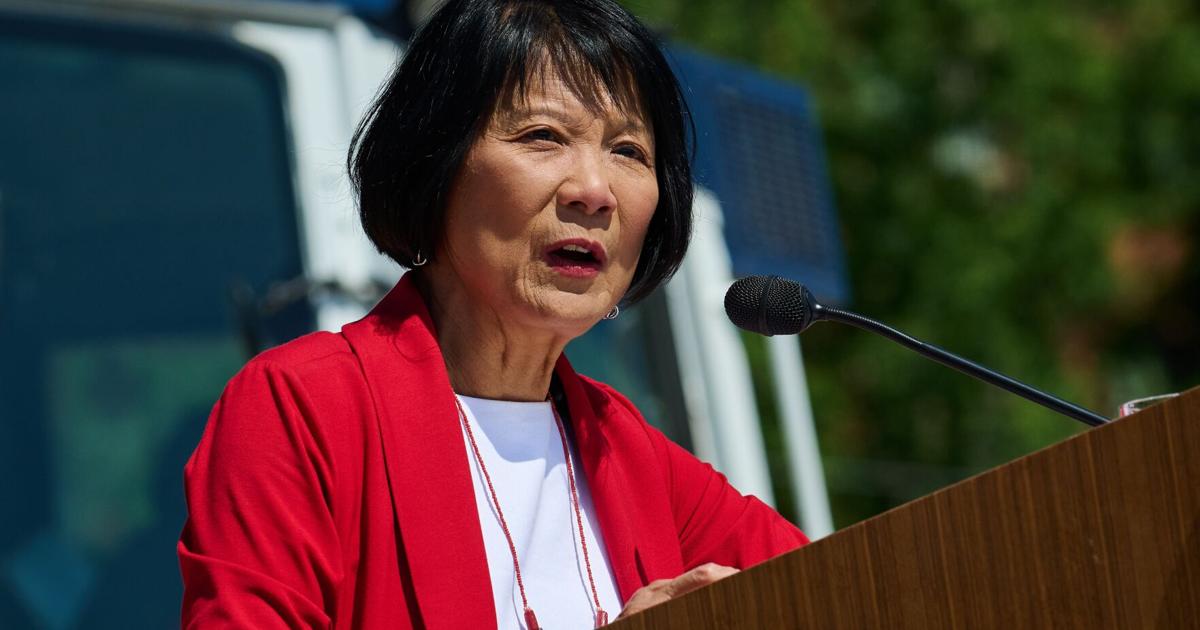
I’m trying to coax the mayor of Toronto into discussing a topic she’d rather not talk about: herself.
asserted
she → try → topic
This places Olivia Chow in sharp contrast to most of the politicians I’ve known, a talkative lot who typically find themselves endlessly fascinating.
asserted
themselves → place → politicians
“If there’s no reason for me to talk about myself, then why would I?” Chow says.
asserted
Chow → ’ → myself
I try a different approach.
asserted
I → try → approach
If I were painting your portrait, I ask, how would I capture the real Olivia Chow?
asserted
I → paint → Chow
She plays along — a little bit.
asserted
She → play → ?
And I’d like my eyes to denote empathy.
asserted
eyes → like → empathy
Because life is colourful, it’s ever-changing.
asserted
it → ’ → ?
And laughter because we enjoy this life, celebrating what we have.”
asserted
we → enjoy → what
The empathy is for those who are disadvantaged, the homeless, the victims of domestic violence — including her mother, until Chow was old enough to rescue her.
asserted
Chow → include → her
The mayor knows I’m not really painting her portrait, which is just as well: even if I knew how to paint, Chow doesn’t really want a portrait on her wall.
asserted
Chow → know → wall
“That would be a bit self-centred,” she says.
asserted
she → say → ?
She’s comfortable opening up about herself when it helps “build a bridge” to those who struggle, as her family did after emigrating from Hong Kong in the 1970s. Or who’ve experienced great loss, as she did with the death of her husband, Jack Layton, in 2011.
asserted
she → open → 2011
I first met Chow in 1997, a few days after we’d both been elected to the amalgamated Toronto’s first city council.
asserted
we → meet → council
She correctly surmised that I would be an ally and asked for a rundown on some of my fellow North York councillors whom she hadn’t met.
asserted
she → surmise → whom
Knowing what makes a politician tick is often critical to maneuvering them into place on a close vote.
asserted
politician → know → vote
“Olivia, there’s nobody I’d rather be manipulated by than you,” the late councillor Howard Moscoe said to her one day while I listened in.
asserted
I → ’ → her
Moscoe smiled; Chow smiled back.
asserted
Chow → smile → ?
She was masterful at working out solutions behind the scenes and cajoling others into adopting them.
asserted
She → work → them
If it was strategic to let others take the credit, that worked for her, too.
asserted
that → let → her
But can you still be a backstage problem-solver when you’re running for re-election, when voters demand a piece of you, a public image, an accounting of everything you’ve done for them, all delivered with gusto?
asserted
all → run → gusto
We think we know the people we vote for when, sometimes, all we really get is the persona.
asserted
we → think → people
It might surprise you to know that former Toronto mayors Mel Lastman and Rob Ford were both stare-at-the-floor shy but would spring into character whenever a camera or microphone was pointed at them.
uncertain
camera → surprise → them
Typically, successful politicians assume a role and play it.
asserted
politicians → assume → it
Chow doesn’t entirely subscribe to that philosophy.
asserted
Chow → subscribe → philosophy
“If I can get peoples’ attention so that I get the change I want, then I’m fine,” she says.
asserted
she → get → change
“If it’s attention for the sake of attention, then it’s pointless.”
asserted
it → ’ → attention
“How much do people really know about her?
asserted
people → know → her
I don’t think very much,” says David Valentin, principal at polling firm Liaison Strategies.
asserted
Valentin → think → Strategies
“I think even some of her superfans would score surprisingly low on a quiz.”
asserted
some → think → quiz
Yet voters have a strong impression of Chow, he says, and it’s a positive one: “Their impression is that she shows up to things, she’s nice, she smiles, she dances, she’s not a mean person, she cares about people.”
asserted
she → have → people
When the mayor’s job unexpectedly opened up after John Tory resigned in February 2023, Chow didn’t immediately jump into the fray.
asserted
Chow → open → fray
She waited until younger left-wing potential challengers Joe Cressy and Mike Layton had opted out.
asserted
challengers → wait → ?
Still, even with no alternative to back, many on the left questioned whether Chow could pull off a win.
uncertain
Chow → back → win
She hadn’t run a strong campaign in 2014, when she lost to Tory, and she had been out of the game for 10 years by the time he resigned.
asserted
he → run → time
Chow proved the doubters wrong, however, and she appears poised to do so again against two serious contenders and some prejudices Torontonians like to pretend don’t exist here.
asserted
Torontonians → prove → contenders
(“That Olivia Chow, she doesn’t speak good English,” a man went out of his way to tell me.
asserted
man → speak → me
“I’m not prejudiced or nothin’,” he added.)
asserted
he → ’m → ?
Since amalgamation, Chow has been Toronto’s only female mayor, the only person of colour to hold the job and the first mayor not to have English as their first language.
asserted
Chow → hold → language
She often dresses in bright clothing to match an occasion — the colours of a given country’s flag at a cultural gathering, for example.
asserted
She → dress → example
…and 30 more, not listed.
 The Aporia