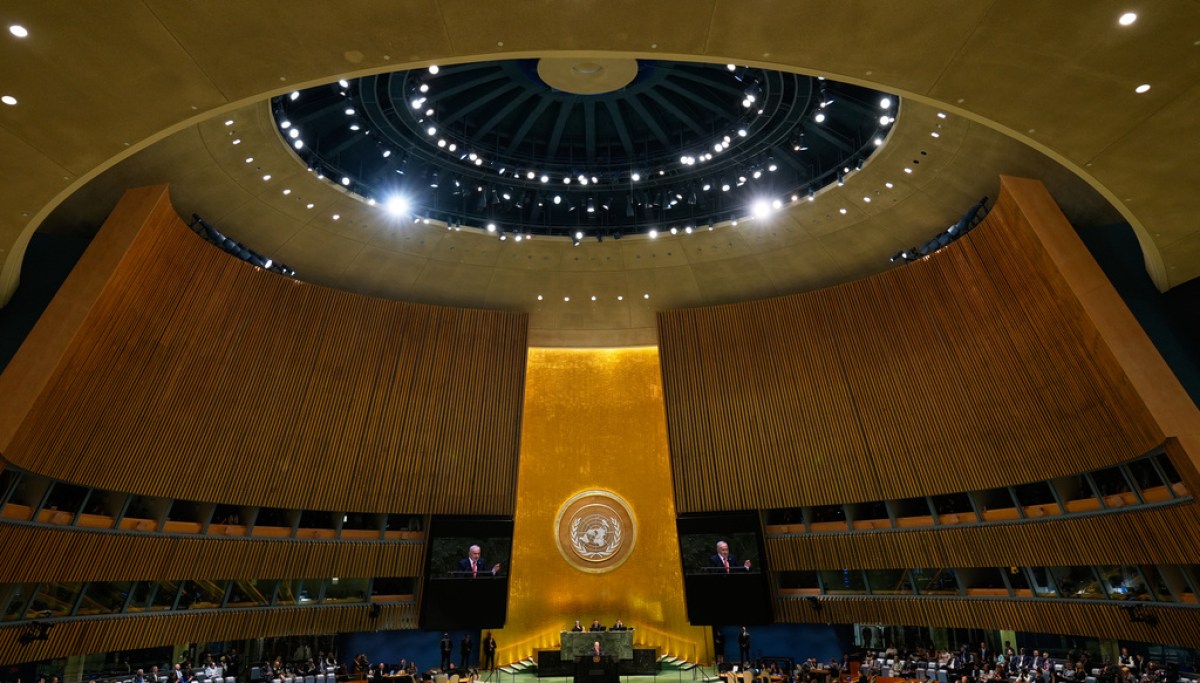
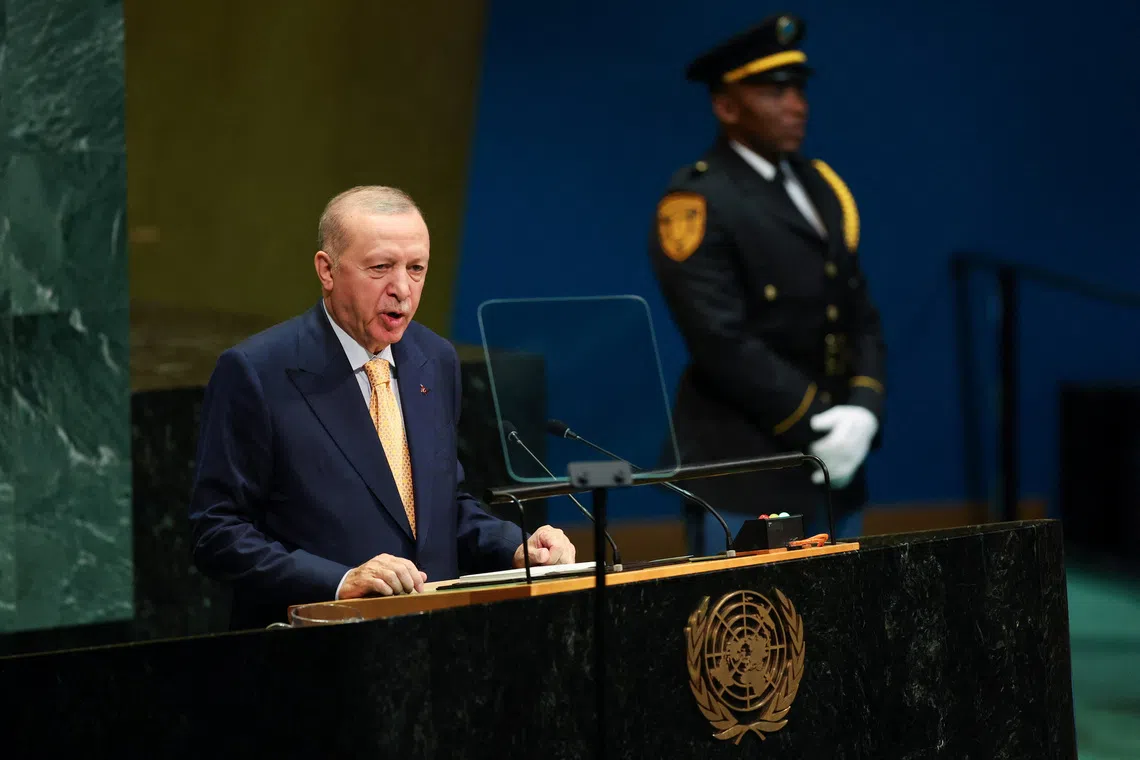
Turkiye’s President Recep Tayyip Erdogan has called for the five permanent members of the United Nations Security Council (UNSC) to lose their veto power, arguing that the current veto system is “unjust” and hinders “global stability and peace”.
asserted
system → call → stability
The call comes as the UNSC, which has five permanent members and 10 rotating, non-permanent members, remains deadlocked on many issues – from Israel’s war on Gaza to Russia’s war in Ukraine and the Strait of Hormuz.
asserted
which → come → Hormuz
Recommended Stories
list of 3 items- list 1 of 3UNGA81: Why has Africa’s Security Council reform push remained unresolved?
- list 2 of 3Did Germany lose its UNSC seat because of support for Israel?
- list 3 of 3Trump invites Putin to Miami G20: Why that matters
The US, one of the five permanent members, has vetoed seven resolutions related to the Israeli-Palestinian conflict over the past three years, including five calling for a ceasefire in Gaza.
asserted
US → remain → Gaza
Russian vetoes have prevented the UNSC from passing any firm resolutions on the war in Ukraine.
asserted
vetoes → prevent → Ukraine
Speaking to journalists in New York on Thursday, Erdogan said, “Let the veto mechanism be abolished… Let us move from a UN model that protects only five members to a mechanism that encompasses all members”.
asserted
that → speak → members
So, could Erdogan’s call become a reality and what would abolishing the veto mean for the UNSC?
uncertain
abolishing → become → UNSC
What is the UNSC veto and who can exercise it?
asserted
who → exercise → it
It is a special power to veto any substantive resolution, granted to the body’s five permanent members – the US, the UK, France, Russia and China.
asserted
It → veto → members
It means that even if 14 of 15 UNSC members vote in favour of a resolution, just one veto from any of the five permanent members (P5) can tank it.
asserted
veto → mean → it
What has Turkiye called for?
asserted
Turkiye → call → What
Erdogan has called for a complete overhaul of the UNSC.
asserted
Erdogan → call → UNSC
That includes ending permanent membership of the council and eliminating the veto power.
asserted
That → include → power
Laying out his case in a September 22 article published by Bloomberg, Erdogan wrote that the UNSC’s current structure, developed eight decades ago, no longer meets the needs of a changing world and that a single country should not be able to block the wishes of the broader international community.
asserted
country → lay → community
“Leaving the resolution of global crises to the will of a handful of capitals is no longer compatible with the realities of today’s world,” he wrote.
asserted
he → leave → world
Erdogan also called for greater powers for the UN General Assembly (UNGA), which he said should elect all UNSC members for set terms.
asserted
he → call → terms
Countries seeking to serve on the council would therefore have to “regain the confidence of the majority of member states through elections”, he said.
asserted
he → seek → elections
Erdogan lobbied for this initiative during his recent address to the UNGA, saying “a system in which the will of more than 190 countries is subject to the whims of five countries is neither fair nor capable of fully establishing trust”.
asserted
will → lobby → trust
What would it take for the UNSC to decide to end the veto?
asserted
UNSC → take → veto
Formally ending the veto would require an amendment to the UN Charter.
asserted
ending → end → Charter
Under Article 108, that requires approval by two-thirds of the UNGA and ratification by two-thirds of UN members, including all five permanent members.
asserted
that → require → members
In other words, the P5 would have to sign off on giving up their own veto power.
asserted
P5 → have → power
What is the France-Mexico proposal that is gaining ground?
asserted
that → gain → ground
In 2015, France and Mexico tabled a proposal urging the P5 to suspend their vetoes on resolutions involving mass atrocities, such as genocide and crimes against humanity.
asserted
France → table → humanity
The initiative would rely on a “collective and voluntary agreement” among P5 states.
asserted
initiative → rely → states
The initiative has recently gained renewed traction, with 21 states, including P5 member the UK, backing it within the last four months.
asserted
states → gain → months
That brings the total number of UN members states supporting it to 128, according to the French government, just one short of the number needed to pass a resolution in the UNGA.
uncertain
That → bring → UNGA
While such a resolution would be non-binding, advocates hope it would exert more pressure on P5 states to withhold their votes in emergency situations.
asserted
it → hope → situations
What is most likely to happen?
asserted
What → happen → ?
Any formal effort to abolish P5 members’ veto power is likely to fail, as it would inevitably face resistance from most, if not all, P5 members.
asserted
it → abolish → members
Russia has already responded to the Turkish initiative by saying it believes permanent UNSC members should retain their veto power, though it did say it supports expanding the number of permanent members on the council.
asserted
it → respond → council
The US and China have previously strongly defended their veto privileges.
asserted
US → defend → privileges
Expanding the UNSC, as Russia proposed, is more likely, though that would also come with challenges.
asserted
that → expand → challenges
The US and China have both previously said they would support modest increases to the council’s composition, including by adding seats for African nations, none of which hold permanent membership.
asserted
none → say → membership
The UK and France have also backed expansion, including permanent seats for Brazil, Germany, India and Japan, as well as African countries.
asserted
UK → back → Brazil
But expanding the UNSC would also require an amendment to the UN Charter, which again requires the backing of all P5 states.
asserted
which → expand → states
Getting the P5 to agree on which countries to share their power with – and whether to extend new members the veto power – has long proved difficult.
asserted
P5 → get → power
“The status quo is not really interested in change,” Professor Ibrahim Gambari, a former Nigerian foreign minister and former Nigerian permanent representative to the UN, told Al Jazeera.
asserted
Gambari → tell → Jazeera
As for the France-Mexico initiative, analysts say its impact would be limited because the commitments are voluntary and non-binding.
asserted
commitments → say → initiative
Writing in a 2022 article for US publication Lawfare, analysts John Ramming Chappell and Emma Svoboda noted that the France-Mexico initiative and others like it are “couched in voluntary language” and lack consensus “from the most frequent veto-users (Russia, the United States and China)”.
asserted
initiative → write → users
As a result, “the principles advanced in the initiatives remain aspirational”, they wrote.
asserted
they → advance → initiatives
…and 10 more, not listed.
 The Aporia