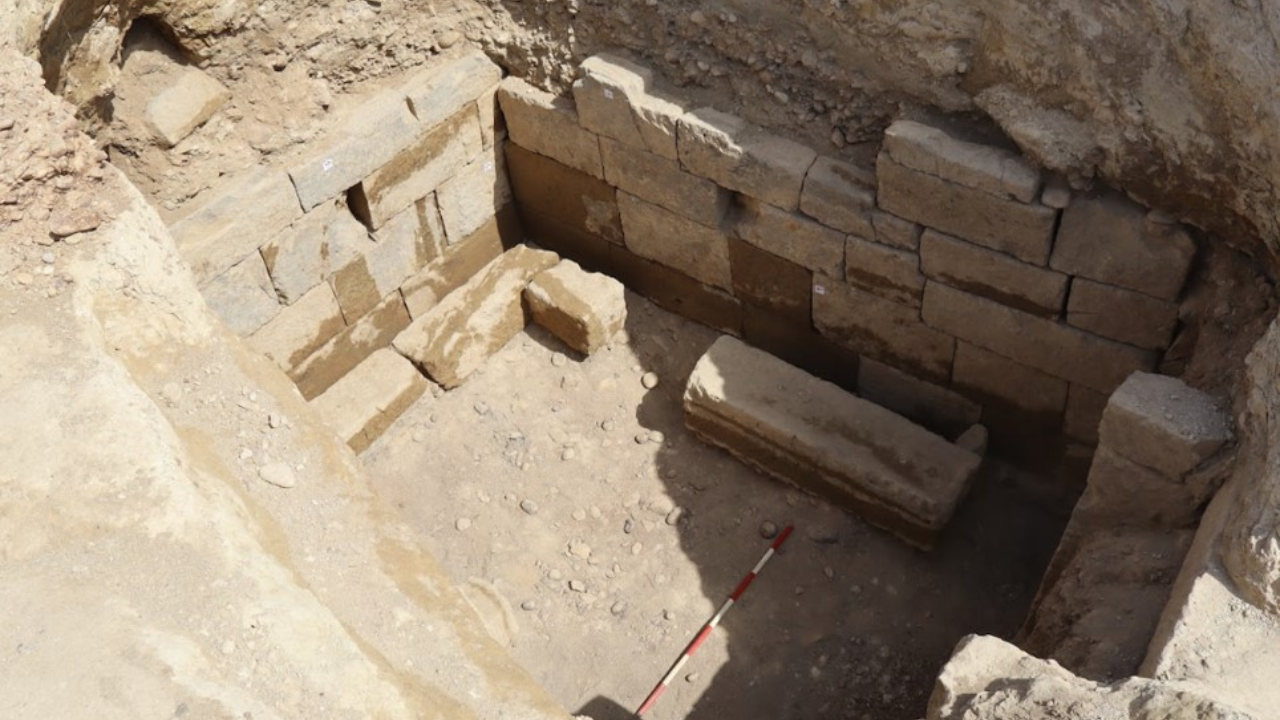
Photo via Times of India

Archaeologists found gold, rare pottery at 2,700-year-old Etruscan tomb in Italy

Read the original at Times of India ↗
Cite

TOI World Desk. (2026, September 27). Archaeologists found gold, rare pottery at 2,700-year-old Etruscan tomb in Italy. Times of India. https://timesofindia.indiatimes.com/world/europe/archaeologists-uncover-2700-year-old-etruscan-tomb-at-italys-vulci-weapons-gold-and-rare-pottery-found-in-elite-burial/articleshow/134482376.cms

Dated when The Aporia collected the article, usually within hours of publication. Check the original for its exact date and byline.

Times of India · collected 2026-09-27 · by TOI World Desk

Quick Summary

Archaeologists in Italy have discovered a 2,700-year-old Etruscan tomb at the Polledrara necropolis near Vulci, which contains valuable artifacts like gold objects, weapons, and high-quality ceramics. This tomb is described as one of the highest ranks based on its grave goods, including rare local pottery called Polledrara Ware used by elite families. The excavation team identified this monumental burial site during their 2026 campaign in a tumulus first noted by French archaeologist Stéphane Gsell in the late 19th century.
Written by AI on 2026-09-27, from this article's own text only (the story summary below draws on all the coverage).

AI analysis

Story summary

Archaeologists discovered a 2,700-year-old Etruscan tomb during excavations at Vulci in central Italy, close to where French archaeologist Stéphane Gsell first identified the burial mound nearly 140 years ago. The newly uncovered Tomb of the Stone Chamber dates back to the late seventh century BCE and was found filled with weapons, a chariot, gold objects, bone and ivory artifacts, high-quality ceramics, and an exceptional banquet service. Christian Mazet, one of the scientific directors of the Return to Vulci project, described it as belonging to "the very highest rank" due to its luxurious grave goods. This find occurred during the 2026 excavation campaign in the Polledrara necropolis at ancient Vulci and suggests that the tumulus is much larger than previously thought, though further investigation is needed to determine its full dimensions.

Written for “Etruscan Tomb Discovery” on 2026-10-31, grounded in this article and the 0 other(s) covering the same event.

Story

📰 Etruscan Tomb Discovery
Science · 1 article(s) covering the same event.

Compared with similar articles

Nothing to compare against. No article is close enough to this one for the pipeline to have linked or judged the pair.
How this article was measured signals, leaning charts, publisher record, byline, topics and claims

Signals How these are calculated →

Claims extracted
26
sentences that state something as happening or true
Uncertain
12%
3 of 26 hedged ("reportedly", "may", "according to")
Leaning
not political
takes no side on a contested political question
Publisher signals
59/100
Times of India's corrections and hedging, across everything collected from it. Not a measure of accuracy.
Outlets on this story
1
Science
Same framing elsewhere
1
articles that frame the event the way this one does
Analyzed 2026-09-27 · how these are computed

How this is being covered How these are calculated →

Article leaning vs. publisher reliability
Source leaning vs. consistency

Publisher

Times of India · 3737 article(s) · 2 correction(s) detected
Running correction rate · 2 correction(s)

Who wrote this

TOI World Desk
1245 article(s) here · 1 carrying a prediction
🔮 Prince William and Kate Middleton may have been made aware of serious allegations against Meghan Markle’s father, Thomas Markle Sr., after a letter detailing the claims was reportedly sent to the joint office shared by the two royal couples at Kensington Palace in 2019.
🔮 The money will support nearly 7,000 children.
🔮 Within two months, Conard identified a property in a Denver strip mall that could be used for a haunted house.
🔮 They allege that Meta could combine this information with activity tracked on Eyemart’s website to identify them and deliver targeted advertisements.
🔮 People from outside Indiana University had also contacted Brian Williams, a professor at the Kelley School of Business who helped develop the programme, expressing interest in taking the course.
🔮 On October 31, the family will take the experience further by welcoming relatives from out of town to help bring the display to life with live actors.
🔮 Thus, a decade ago, he began collecting Halloween costumes for kids who couldn't afford them.
🔮 He expressed concern that the confrontation could cost him his job.
🔮 They said the celebrity's "suicide risk" could be lowered through treatment.
🔮 In one recording, Higby explained that they wanted to find out whether people could vote without showing identification.
Wire or desk byline, not an individual reporter.
Also by TOI World Desk
Nothing else under this byline is closely related to this article, so these are simply their most recent.
All 1245 articles by TOI World Desk →

Topics

Etruscan Etruscan Times French Italy Vulci

Subjects

Vulci GPE · 6× Gsell PERSON · 4× Stéphane Gsell PERSON · 3× Christian Mazet PERSON · 2× Etruscan NORP · 2× Etruscan Times ORG · 2× French NORP · 2× Italian Superintendency ORG · 1× Italy GPE · 1× Return to Vulci ORG · 1×

Narrative

Christian Mazet, one of the scientific directors of the Return to Vulci project, said the presence of weapons, a chariot, gold objects and high-quality ceramics of the type found in princely tombs of the Osteria necropolis showed that the burial belonged to the highest rank.
framing: assertive · carried by 1 article(s) · first seen 2026-09-27
🔮 The 2026 investigation also revealed that the tumulus may be considerably larger than previously believed, although its full dimensions still need to be established through further work.

Claims (26 extracted, 3 hedged)

Archaeologists have uncovered a monumental Etruscan tomb inside an ancient cemetery at Vulci in central Italy, nearly 140 years after French archaeologist Stéphane Gsell first identified the burial mound surrounding it. asserted
Gsell → uncover → it
The newly excavated Tomb of the Stone Chamber dates to the late seventh century BCE, one of the most prosperous periods in Vulci's history, when the city also had intense connections with the Mediterranean. asserted
city → excavate → Mediterranean
The burial contained weapons, chariot fittings, gold and bronze objects, bone and ivory artefacts, high-quality ceramics and an exceptional banquet service. asserted
burial → contain → weapons
Archaeologist Christian Mazet described it to Etruscan Times as a tomb “of the very highest rank”, based on the nature of its surviving grave goods. asserted
Mazet → describe → goods
A monumental Etruscan tomb hidden inside the Gsell tumulus The discovery was made during the 2026 excavation campaign in the Polledrara necropolis at ancient Vulci. asserted
discovery → hide → Vulci
According to Etruscan Times, the Return to Vulci team identified the great Gsell Tumulus on the ground and brought to light what is in all probability the princely burial that Gsell had searched for but never managed to find. uncertain
Gsell → accord → that
The newly uncovered structure, known as the Tomb of the Stone Chamber, lies within the monumental complex. asserted
structure → uncover → complex
The 2026 investigation also revealed that the tumulus may be considerably larger than previously believed, although its full dimensions still need to be established through further work. uncertain
dimensions → reveal → work
Why archaeologists call it a tomb of the highest rank The burial's architecture and surviving grave goods point to its exceptional status within Vulci's society. asserted
architecture → call → society
Christian Mazet, one of the scientific directors of the Return to Vulci project, said the presence of weapons, a chariot, gold objects and high-quality ceramics of the type found in princely tombs of the Osteria necropolis showed that the burial belonged to the highest rank. asserted
burial → say → rank
The official Italian Superintendency likewise described the discovery as particularly important for understanding the aristocracy of Vulci at the end of the seventh century BCE. asserted
Superintendency → describe → BCE
The tomb consists of three chambers, with the walls of the main chamber built from large blocks of nenfro set into natural deposits associated with the ancient course of the Fiora River. asserted
walls → consist → River
Despite clandestine intrusions into the tomb during the 20th century, archaeologists found groups of objects in the side chambers that had survived in their original positions. asserted
that → find → positions
The excavations recovered weapons, chariot fittings, gold and bronze sheets, as well as objects made of bone and ivory. asserted
excavations → recover → bone
Researchers also found Corinthian pottery and bucchero wares, along with a bronze tripod associated with a lamp made of alabaster gypsum, probably of Aegean origin. asserted
Researchers → find → origin
The side chambers also contained an important banquet service made from Polledrara Ware, a rare local polychrome pottery that was used by Vulci's leading families. asserted
that → contain → families
The assemblage included dinoi for mixing wine and water, cups and other vessels for holding liquids, as well as a grater associated with wine preparation. asserted
assemblage → include → preparation
A large polychrome ceremonial cup in the Ionian Wild Goat Style was also recovered, with very close parallels among the grave goods from the Tomb of Isis. asserted
cup → recover → Isis
Stéphane Gsell identified the mound in 1889 The newly uncovered tomb is closely connected to the work of French archaeologist Stéphane Gsell, who investigated the necropolises of Vulci in the late 19th century. asserted
who → identify → century
In 1889, Gsell identified the large tumulus at Polledrara, reconstructed its perimeter and searched for its main tomb. asserted
Gsell → identify → tomb
He eventually had to stop excavating because he no longer had the money or time needed to find the burial. asserted
he → have → burial
More than a century later, the Return to Vulci team returned to the site and uncovered what it believes is the princely burial Gsell had searched for. asserted
Gsell → return → site
What the discovery reveals about ancient Vulci The newly uncovered burial dates to the end of the seventh century BCE, a period when Vulci was experiencing one of the most prosperous phases in its history and maintaining intense connections with the Mediterranean. asserted
Vulci → reveal → Mediterranean
The wealth and variety of objects recovered from the tomb provide evidence of the high status of the people buried there. asserted
wealth → recover → people
The discovery also offers an opportunity to compare the complex with other important Vulci burials, particularly the nearby Tomb of Isis, which was discovered in 1839 and is now associated with the British Museum. asserted
which → offer → Museum
According to the Italian Superintendency, similarities between the two complexes could help researchers investigate funerary rituals, artistic production and exchange networks among Vulci's elites at the end of the seventh century BCE. uncertain
researchers → accord → BCE

💬Give feedback
🕘History 🎫Support