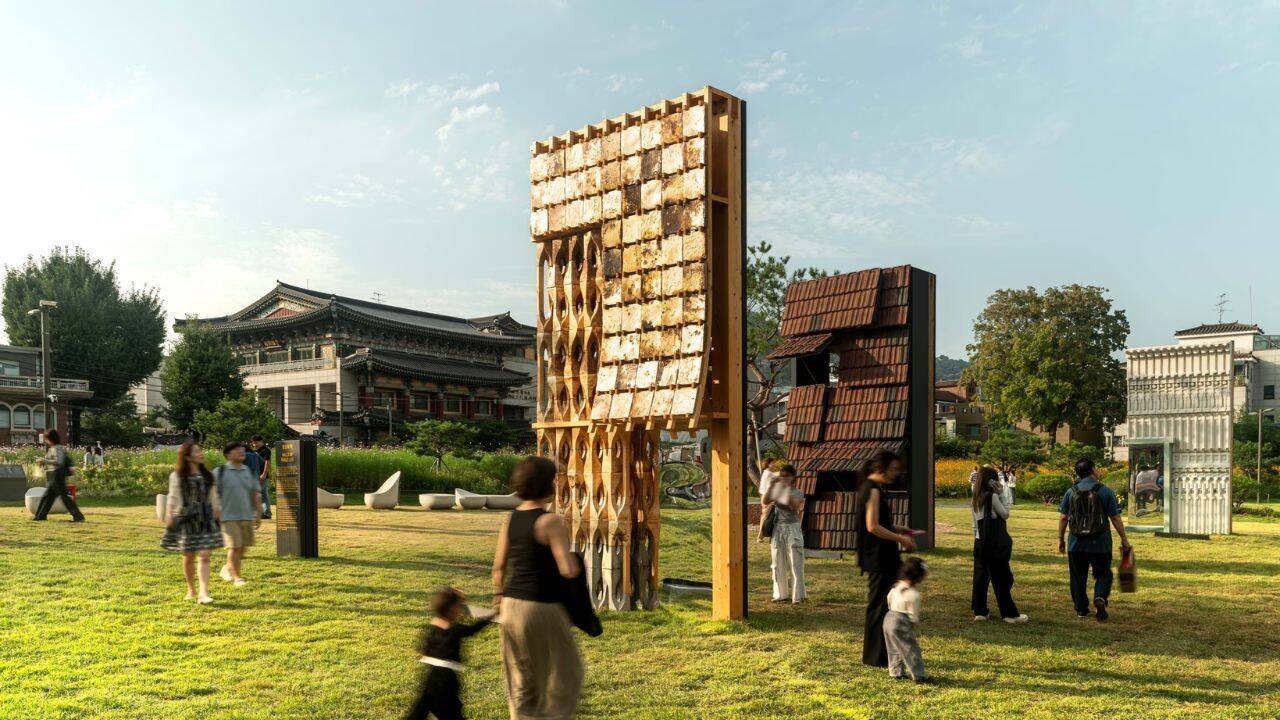
Seoul became the setting for an unique architectural experiment in 2025, where a public installation was made from mushroom mycelium and agricultural waste instead of conventional building materials.
asserted
installation → become → materials
Named as Walls of Public Life, the project was created by Mumbai-based
Anomalia for the 5th Seoul Biennale of Architecture and Urbanism.
asserted
project → name → Architecture
Its blocks were grown using fungal networks that bind crop waste together, turning discarded organic material into lightweight building components.
asserted
that → grow → components
The installation offered a different way of thinking about walls, showing how some future construction materials could be cultivated rather than manufactured.
uncertain
materials → offer → walls
Seoul’s mycelium walls turn mushroom waste into architecture
The Walls of Public Life installation was created for the first outdoor exhibition of the Seoul Biennale, held at Songhyeon Green Plaza.
asserted
installation → turn → Plaza
According to Anomalia’s project website, the studio was invited to create one of 24 Walls of Public Life for the 2025 event, curated by Thomas Heatherwick.
uncertain
studio → accord → Heatherwick
The project explored what building facades could become if they were grown from mushroom mycelium rather than produced entirely through conventional industrial processes.
uncertain
they → explore → processes
Instead of treating agricultural waste as something to discard, the project used it as the main growing material.
asserted
project → treat → material
Crop waste was mixed with mycelium cultures, allowing the fungal network to spread through the organic material and naturally hold it together.
asserted
network → mix → it
This gave the waste a new purpose.
asserted
This → give → purpose
Anomalia states that each block used 2.1 kilograms of crop waste while weighing about 1.5 kilograms.
asserted
block → state → kilograms
The resulting material could then be shaped into architectural components without relying on the energy-intensive processes normally associated with many conventional construction materials.
uncertain
material → result → materials
Image Credit: ANOMALIA
The wall was grown through a low-energy process
The production method was relatively straightforward.
asserted
method → grow → process
Once the crop waste and mycelium cultures were combined, the mixture was placed into moulds.
asserted
mixture → combine → moulds
The fungal network grew through the material and acted as a natural binding system.
asserted
network → grow → system
The blocks were then dried and stabilised, producing the components used for the Seoul installation.
asserted
blocks → dry → installation
Architecture Lab, in its report on Walls of Public Life, describes the installation as being made from MycoBlox and Biobo panels, which are mycelium-based materials combined with agricultural byproducts.
asserted
which → describe → byproducts
The fungal networks bind the organic material as they grow, producing lightweight components with significant compressive strength.
asserted
they → bind → strength
Anomalia’s own account gives the blocks a tested compressive capacity of up to 1.5 tons.
asserted
account → give → tons
That detail is important because the project was not simply about making an unusual surface from mushrooms.
asserted
project → make → mushrooms
It was also an attempt to demonstrate that materials grown from biological processes could have practical qualities suitable for architectural use.
uncertain
materials → demonstrate → use
What made the facade different from an ordinary wall
The installation was designed to look and behave differently from the sealed surfaces commonly found on buildings.
asserted
installation → make → buildings
Its porous structure allowed air and light to pass through, while its uneven texture created a surface that could be experienced through touch as well as sight.
uncertain
that → allow → touch
MYCL, the Indonesian material company involved in the research and production, describes the installation as a breathable and interactive facade.
asserted
MYCL → involve → facade
Its account says the MycoBlox provided 3D modular blocks, while the square BIBO panels created another layer within the structure.
asserted
panels → say → structure
Instead of functioning simply as a solid division between people and their surroundings, the installation was intended to create a more open relationship between the structure, visitors and the surrounding environment.
asserted
installation → function → structure
The project connected Mumbai, Bandung and Seoul
The unique wall was also the result of work spread across three countries.
asserted
wall → connect → countries
According to Anomalia, the design was developed in Mumbai, India, while the materials were grown in Bandung, Indonesia, in collaboration with MYCL.
uncertain
materials → accord → MYCL
The finished components were then transported to South Korea and assembled at Songhyeon Green Plaza in Seoul.
asserted
components → transport → Seoul
MYCL similarly describes the project as a cross-border collaboration between architectural design and material research.
asserted
MYCL → describe → design
Its production model avoided the idea that every part of a building material has to come from a conventional high-heat manufacturing facility.
asserted
part → avoid → facility
The collaboration also brought together different areas of expertise.
asserted
collaboration → bring → expertise
Anomalia handled design and research, while MYCL worked on material research and production.
asserted
MYCL → handle → research
The project was supported by the Seoul Metropolitan Government and P4G(Partnering for Green Growth and the Global Goals 2030).
asserted
project → support → Growth
What could grown building materials offer future architecture
uncertain
materials → grow → architecture
The Seoul installation presented mycelium materials as biodegradable and carbon negative.
asserted
installation → present → materials
MYCL describes that the materials were designed to return to the earth at the end of their useful life.
asserted
materials → describe → life
MYCL notes that the framework allowed the installation to be disassembled, supporting a more circular approach to construction rather than treating the structure as something permanently fixed in place.
asserted
installation → note → place
Architecture Lab describes Walls of Public Life as a practical test of mycelium composite blocks in an outdoor public setting, where the material faced rain, storms, humidity and regular human interaction.
asserted
material → describe → rain
 The Aporia